



By Naveen Khan
Why do the Pashtun and Kurdish peoples—two corresponding ethnic groups—tend to respond oppositely to Islamist extremism, exhibiting conflicting recruitment patterns? This is a conundrum that remains unanswered: numerous Pashtuns joining the Taliban despite the group bringing misery and bloodshed to the former, versus scores of Kurds resisting Daesh through national militias in spite of its heavy price.
Despite conspicuous similarities between these two populations, opposite recruitment profiles indicate deeper, socio-cultural factors—such as conflicting everyday ideas pertaining to women and identity—that could account for such divergent outcomes.
These conflicting responses to Islamist extremism not only carry global security implications since both the Pashtun and Kurdish regions are geostrategic, but also provide a broader, policy-relevant idea of how any society, based on its everyday values, is likely to respond to emerging jihadist groups.
Pashtun and Kurdish Paradox Vis-à-vis Islamist Extremism
The Pashtuns and Kurds are, historically, tribal ethnic groups inhabiting South Asia and West Asia respectively. Both are Muslim-majority Iranic peoples, with shared histories of colonisation and state repression. Both also face widespread poverty and have been termed “stateless”, as they each lack a state of their own inhabited by the majority of their populations. The Pashtun land is partitioned between Afghanistan and Pakistan, while the Kurdish homeland is also divided among Türkiye, Iran, Iraq and Syria—although socially and politically none of these peoples is monolithic. Additionally, the Pashtuns and Kurds have also experienced insurgent attacks and Islamist governance within their areas by extremist groups, namely the Taliban and Daesh, respectively.
Despite similar structural profiles, these groups have become known for opposite phenomena: the Pashtuns for providing human resources to the Taliban, and the Kurds for fighting Daesh. The considerable support for and staunch opposition to extremism manifest themselves routinely, e.g., pro-Taliban users—who are mostly if not all—Pashtuns on Twitter reacting strongly to human rights activists’ criticism of the group, and anti-Daesh Kurds managing social media accounts on behalf of the fighters.
Although the Taliban and Daesh, having Islamist ideologies, do not use ethnic idiom, responses to them from the ethnic groups barely match. The Taliban have experienced great success in mobilising many Pashtuns around their cause, whereas Daesh has mostly encountered resistance from the Kurds. Such divergent outcomes produced by corresponding societies vis-à-vis the same extremist phenomenon reflect intriguing alignment patterns—factors behind which have not yet been comparatively studied. Although there are also instances of the Pashtuns fighting the Taliban, and the Kurds joining Daesh, these constitute exceptions.
Pakistan’s pro-Islamism role weakens Pashtun ethnic identity, replaces political ethnicity by political Islam, and facilitates Taliban recruitment through madrasas, while no such state-sponsored extremist pipeline exists in Türkiye, Iran, Iraq and Syria to exploit the Kurds. However, Pakistan cannot be solely blamed when Pashtuns keep sending their children to madrasas that eventually mobilise them as violent extremists—despite their people having suffered heavily from Taliban attacks and military operations. Considering their history of resistance, it appears unusual that instead of fighting, the Pashtuns could reinforce the Taliban who have caused material and cultural damage. A shared ethnic identity also fails to explain Pashtuns joining the Taliban in such large numbers.
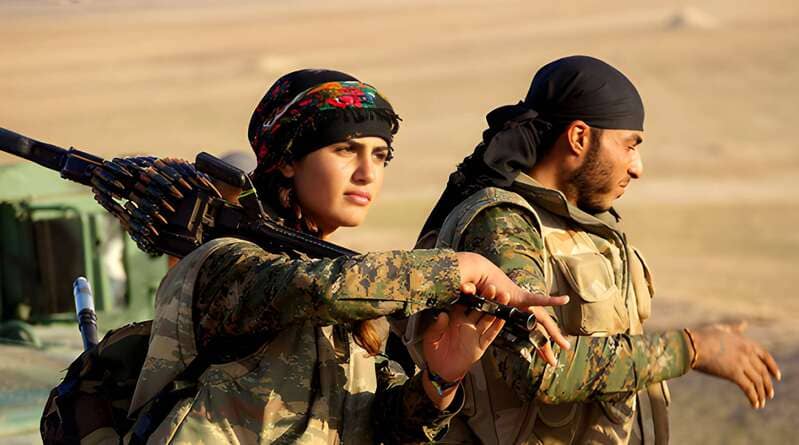
Similarly, insights are lacking on the Kurds’ anti-extremism mobilisation that saved their socio-cultural structures but at a dear price. It is perplexing why the Kurds refuse to compromise on their identity and way of life with extremists—when the price of their resistance has been the loss of more than 11,000 Kurdish lives until 2019 alone. Daesh being largely Arab, in isolation, is not sufficient to explain the Kurds’ online/offline resistance when cooperating was a much more convenient option—especially considering that up to 600 Kurdish men from marginalised pockets had already joined the group.
Why Economic Deprivation Doesn’t Explain Opposite Recruitment Patterns
While there have been intense online recruitment efforts by the Taliban and Daesh for community-building, the Taliban greatly succeed in luring the Pashtuns while Daesh has largely failed with the Kurds. Citing Nigerian recruitment in Boko Haram, certain researchers believe it is mainly because of poverty that the youth are drawn to the group. Intriguingly, the Kurds, despite the financial profitability in joining Daesh, resisted and paid with their lives—an outcome that diverges from what economic logic predicts.
Contrary to the perceived financial motive, it has been argued that all empirical evidence refutes the “simplistic economic deprivation theory”—a case in point is the tribal and ethno-cultural factors that lay behind the 1970s’ Maitatsine Islamist insurgency in Nigeria. This view aligns better with the comparative pattern analysis of large-scale Pashtun mobilisation for and Kurdish opposition to extremism, as similar economic conditions cannot produce opposite outcomes.
Since economic deprivation does not explain the problem, deeper reasons embedded within these societies’ mainstream structures beg attention—despite a great dearth of research on the interplay of extremism with Pashtun and Kurdish offline, and particularly online, systemic dynamics.
Conflicting Outlooks on Women
Research has noted that Pashtun culture is driven by the idea of “male autonomy”—wherein masculinity is understood so patriarchally that it constructs a “man’s world”, with women being minimally visible virtually and physically. Such erasure is evident from how the tribal code, Pashtunwali, values nang (‘masculine honour’), safeguarding which greatly hinges on ensuring namus (‘female integrity’)—with violence, if necessary. This social structure results in the severe restriction of women’s basic rights.
As the “close relationship” between misogyny and violence is already established, the everyday misogyny and violent honour, long embedded within Pashtun identities and structures, apparently serve as a crucial mechanism that links practitioners of the culture with extremists having similar worldviews. Although research is needed here and also regarding the digital Pashtun culture, women are similarly erased from online spaces, which signals a potential bi-directional relationship between mainstream culture and extremist ideas that goes beyond unidirectional online recruitment by the Taliban.
This is contrasted with the Kurdish case where, though patriarchal gender norms still persist, gender equality is gradually becoming so mainstream that it is helping to engineer a “social revolution”. Such importance accorded to women’s emancipation online and offline—when the slogan of “Woman, Life, Freedom” has become a symbol of Kurdish identity and resistance—seems to be unhelpful in ideological convergence with or conspiracy diffusion by misogynistic Islamists.
Just as this has not been studied yet, why Kurdish men resist extremists when they could ‘benefit’ from the latter’s male hegemonic practices remains unaddressed. Similarly, any online recruitment by the Kurdish forces and the community’s men’s positive responses as well as the underlying motives—while they greatly rejected Daesh’s online recruitment efforts—have not been researched so far.
Divergent Sources of Identity
Another mainstream cultural factor that may facilitate digital/physical extremist recruitment among Pashtuns, that is, treating Islam as a “fundamental aspect” of identity. Although this has happened through the Pakistani state’s inevitable conflation of religion with identity, the subversion of Pashtun identity is not something that can be squarely blamed upon the state, considering that the Pashtuns have been secular from times immemorial.
Nevertheless, when religion becomes public and political, Islamists acting in its name position themselves as a socially “legitimate alternative”. Such intertwining of ethnicity with religion may help build extremist communities based on “dense and enduring local networks”. This identity crisis within Pashtun online/offline structures seems to facilitate such narrative diffusion that both the Afghan and Pakistani Taliban are mostly Pashtun as they build on systemic dimensions of the very society.
The Kurds’ “nationalist ideology” and “centuries of struggle” for protecting their cultural and political existence impart them with a shared culture-based identity. The online rise of pan-Kurdism that centers around the symbols of Kurdish culture has also been noted in research, effectively sustaining a “Digital Kurdistan” through considerable engagement. Thus, Daesh can barely exploit such a secular Kurdish identity for community-building, as there appears to be little intersection of the everyday mainstream with the Islamist extreme.
Radicalisation in Opposite Directions
The 3N model of radicalisation appears helpful in explaining this paradoxical problem involving the two ethnic groups. The first ‘N’, need, or the motivation for significance, can become triggered in individuals alike.
It is the second ‘N’, narrative, or the ideology providing the means to the end, that differs online/offline across Pashtun and Kurdish societies. Among Pashtuns, such a narrative may be provided by extremists that channel the pre-existing cultural tendency for violence towards perceived enemies of Islam. For Kurds, it is the nationalist militias that outline the path to significance through resistance.
The third ‘N’, network, or the social environment, validates the narrative and provides belongingness. For the Pashtuns, such a network may be the extremists claiming to defend sacred values, but for the Kurds, this purpose is served by the resistance forces.
The above distinctions between the need, narrative and network, corresponding differently to the Pashtuns and Kurds, provide a clear way of explaining how people facing broadly comparable structural conditions might nevertheless be drawn towards very different forms of mobilisation. In other words, although both the Taliban and Daesh make online/offline recruitment attempts to appeal to the respective ethnic groups, their successes vary.
This is because the Pashtuns’ identity remains exploitable—enabled by their mainstream culture that tends towards misogyny, violence, and a lopsided obsession with the idea of honour. This may provide an ideological overlap with extremist worldviews and leave young men vulnerable, even if they are not Taliban sympathisers. Weak Pashtun nationhood also appears to facilitate extremist conspiracy diffusion and community-building. Any society possessing such characteristics may not be able to resist extremists virtually and physically as their narratives may exploit the pre-existing aspects of the very culture.
The Kurds’ nationalist ideology with their people at its centre, non-negotiable and secular ethno-cultural identity that resists fusion with extremism, and women’s social and digital visibility, seem to create ideological friction with and hinder narrative diffusion—even virtual community-building—by Daesh extremists. These mainstream societal dynamics collectively reinforce Kurdish resistance as Daesh worldviews are perceived as grave threats to the existence of Kurds as a people, which is why the mobilisation against its ‘caliphate’ happened at such a large scale.
Broader Implications
It appears that elements from extremist ideologies are embedded to an extent within mainstream Pashtun socio-cultural and digital structures, causing ideological convergence with the Taliban, but not as much within Kurdish structures which results in divergence from Daesh. It also seems that the societies’ respective mainstream gender norms and identities facilitate the online/offline diffusion of extremist movements’ worldviews among Pashtuns, but block the same among Kurds.
Broadly, it is evident that economic deprivation and structural conditions alone may not explain extremist mobilisation, and that the interaction among identity, gender norms, narratives and social networks deserves greater attention. This phenomenon may extend to any society and carries policy implications, thus the factors facilitating or hindering extremist recruitment should be considered seriously and policies devised accordingly by governments that are concerned by their respective citizens joining militant or non-militant extremist outfits.
Author: Naveen Khan – Nonresident Research Fellow with Michael J. Morrell Center for Intelligence and Security Studies at the University of Akron, USA. She also writes as a columnist for Government Technology and Services Coalition’s Homeland Security Today magazine. Holding an MSc in Sociology from the London School of Economics and Political Science (LSE), she specialises in Afghanistan-Pakistan security affairs and has conducted original primary research in the same region.
(The views expressed in this article belong to the author and do not necessarily reflect the views of World Geostrategic Insights).
Image Credit: Kurdish Struggle/Flickr.com.