



By Giancarlo Elia Valori
The 2026 Annual Meetings of the International Monetary Fund (IMF) and the World Bank Group, held in Bangkok, Thailand, from October 12 to 18, centered on global economic growth prospects, sovereign debt risks, the macroeconomic implications of artificial intelligence (AI), and ongoing geopolitical conflicts.

The proceedings highlighted a fundamental dichotomy shaping the contemporary global economy: a negative supply shock in the energy sector coupled with a positive demand shock driven by rapid AI integration. Despite these diverging forces and their interconnected risks, global economic growth has demonstrated notable resilience.
Nevertheless, intensifying geopolitical conflicts continue to disrupt energy supply chains. Since early 2026, systemic instability in the Middle East has induced substantial volatility in oil prices, maintaining them at elevated levels. This surge in energy costs has driven global inflation, inflated corporate production costs, diminished consumer purchasing power, and subsequently suppressed aggregate investment and consumption—a trend particularly pronounced in energy-dependent emerging markets and developing economies.
Simultaneously, environmental anomalies exacerbate these economic pressures. The World Meteorological Organization forecasts temperature anomalies of up to 3.8 degrees Celsius in the equatorial Pacific between November 2026 and January 2027, driven by the El Niño phenomenon. Humanitarian Director Tom Fletcher has warned that these unprecedented ecological shifts could severely impact global economic stability, potentially exacerbating conflicts and forced displacement. Coupled with rising prices for fertilizers and food commodities, these factors have rendered inflation more persistent than initially anticipated, further dampening growth.
Fiscal Vulnerabilities and the Costs of Geoeconomic Fragmentation
Against this backdrop of elevated interest rates, persistent inflation, and high oil prices, the probability of further monetary tightening by the Federal Reserve continues to escalate. Consequently, the domestic fiscal and monetary challenges of the United States are increasingly transmitting to global markets, potentially evolving into systemic risks.
This confluence of sticky inflation and sovereign debt pressure severely compromises debt sustainability within developing economies. Institutional consensus underscores that trade protectionism and geoeconomic fragmentation remain primary impediments to international trade expansion and cross-border investment.
During the meetings, IMF Managing Director Kristalina Georgieva emphasized that preliminary estimates suggest economic fragmentation could reduce global GDP by up to 7 percent, noting that the true cost encompasses not only direct losses but also the substantial opportunity costs of diminished multilateral cooperation. However, certain advanced economies continue to over-extend the concept of “economic security,” thereby increasing global trade policy uncertainty and directly hindering poverty reduction and employment generation in developing nations.
Despite recent monetary tightening by major central banks, inflationary pressures remain entrenched. The IMF’s updated projections estimate that global inflation will reach 4.7% by the end of 2026, up from 4.1% in 2025. Concurrently, global public debt is projected to reach approximately 100% of GDP. Because sovereign interest rates in advanced economies generally exceed nominal economic growth rates, fiscal space for natural debt sustainability is severely constrained. Notably, in August 2026, U.S. federal debt surpassed the $40 trillion threshold, while the 30-year U.S. Treasury bond yield continued its upward trajectory, reaching a 24-year high.
Drivers of Resilience: AI Integration and Microeconomic Adaptability
A more profound structural shift resides in the transition between traditional and emerging growth drivers. Next-generation productivity, anchored in AI, is reshaping the foundational logic of economic expansion; yet, this technological revolution remains fundamentally uneven in its distribution of efficiency gains. Technological barriers, supply chain restructuring, capital concentration, and disparate regulatory frameworks collectively widen the global North-South divide, while simultaneously driving divergence among developing nations themselves.
Concurrently, legacy sectors—such as energy, labor-intensive manufacturing, and natural resources—face compounding pressures from energy shocks, decelerating global demand, and technological substitution. Because this structural transformation proceeds at varying velocities and yields asymmetrical benefits, the cross-country growth gap continues to widen across developed and emerging markets.
According to the IMF’s latest World Economic Outlook, global economic growth is projected to decelerate to 3.1% in 2026, down from 3.5% in 2025, before experiencing a modest recovery to 3.4% in 2027. Despite this slowdown, the macroeconomic consensus maintains that global economic resilience remains structurally intact, driven by several key factors.
First, the current surge in AI-related investment and commerce has emerged as a primary engine of global growth. IMF Chief Economist Silvana Tenreyro underscores that robust technology-driven demand has largely counterbalanced the negative supply shocks originating in energy markets. Empirical estimates indicate that the AI infrastructure boom could contribute between 0.5% and 1.0% to GDP growth in advanced Asian economies, and between 0.2% and 0.8% in emerging Asian economies. Thus, the digital revolution provides a critical countercyclical buffer during macroeconomic downturns.
Second, microeconomic adaptability serves as a foundational pillar of this resilience. As the primary agents of economic activity, private firms have demonstrated unexpected agility in mitigating compounding risks. Leveraged by advanced data analytics and AI tools, enterprises have rapidly deployed strategic countermeasures, including supply chain recalibration, optimized export diversification, and dynamic inventory management. This accelerated private-sector responsiveness has effectively cushioned the global economy against macroeconomic shocks, granting governments crucial fiscal and monetary breathing room. Consequently, the IMF notes that these rapid firm-level adjustments have partially insulated global trade networks from tariff-induced disruptions.
Third, the structural response of the energy sector has surpassed initial institutional expectations. While geopolitical conflicts initially inflated commodity prices, the ongoing global transition toward renewable energy, coupled with robust strategic reserves and supply-source diversification, has significantly attenuated direct economic shocks. Furthermore, targeted fiscal interventions across multiple jurisdictions have successfully shielded vulnerable demographics and systemic industries, thereby averting a more severe global recession.
The Structural Shift Eastward: China’s Role as a Regional and Systemic Anchor
According to the Trade and Development Report 2026 released by the United Nations Conference on Trade and Development (UNCTAD) on September 9, Asia is projected to account for approximately 59% of global economic growth in 2026. Concurrently, the IMF has upwardly revised its growth forecast for emerging and developing economies in Asia to 5.1% for 2026. This figure significantly outpaces both the projected global growth rate and the 3.7% growth estimated for emerging and developing economies globally, underscoring a structural eastward shift in the center of gravity of the global economy.
Within this regional context, the People’s Republic of China (PRC) serves as a critical systemic anchor. As Tenreyro notes, the PRC remains a primary engine of regional expansion, driven largely by its integration into the global AI economy. By expanding AI-related exports, modernizing its foreign trade architecture, and stabilizing global supply chains through the provision of industrial intermediate goods, the PRC has facilitated broader international access to technological advancements.
Through a framework prioritizing multilateral technological access, the PRC has supported capacity-building initiatives across the Global South. This includes accelerating the establishment of joint international AI application centers within major regional blocs, including the Association of Southeast Asian Nations (ASEAN), the Arab League, the African Union, the Community of Latin American and Caribbean States (CELAC), the Shanghai Cooperation Organization (SCO), and BRICS. Furthermore, the open-source dissemination of core technological capabilities, such as large-scale foundational models, has lowered entry barriers, mitigated market concentration, and enabled developing economies to leverage advanced AI applications without prohibitive capital expenditure.
Energy market stabilization constitutes another dimension of the PRC’s macroeconomic role. During recent supply disruptions in the Strait of Hormuz, when market panic induced a sharp spike in crude oil prices, the PRC abstained from competitive spot-market procurement. Instead, a strategic reduction in short-term purchases helped alleviate speculative pressure and temporarily stabilize global crude markets. Concurrently, the PRC has accelerated its domestic transition toward a low-carbon energy framework, maintaining the world’s largest installed capacity of wind and solar power. The export of its “new three pillars”—electric vehicles (EVs), lithium-ion batteries, and photovoltaic cells—has lowered the cost of capital goods necessary for the global energy transition, thereby partially offsetting the inflationary shocks of traditional energy disruptions.
In an environment characterized by elevated global public debt and constrained fiscal space, the PRC’s domestic market—encompassing over 1.4 billion consumers and a middle class exceeding 400 million—remains an important source of external aggregate demand. Accounting for approximately 30% to global economic growth, this import capacity provides vital export revenues for partner economies, structurally supporting their external debt sustainability.
Nevertheless, significant structural vulnerabilities remain unaddressed. Current global growth is highly concentrated within a narrow cluster of sectors and advanced economies, particularly those exposed to AI infrastructure. Should investment expectations diminish or compounding energy crises intensify, this macroeconomic resilience will face severe constraints. Critically, the IMF’s Global Financial Stability Report warns of potential asset price corrections within AI-related equities and underscores the urgent need to curtail excessive corporate leverage while reinforcing systemic financial buffers.
As the 2026 annual meetings emphasized, the contemporary global economy is highly interconnected, meaning that localized systemic risks carry significant cross-border spillovers. Consequently, addressing these shared macroeconomic challenges requires enhanced international policy coordination and multilateral cooperation. Moving forward, the continued expansion of institutional openness and market access via frameworks such as the Belt and Road Initiative (BRI) will remain pivotal in determining whether current resilience can be successfully converted into long-term, high-quality global growth.
Author: Giancarlo Elia Valori – Eminent Italian executive and academic who plays a prominent role in international relations, fostering dialogue and strategic cooperation worldwide. An Honorable de l’Académie des Sciences de l’Institut de France and Honorary Professor at Peking University, he currently serves as President of the Foundation for International Studies and Geopolitics. Over a distinguished career, he has led several major industrial groups and global corporations
(The opinions expressed in this article are solely those of the author and do not necessarily reflect the views of World Geostrategic Insights).
Note: This article, like all articles published on World Geostrategic Insights, cannot be republished without the written permission of the editor of World Geostrategic Insights.
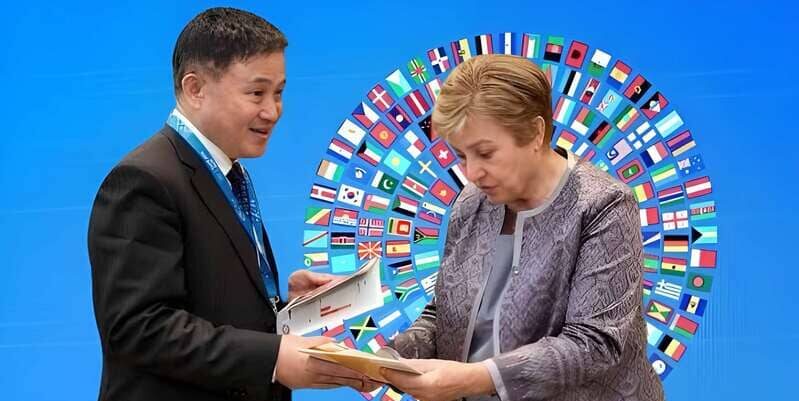
Image: People’s Bank of China Governor Pan Gongsheng meets with IMF Managing Director Kristalina Georgieva and the Chinese delegation during the 54th IMFC Meeting in Bangkok, Thailand (October 16–17, 2026) to discuss global economic growth, China’s market outlook, and bilateral financial cooperation.