



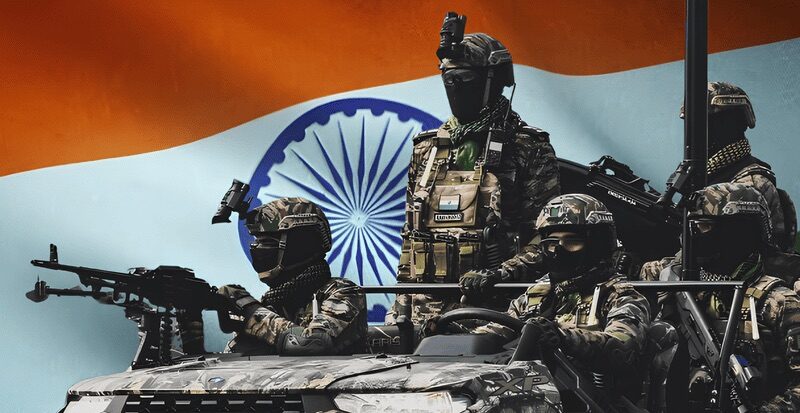
The geopolitical landscape of South Asia is undergoing a profound transformation that is reshaping not only regional balances of power but also the broader architecture of global security. At the centre of this epochal shift stands India, a nation that is gradually moving away from its traditionally defensive posture to assume an increasingly proactive military role. This transformation is not limited to a doctrinal evolution; it is reflected in a far-reaching industrial and organisational restructuring.

Long regarded as the world’s largest net importer of arms, New Delhi is undergoing a remarkable transformation, evolving into an indigenous defence producer and a strategic exporter. The drive towards technological self-reliance, embodied in the political and economic programme Atmanirbhar Bharat, has become the cornerstone of this new era. Deterrence is no longer primarily acquired from foreign suppliers but increasingly conceived, developed and manufactured domestically, while being integrated into a flexible and pragmatic foreign policy.
The catalyst for this strategic acceleration was Operation Sindoor, conducted during the night of 7–8 May 2025. The joint operation represented the first operational test of India’s emerging doctrine of calibrated conventional response. In reaction to a major terrorist provocation, New Delhi struck strategic targets deep inside Pakistani territory through the coordinated employment of precision-guided missiles, long-range artillery and unmanned aerial systems, demonstrating the ability to conduct effective military operations below the nuclear threshold. Operationally, the integrated use of BrahMos, Pralay and SCALP missiles, together with kamikaze drones and loitering munitions, highlighted the technological maturity achieved by India’s defence industry and its growing capability to conduct long-range precision strikes.
The tactical success of Operation Sindoor reignited the debate within India’s defence establishment over the creation of an integrated Missile and Rocket Force. At present, India’s conventional missile arsenal remains divided among the three armed services. The Army operates surface-to-surface systems such as Pralay, Prahaar and Shaurya, together with BrahMos, Nirbhay, and the Pinaka and Smerch multiple-launch rocket systems.
The Air Force controls air-launched weapons, including the Astra missile and the air-launched variants of BrahMos and SCALP, while jointly operating Akash, Barak-8 and S-400 air-defence systems with the Army.
The Navy, in turn, manages the naval variants of the BrahMos missile and its own air-defence systems. This fragmentation is increasingly regarded as a vulnerability in an era of high-intensity warfare, where rapid decision-making and operational coordination are decisive. The proposal to unify these capabilities under a single command aims to centralise the chain of command, optimise resource management and shorten response times, following models already adopted by China’s People’s Liberation Army Rocket Force and Pakistan’s Army Strategic Forces Command, both of which regard missile forces as the core of their deterrence posture.
International tensions and the need to overcome institutional fragmentation must be understood within the context of a rapidly evolving geopolitical environment. Recent crises have demonstrated the growing vulnerability of wartime supply chains. For a country such as India, confronted with simultaneous security challenges along its borders with Pakistan and China, national security cannot depend on imported critical components. Consequently, defence policy has become increasingly intertwined with New Delhi’s strategy of multi-alignment.
India has progressively reduced its dependence on Russia, whose share of Indian arms imports has fallen to around 40 percent, while continuing to rely on Moscow for the maintenance of its T-90 main battle tanks and Sukhoi fighter aircraft. At the same time, New Delhi has significantly expanded defence cooperation with the West and Israel.
France has become India’s second-largest defence supplier through the delivery of Rafale fighter aircraft and cooperation on Scorpène-class submarines; Israel remains its principal partner in radar systems, electronic warfare and unmanned aerial vehicles; while the United States, within the framework of the Quad, cooperates with India in Indo-Pacific security and the co-production of advanced aircraft engines.
Italy has likewise strengthened its strategic role through the 2026–2027 Bilateral Military Cooperation Plan with New Delhi, involving companies such as Leonardo and Fincantieri in naval construction and defence electronics. This network of partnerships enables India to acquire advanced technologies while transferring valuable know-how to its domestic industrial base.
The figures relating to defence expenditure and force structure highlight the magnitude of the challenge India faces. In 2025, the country’s defence budget reached US$92.1 billion, the fifth largest in the world. Yet nearly half of these resources are still absorbed by personnel costs and pensions for an active force exceeding 1.4 million service members, limiting investment in military modernisation. The comparison with China reveals a substantial disparity: despite allocating a comparable share of GDP to defence, Beijing commands a military budget exceeding US$336 billion, enabling large-scale investment in artificial intelligence, hypersonic weapons and cyber capabilities. Pakistan, by contrast, maintains a defence budget of only US$11.9 billion, directed primarily towards asymmetrically counterbalancing India’s conventional superiority with extensive military and financial support from China.
To address these constraints, New Delhi has launched far-reaching reforms, including the controversial Agnipath recruitment programme, designed to rejuvenate the armed forces while freeing resources for innovation. Atmanirbhar Bharat aims to transform India’s defence industry from a licensed assembler into a developer of advanced indigenous technologies. The results are already visible in systems such as Pinaka and Akash, and, above all, in the rapid growth of defence exports, which exceeded 38,000 crore rupees (approximately US$4.5 billion) during the last fiscal year. BrahMos missiles have been acquired by Southeast Asian countries including the Philippines, Vietnam and Indonesia, while Armenia has purchased the ATAGS artillery system and Swathi weapon-locating radars. Defence manufacturing has thus become an important instrument of foreign policy, strengthening India’s position as both a strategic partner and an emerging security provider for the Global South.
India’s ambition to participate in sixth-generation combat aircraft programmes, notably the Global Combat Air Programme (GCAP) led by Italy, the United Kingdom and Japan, fits naturally within this broader strategy of technological advancement.The programme recently reached a major milestone with the award of a contract worth approximately US$6.3 billion to the Edgewing joint venture, bringing together BAE Systems, Leonardo and Mitsubishi Heavy Industries, with the objective of achieving the aircraft’s maiden flight by 2035.
GCAP remains the only Western sixth-generation fighter programme conceived from the outset as a genuinely multinational initiative with a strong export orientation, attracting interest from countries including India, Australia, Canada, Germany and Saudi Arabia. By contrast, the U.S. Next Generation Air Dominance (NGAD) programme, centred on the future F-47, remains focused primarily on meeting American operational requirements and, at least for the foreseeable future, does not envisage a comparable model of international cooperation.
Although India remains excluded from the core group of founding members—largely because of its enduring technological ties with Russia—it seeks to engage with major aerospace programmes not merely as a customer but as an industrial partner. By offering its expanding manufacturing capacity and vast domestic market in exchange for advanced technology transfers, New Delhi aims to accelerate the development of its indigenous Advanced Medium Combat Aircraft (AMCA) while reinforcing its long-term strategic autonomy in the aerospace sector.
By strengthening its deep-strike capabilities through the integration of missiles, unmanned systems and greater logistical autonomy, India is increasingly positioning itself as an autonomous strategic pole consistent with its policy of multi-alignment. Yet the most profound transformation extends beyond the expansion of conventional arsenals. The real revolution lies in the emergence of computational power as a new foundation of military superiority.
The integration of artificial intelligence, autonomous systems, C4ISR networks, electronic warfare, semiconductors and, ultimately, quantum computing is fundamentally reshaping deterrence and the conduct of military operations. In this new paradigm, strategic advantage depends less on the number of available platforms than on the ability to collect, process and exploit data in real time, integrating missiles, drones, satellites and conventional forces within a unified operational architecture. Atmanirbhar Bharat therefore assumes a broader strategic significance: its objective is not simply to replace imported military equipment but to build a national computational base capable of supporting the defence architectures of the future. India’s rise demonstrates that, in the twenty-first century, strategic sovereignty derives from the integration of industrial capability, computational power and autonomous decision-making. In this respect, New Delhi represents one of the world’s most advanced laboratories for the ongoing transformation of national power.
Author: Alberto Cossu – International Management Consultant, collaborating with research institutes and government agencies on strategic and geopolitical analysis. He is a Geopolitical Analyst at Vision & Global Trends and a regular contributor to the journal Geopolitica. His work is also published in prominent Italian policy and defense outlets, including Airpress – Formiche, Analisi Difesa, and Digit-export, the online magazine of the Union of Chambers of Commerce of Lombardy. His research focuses on global geopolitical dynamics, with particular emphasis on the United States, India, Russia, China, and the Middle East, as well as on the strategic implications of innovation and emerging technologies in the evolving international order.
(The views expressed in this article belong only to the author and do not necessarily reflect the views of World Geostrategic Insights).