



By Marriam Kousar
Arabian Sea is the most under-utilized strategic and economic asset of Pakistan. It lies almost 1,000 kilometers along the Pakistani coastline and lies at the center of the most crucial global maritime chokepoints. It connects Pakistan to the Middle East, Africa, Europe and South East Asia.

Irrespective of this geographic position, the national development strategy of Pakistan has long focused on land based economic activity with insufficient convergence of maritime trade and port-industrialization.
The sea borders a highly endowed Persian Gulf through which a substantial percentage of the world’s oil and liquefied natural gas passes through. With the increased diversity in global supply chains and the increased strategic importance of maritime chokepoints, states that can provide secure and efficient routes and politically stable transit gain disproportional power. Limited use of Pakistan’s maritime trade through Arabian Sea can thus be viewed as one of the main missed opportunities due to long-term growth and strategic advantages.
The Arabian Sea can act as the “One Water Access point” that has the capacity of being directly linked to the Persian Gulf, Red Sea, Indian Ocean, Pacific Ocean and also indirectly linked to the Mediterranean Sea via the Suez Canal. This geo-strategic location grants access to crucial trade routes in the world and Pakistan could become a key hub in international trade and not a marginalized transit state. It is such structural privilege that not many states have and even fewer exercise powerfully.
From a geo-economical perspective, the worth of the Arabian Sea goes beyond the volumes of trade to the questions of internal stability and fiscal independence. More maritime trade would spur revenue collection by port charges, custom duties, logistics services, shipbuilding, and other related production leading to expansion of the domestic tax base.
The growth can help decrease the long dependency of Pakistan on external support in the form of the International Monetary Fund (IMF) and foreign aid by enhancing the measures of internal development. Better trade performance will also assist in infrastructural development, urban job creation as well as integration among the regions thus contributing to political stability. Meanwhile, traditionally, states that have diversified their trade contacts and have a strong port economy have been more resilient to fiscal shocks and external coercion, which means that maritime construction might increase the long-term economic sovereignty of Pakistan.
The economic potential, especially the creation of a comprehensive blue economy system, cannot be considered apart from the strategic value of the Arabian Sea. The blue economy represents the sustainable utilization of ocean resources to enhance economic growth, employment and environmental protection which include ports, shipping, fisheries, offshore energy, seabed minerals, and also coastal tourism. The current maritime industry in Pakistan is having a relatively low contribution to the national GDP due to the structural underinvestment, regulatory inefficiencies, alongside weak governance effectiveness. With integrated planning however, the Arabian Sea will be able to catalyze a shift in the economy that relies on aid to an economic system based on trade. Port-led development focusing on Karachi Port, Qasim Port and Gwadar Port can create potential impact by connecting maritime trade with industrial regions, logistics and regional chains of value creation. Additional diversification of the economic base of Pakistan can be achieved by easier extraction of offshore and seabed mineral resources alongside the enhanced management of fisheries and marine aquaculture that will lessen the pressure on land-based resources.
Geo-strategically, the relevance of the Arabian Sea to Pakistan is huge as the world becomes increasingly dominated by maritime politics. Domination and control of sea lines of communication continue to serve as a key focus in global power tussles, especially in the Indo-Pacific region.
The strategic relevance that Pakistan has is given by the fact that it is located close to the Strait of Hormuz through which a substantial part of the global energy flows. With ongoing growth in maritime presence led by efforts like port-access deals and maritime alliances on the Indian Ocean, Pakistan is facing increased pressure to revise its own maritime approach as India pursues its Act East policy. The Necklace of Diamonds strategy of India which seeks to increase influence by port development and access points in the sea domain, make it important to emphasize that Pakistan must enhance its maritime capability in terms of trade and naval positioning to prevent the marginalization of its strategic objectives.
The growing dependence of China on sea trade routes presents both opportunity and threat to Pakistan. Arabian Sea can be seen as a crucial point for Chinese correlation with the larger maritime policy labeled as the String of Pearls. With Gwadar port linking China to the Arabian Sea, Pakistan enables itself to be a key collaborator in larger connectivity networks, including the China Pakistan Economic Corridor. Such a tactic will produce a win-win dynamic that provides infrastructure investment, industrial capacity, and better naval deterrence to Pakistan and will offer China access to global markets at shorter and more secure distances. Such cooperation, however, must be wrought with strategic caution. Without domestic capacity building, diversified alliances and effective governance, Pakistan risks becoming an asymmetrically dependent nation with short-term strategic implications at the cost of long-term economic autonomy. Over-reliance on one external sponsor may inhibit policy elasticity, dampen bargaining priorities, and place the nation at the mercies of foreigners, compromising the ability of sole decision-making.
The dangers of underdeveloped internal foundations are high as continuous political unsteadiness, unsound governance systems, policy inability, lack of technological capacity and underdeveloped industries all severely limit Pakistan to transform the maritime opportunities into viable leverage. A dependency on external lending as opposed to productive investment may lead to structural outflows of capital and debt buildup not accompanied by the addition of domestic value.
Further, regulatory gaps and skills deficiencies reduce the competitiveness of Pakistani ports to international shipping lines and logistics companies. Such an environment would increase strategic exposure and not enhance national security. Increasing maritime involvement in the absence of internal reform would serve as an open invitation to regional competition as well as conflicts, without providing Pakistan a veto power needed to influence results.
Pakistan needs to pursue a long-run maritime policy, based on trade and industry instead of a tactical alignment. All ports must be transformed into deep-water, value-addition centers combined with special economic zones, manufacturing zones, and inland transport systems. This requires an efficient intermodal connectivity between ports and rail, road and energy infrastructure, to convert maritime access into industrial output and regional transit trade, especially among landlocked countries in Central Asia. The other essential measure is the diversification of trade relations with the Gulf Cooperation Council states, ASEAN economies, and African markets, which leads to a decreased dependency on a single patron as well as the increase of diplomatic maneuverability in the hands of Pakistan.
Maritime security has to be understood as an instrument of trade and not its projection. Ensuring sea lanes and ports, along with consumer shipping, against piracy, smuggling and non-traditional security threats is essential to maintaining investor confidence and continuity in trade. The deployment of coastal radar, Automatic Identification System networks, satellite surveillance and integrating data with the command infrastructure of the Pakistan Navy can enable investment capabilities to greatly contribute to maritime domain awareness and maintain naval security. A safe sea passage, transparent governance, a competent workforce, and consistent regulatory frameworks will prove to be critical in attracting both local and foreign investment within the shipping, logistics, and marine sectors.
At the end of the day, it is the Arabian Sea that can provide Pakistan with an avenue to achieve sustainable economic transformation and greater geostrategic relevance, however, only by consistent policy, institutional reform, and diversified participation in global trade. Pakistan can translate this geo-strategic advantage into sustainable economic and capital by merging maritime trade with industrial development, regional connectivity, and national capacity building. In the absence of such an approach, maritime expansion could always be merely a transient tactical advantage, not the bedrock of sustained national strength.
Author: Marriam Kousar – Master’s student in Public Policy at the University of Management and Technology, Pakistan. She holds a bachelor’s degree in Public Administration and has received several academic awards, including the Dean Merit Award. He has research expertise in global governance, international relations, and public policy.
(The opinions expressed in this article are solely those of the author and do not necessarily reflect the views of World Geostrategic Insights).
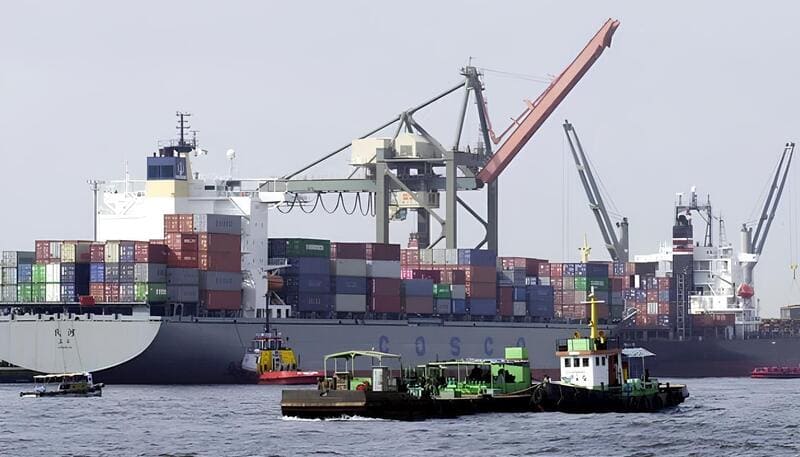
Image Credit: AFP (A container ship loaded with cargo at Karachi port).