



Part VII of the Special Series GLOBAL ALLIANCE AND POWER STRUCTURE: a collaboration between WGI.WORLD (World Geostrategic Insights) and CGPS (Center for Global Peace and Security).
By Sunny Lee – Founder and President at CGPS (Center for Global Peace and Security), and Director at IKUPD (Institute for Korea-U.S. Political Development), Washington DC.
Kim Yong, 12th President of the World Bank Group commented, “economic miracle of the 21st century would come up in Africa” while diagnosing its marvelous potential as the global future. Such a confirmed prophecy sent shock waves to economic specialists and Professor Dani Rodrik at Harvard immediately proved his prospective vision with detailed data. The top 15 among the fast-growing 20 countries in the world will also belong to Africa in 2026.

Africa’s average economic growth rate from 2010 to 2020 before Covid-19 was 4.6% with Ethiopia 9.5%, Rwanda 7.2% and Republic of Cote d’Ivoire 7.0%, compared to the world 3.3%. IMF projections also indicate that Africa will beat up all other regions in real GDP growth from 2026 to 2029. Africa will reach 4.4% much higher than world 3.1% in 2029, surpassing Asia & Pacific 4.0%, South America 2.5%, North America 2.1%, and Europe 1.5%.
Abebe Aemro Selassie, economist and retired Director in the African Department of the IMF emphasizes that Africa is surely the continent of prominent opportunity as the world center of economic challenge. Africa’s investment landscape for attracting foreign direct investment (FDI) is vividly undergoing a dynamic transformation beyond simple economic growth. UNCTAD data show that FDI to African countries hit $80 billion in 2021 and rose 85% from the previous year in 2024. For example, due to mergers and acquisitions, Egypt has received over $35 billion, which was one-third of Africa’s total FDI.
Currently, Africa is a black gem as well as a new hope to flourish the global society with two critical elements of population and natural resources. Africa has been the youngest continent in the world with the median age 19.3 and population will increase from 1.57 billion in 2025 to 2.5 billion by 2050. In particular, the population rate under 30 years is 67.2% as double to Europe 32.2%. It guarantees variable labor sectors and simultaneously, consumer markets which stimulate economic growth based on sustainable start-up business by the young generation.
Africa also contains 92% of platinum and chromium and 40% of gold in the world as the largest reserves of cobalt, diamonds, platinum and uranium. Africa also produces 71% of its cobalt, 89% of its gold, 75% of its diamonds, and 60% of its chromium, absolutely influencing the industrial environment in the world economy. Moreover, the continent amazingly holds 65% of the world’s arable land as well as 10% of the Earth’s fresh water source with a giant scale of renewable energy, directly involving human life.
Despite such a prominent vision, Africa still struggles with fundamental obstacles hindering sustainable development and growth. Political instability, impotent governance, economic discrepancy, and security environment have been revealed in variable fields. At this point, the African Union (AU) and the African Economic Community (AEC) conduct their mission to promote unity and solidarity by spurring mutual economic development and international cooperation. South Africa with the AU successfully hosted the 2025 G20 Summit in the slogan of global equity, sustained development, and collaborative solutions, marking a shift from a developed economy to a platform of emerging countries, particularly Africa and Global South.
Africa’s Potential Vision
Agenda 2063 of Africa is a pivotal blueprint as well as a master plan for transforming Africa into the global powerhouse of the future. As the continent’s strategic framework and concrete manifestation of the pan-African, it aims to achieve goals of inclusive and sustainable development through unity, self-determination, freedom, progress and collective prosperity.
Nonetheless, as entering 2026 with a moment of dangerous convergence, Africa faces multiple strategic dilemmas and severe obstacles against the continent’s future. As worldwide syndromes, democratic agitation, prolonged wars, climate shocks, and unsustainable debt are currently prevailing by rapidly shifting global order. In contrast, Africa has surprisingly explored its immeasurable potential to signify the world’s future. The continent hosts 60% of the world’s solar resources and provides minerals essential to the global energy transition, even though it remains politically and economically underpowered or underdeveloped.
First, the unstable structure of democratic system and governance are the most fundamental obstacles. African countries mostly move away from democratic norms and standards with the collapse of legitimacy. By the end of 2025, more than half of African countries were classified as not free by the Global Democracy Index. Civilian activities have been sharply prohibited so that journalists, human-rights defenders, and opposition leaders would be increasingly criminalized in authoritarian governments counting on dictatorship.
In 2026, Africa goes through 14 national elections, already marked by repression, insecurity, or economic crisis while deepening political alienation. As the worst case, the President Yoweri Museveni of Uganda in power since 1986 will extend his dictatorship along with intimidation and stronger militarization to press people. Moreover, horrible elections will take place in Ethiopia with a deeper backdrop of continual conflicts in Tigray, Amhara, Oromia, and Somali regions. The danger will not only flaw elections but also the normalization of democratic fraud, frustrating fertile ground for coups, insurgencies, and social explosions.
Second, it is conflict against the security environment as a critical symptom of governance failure and the worst factor hampering national development. Africa’s wars persist due to not lack of mediation but lack of accountability, sanctions, or enforcement. As a result, many countries in Africa have struggled with severe civil war along with massacre and destruction.
Sudan’s catastrophic civil war has continued for many decades so far, representing the tragic case of the gravest humanitarian crisis in the world. Over 12 million people including 4 million refugees were already displaced and furthermore, 50% of the population would suffer from starvation with acute food insecurity. Although the estimated death toll exceeds 150,000, conflict will be intensified in Kordofan with increased drone warfare and regional spillovers.
Third, it is debt, cost of capital, and the structural trap by unfinished business that Africa’s debt crisis is often misdiagnosed. Usually, most countries consider less about reckless borrowing but more about systemic financial discrimination. As a result, average African sovereign borrowing costs are 2-4 times higher than those of advanced economies.
In 2025, over 20 African countries spent increasingly on debt servicing and should pay $30-40 billion annually with excessive interests due to risk premiums. Unless they establish a proper reform system of credit ratings along with liquidity access and multilateral lending rules, Africa will be surely locked in a cycle, where growth fuels not development and investment for national prosperity but simply repayment.
Fourth, it is geopolitics for leverage, coercion, and the test of African solidarity. Africa’s geopolitical landscape is no longer defined by its own multilateral rules. Instead, transactional power politics, selective enforcement of norms, and normalization of coercive diplomacy arise as a new venture. The U.S., China, Russia, Gulf countries, and middle powers are competing openly for strategic advantage over Africa’s minerals with military access, trade routes, and ideological alignment. In such a stressful environment, Africa is simultaneously courted and pressured but its strategic value for sovereignty and collective voice initiates further venture.
The US decision not to invite South Africa to the 2026 G20 Summit shockingly crystallizes this reality. Such an unprecedented and politically exclusive move obviously signals a shift from diplomatic disagreement to institutional punishment, weaponizing summit invitations as a tool of geopolitical discipline. If a G20 member from Africa becomes sidelined, African participation in global governance would be conditional without guaranteeing further process. Simultaneously, the African Union, alongside like-minded G20 members from the Global South and beyond, also faces a defining choice to assert collective solidarity. Hence, in a multipolar world drifting toward coercion, Africa’s solidarity is not symbolism but strategic leverage.
Fifth, it is digitalization and data governance through digital infrastructure, trusted data systems, and frontier technologies. They are not optional enablers but the backbone of productivity, service delivery, security, and democratic accountability. Although Africa has propelled real, measurable strides in digitalization, progress still remains ambiguous to compete effectively in the global digital economy. Nonetheless, across the continent, the digital economy’s contribution to GDP has risen rapidly from 1.1% in 2012 to 5.2% by 2025, expanding internet access and vibrant tech ecosystems through improved policy frameworks. Egypt boasts internet penetration rates exceeding 70%, supported by robust regulatory environments with mobile broadband subscriptions.
Despite such a remarkable achievement, millions of African people remain unconnected to mobile internet, with stark divides in digital usage and skills. Currently, Africa hosts less than 1% of global data-center capacity, even as demand for data services and cloud infrastructure surges. However, global institutions such as the World Bank are continuously addressing significant investments to reduce its worldwide gap.
The African Union and its Transnational Development
South Africa, Algeria, Egypt, Nigeria, Morocco, and Libya are top 6 economic powers with 35% of African population, 56% of total GDP, and 60% of trade inventory in Africa. As a rising partner in the world space industry, South Africa has been also an innovative space icon since it launched satellite in 1999. Its fast-growing speed as a national strategy with a sustainable space development goal based on economic prosperity has amazingly surpassed GDP growth. Consequently, the African Union with 55 countries, founded in 2002, has propelled space development by establishing the African Space Agency (AfSA) in 2023.
Since Africa turned to a rising star in the global society with great potential, the African Union has coordinated variable international relations and foreign policies on a state-by-state basis. In particular, the AU represents African people’s interests through intergovernmental organizations (IGOs), such as a permanent observer at the United Nations General Assembly. The AU’s mission to the UN aspires to serve as a bridge between organizations and it also maintains special diplomatic relations with the U.S., the EU, and other global powers.
First, it is Africa-EU relations as a key priority. The Africa-EU partnership vision is outlined in the Joint Communication with the title, ‘Towards a Comprehensive Strategy with Africa.’ Green Transition and Energy Access, Digital Transformation, Sustainable Growth, and Security and Governance are main initiatives to fulfill projects.
As strengthening resilience and security, the African Union and the European Union are closely linked for sustainable development, prosperity, and resilience of societies. They also work together to promote resources management, environmental resilience, and climate change mitigation as the Africa Adaptation Initiative is supported by the European Union.
Second, it is Africa-China relations. The leading economic partners of the continent have focused on conducting economic projects with China. Especially, the Forum on China-Africa Cooperation (FOCAC) is the main multi-lateral coordination mechanism between the African countries and China. Since joining FOCAC in 2012, the African Union has increasingly played a coordinating role, even though each country in FOCAC represents itself individually.
Third, it is Africa-United States relations for the future vision. Despite overall tensions caused by Trump’s global tariff war, relatively positive developments emerged in US-Africa economic relations during 2025. The recalibration of US-Africa relations for economic preference ultimately explores both challenge and opportunity through trade, aid and geopolitics. The African Development Bank has deepened cooperation with Trump Administration’s Prosper Africa Initiative (PAI) to connect U.S. and African businesses with new buyers, suppliers, and investment opportunities. This enhanced cooperation focuses on boosting capital flows to African countries and supporting private sector development in key industries. The success of these economic cooperation signifies how Africa-US relations evolve trade and investment.
Fourth, it is Africa-Russia relations as a new challenge. In 2025, Russia’s diplomatic activities in Africa show how Moscow is changing its national strategy by opening total 22 embassies. As well, Business diplomacy has proliferated with government-sponsored projects such as energy and mining. Numerous Russian state-owned companies have signed agreements and built momentum of Russo-African commercial ties. For example, DRC ratified a deal that Russia develops its oil pipeline with estimated delivery by 2029. Through a build-own-operate-transfer model, Russia will retain use of the infrastructure for 25 years.
Fifth, it is Africa-South Korea relations as the most successful model. Economic adventures between Africa and South Korea have explored a close relationship by transmitting South Korea’s growth model beyond trade or investment. By benchmarking the South Korean development model, many African countries jump up toward a developed country in the world. Algeria is sending remarkable numbers of international students to learn about South Korea’s high-growth model. South Africa also benchmarks South Korea’s successful model through continual cooperation, such as new village strategy (Sae-maul Undong).
Moreover, the Korea International Cooperation Agency (KOICA) as a national institution for Africa’s development has been steadily conducting projects with Africa since establishing the first African strategy in 2012. KOICA is striving for African countries’ prosperity while passing on South Korean technologies and advanced systems. KOICA mainly designs new projects to re-systemize governance structures with the goals of national growth, economic prosperity, and job opportunities through variable activities in African countries.
Natural Resources and Economic Prosperity
Africa’s extraordinary but underutilized resources are absolutely based on natural capital with 30% of global mineral reserves. Africa will capture over 10% of the projected $16 trillion in revenues of the global key green minerals by 2030. In addition, as the prospective place of business capital, full implementation of the African Continental Free Trade Area (AfCFTA) could increase exports up to $560 billion and boost continental income of $450 billion by 2035. Africa’s economic potential for faster long-term growth is encouraged by a rapidly expanding population as a human capital along with upward economic mobility opportunities.
As the world’s most significant continent, Africa accommodates the wealthiest countries based on abundant natural resources such as Seychelles, Mauritius, Gabon, Egypt, and Botswana as contributing to its relatively high GDP per capita. Nonetheless, still lots of countries struggle with poverty in extremely impoverishing conditions because simply relying on natural resources is very risky without diversifying into technologies, services or agriculture and prohibiting corruption or monopoly development. In particular, the most critical minerals: e.g., cobalt, lithium and copper, have been the important key elements to the green energy transition which will determine the future of Africa. They also guarantee that Africa benefits massively by entering the global chain rather than just exporting raw materials.
At this point, the AfCFTA successfully conducts intra-African resource processing, trade, and joint infrastructure projects for top 10 African countries with the most natural resources in 2025: DRC, Nigeria, South Africa, Angola, Algeria, Ghana, Libya, Zambia, Botswana, and Sudan/South Sudan. Through better governance, regional cooperation and responsible reinvestment, they have concentrated on building resilient and diversified economies and finally become profoundly rich and wealthy countries into widespread prosperity.
In particular, DRC with abundant cobalt, copper, gold and oil produces 70% of global cobalt and South Sudan holds over 75% of oil reserves in Africa. Angola, filled with oil and diamonds, boasts its national status as a major OPEC member as well as Algeria being the main gas supplier to Europe. First of all, oil reserves have provided the fastest propeller in African economies as Africa’s economic powerhouses. Nigeria, Libya, Algeria, Egypt and Angola among top 10 richest countries by nominal GDP account for 85% of the continent’s oil production.
Africa 2026 outlook scenarios signify that 2026 will be a turning point as well as a outstanding milestone that Africa could reshape its economic and political direction. Through economic reforms, political elections, and new ventures of international relations, African countries reach the enhancement of resilience and prosperity simultaneously. As well, while focusing on clear governance and long-term competitiveness, upper employment rate and lower living cost can not only reduce debt but also encourage investment.
Political shifts and governance trials through elections, coalition politics, and legitimacy debates also increase political competition that investors become confident and citizens surely experience improved service delivery. In particular, governance reforms would work out for anti-corruption enforcement, procurement transparency, and judicial independence. These factors increasingly influence credit ratings for foreign direct investment decisions as well as climate finance access as the new venture in international economic relations.
As a result, Africa is striking multiple deals with various partners regarding trade, debt, energy, and even security matters by enhancing bargaining power. Meanwhile, AfCFTA implementation also creates larger markets, standardizes rules, and scales African firms beyond borders. Currently, most African countries experience such a synergy effect to propel economic prosperity based on regional security, where digital innovation is rapidly growing through strategic diversification.
Invisible Dark Horse in the World Power
Setting to shape Africa’s future, its economic and infrastructural transformation are now gaining an enthralling momentum from AI to green energy. Africa’s population size is expected to be a quarter of the world by 2050, guaranteeing market expansion and a new wave of innovators with a burgeoning per capita. As well, Africa’s abundant resources and critical minerals to fulfill global demands reposition its status as a potential global leader in the world power. As the successful process, under Pan-Africanism and African Renaissance, African leaders have conducted Agenda 2063 to become a dominant player in the global order.
Even though lots of countries in Africa have stagnated in political and economic systems, their ongoing endeavors through the African Union would initiate numerous prospects. Sooner or later, Africa might surprisingly appear as a dark horse to reorganize global power structure. Currently, the global economic system mainly focused on the U.S., the EU, the BRICS, and the ASEAN has revealed variable dilemmas by discrepancy or monopoly activities. However, the African Union relatively keeps its vision with the communal goals of member countries. Because of natural resources to shake the world markets, many countries in Africa might upgrade their national competitiveness toward an advanced level.
Nonetheless, there are still waiting for urgent actions needed to handle resource leakages as massive capital outflows are critically undermining Africa’s development. For example, compared to $190.7 billion of financial inflows received in 2022, Africa lost approximately $587 billion through financial leakages. This lost amount mainly includes around $90 billion by illicit financial flows, a further $275 billion siphoned away by multinational shifting profits, and $148 billion by corruption. Without fixing those issues, Africa’s economic prosperity will not guarantee its future or even resource wealthy countries can be inevitably impoverished.
Therefore, unless Africa allocates its own capital composed of human, natural, fiscal, business and financial assets effectively, the global society will not look for Africa to accelerate investments. It is the most critical dilemma that member countries belonging to the African Union should resolve through economic reforms based on democratic stability. In addition, it is the shortest way for Africa to become a real global power.
Author: Sunny Lee – Founder and President at CGPS (Center for Global Peace and Security), and Director at IKUPD (Institute for Korea – U.S. Political Development), Washington DC. Sunny Lee is the author of 115 academic books in politics (original English and in German, French, Russian, Polish, Dutch, Italian, Spanish, and Portuguese). She is a bestseller writer not only in politics but also in literature on Amazon. Her recent book is titled: “The Influence on Humankind’s Peace through Korean Reunification: Creating new paradigm in social science by interdisciplinary research.”
(The opinions expressed in this article are solely those of the author and do not necessarily reflect the views of World Geostrategic Insights).
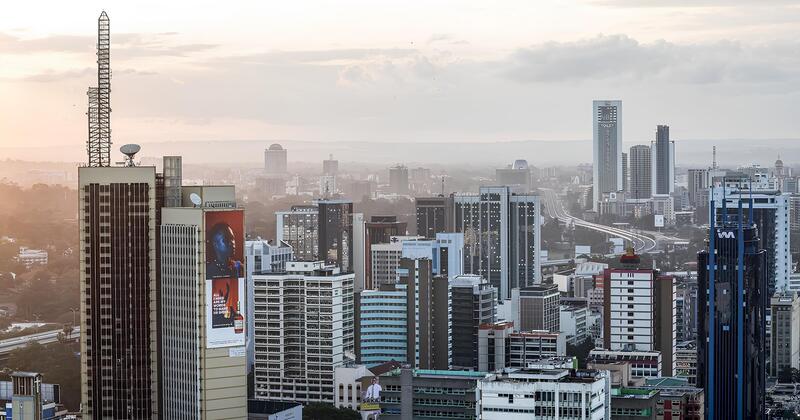
Image Credit: Picture Alliance (View of Nairobi, capital of Kenya).