



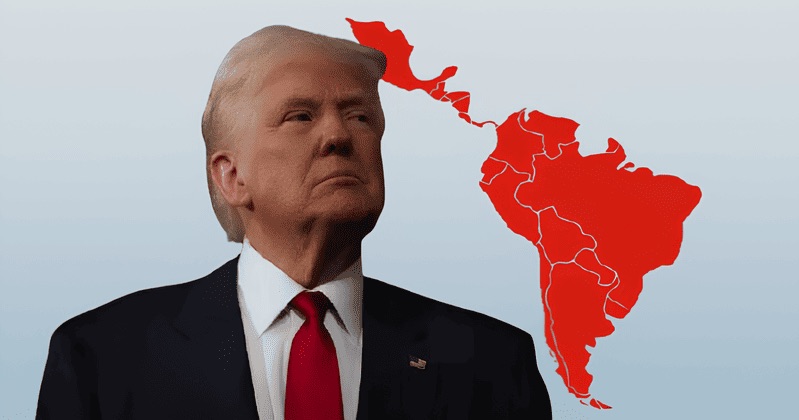
According to The Economist: “The ‘Trump corollary’ to the Monroe Doctrine, featured in America’s new national security strategy in December, vowed to deny ‘non-hemispheric competitors’ the ability to position military forces or control strategic assets in the western hemisphere. The target was clear: China”. (The Economist, 2026).
On its side, Mike Froman wrote: “For President Donald Trump, Venezuela has become ground zero for his 21st century corollary of the Monroe Doctrine – an experiment in power projection…rooted in the president’s belief that hemispheric dominance is a national security imperative”. (Froman, 2025).
Strategic Assets
If hemispheric dominance is a national security imperative and China is the main intruder within the Western Hemisphere, the issue is certainly not the presence of its military forces but its control of strategic assets. Targeting Venezuela (ground zero as Mike Froman called it) served not only as a dissuasive message to other countries of the region as to the limits of China’s encroachment, but to Beijing’s hemispheric assertiveness as well. It also served, of course, to take control of Venezuela’s important strategic assets.
Fact is that in addition to its gigantic oil and gas reserves, Latin America tops the list of global reserves on several critical minerals. These include lithium, graphite, cooper, zinc, niobium, cobalt, nickel, silver, or rare earths. In addition to the gigantic lithium reserves in the so-called “lithium triangle” (Argentina, Chile and Bolivia), the region as a whole holds 52 percent of the world’s reserves of that mineral. It also has 38 percent of the global reserves of copper, 39 of silver, 24 percent of graphite, and 17 percent of nickel, zinc and rare earths. Brazil alone has 80 percent of the global niobium reserves. Moreover, Chile and Peru are the world’s leading copper producers with about 40 percent of the global supply. (Purdy and Castillo, 2022; Ríos, 2023; Center on Global Energy, 2023).
China’s Role
Since more than two decades ago, China has been strategically and patiently investing in the exploitation, mining and refining of those natural resources. Moreover, it has built the infrastructure needed for its domestic and overseas transport. By 2021, China’s outward investments in Latin America reached US$693.740 billion. (CEIC, 2023), a very important part of which was dedicated to hydrocarbons and critical minerals. A good example of it can be found in the following quote by ChinaDaily: “Latin America has become a vital supplier of raw materials and resources that support China’s industrial production and manufacturing sectors. About 77 percent of Chile’s copper exports went to China, while Argentine and Bolivian lithium – central to battery production – accounts for a growing share of global supply from the ‘lithium triangle’, which holds roughly 40 percent of global lithium reserves”. (Golombiewski Texeira, 2026).
China also invested in strategic infrastructure linked, to an important degree, to the transport of such critical minerals. Good examples of it are the construction of Chancay Megaport in Peru and the Belgrano Cargas Railway in Argentina, as well as the modernization of Port Colón in Panama. Chinese companies, as reported by the Financial Times, have built or operate 31 active ports in Latin America and the Caribbean. (Stott, 2025).
All along this process, China also became Latin America’s biggest lender as well as South America’s largest trade partner (number two for the region as a whole). Meanwhile, and with the exception of its huge involvement in Mexico, the United States was missing in action. An absence difficult to understand when bearing in mind the U.S.’ historical obsession over controlling its own hemisphere, and which can be explained through the logic imposed by globalization. Especially so as the U.S. essentially retreated into services and left China in charge of much of the manufacturing that it needed.
From “Chimerica” to Onshoring
Indeed, within the notion of “Chimerica”, coined and developed by Niall Ferguson and Moritz Schularick, East-Chimericans (Chinese) manufactured and West-Chimericans (Americans) basically provided services, East-Chimericans exported and West-Chimericans imported. (Karabell, 2009, p. 256). Under this symbiotic vision of the U.S.-China relationship, the redirection of Latin American commodities toward Chinese factories made economic sense. At the end of the day, a “de facto” triangulation materialized between them, with Latin American exporting its commodities to China, China exporting finished products to the U.S., and the U.S. exporting services to both.
However, Chimerica was replaced by an emerging Cold War between China and the United States, globalization faded, geopolitics came back to the forefront with Russia’s invasion of Ukraine, Covid utterly disrupted global supply chains, and protectionism took hold in the United States. This concatenation of factors put in motion the onshoring of American companies. Manufacturing, indeed, has gotten back to America. Essentially, high-tech, capital-intensive manufacturing.
Hostage to China
As it happens, though, high-tech manufacturing is dependent on critical minerals. Electrical vehicles need lithium, nickel, cobalt and graphite. Semiconductors need gallium and rare earths. Renewables need copper, silver and rare earths. And so on. But the Global South controls geology and China has become its gate keeper. On top, Artificial Intelligence demands energy, huge amounts of it. Preferably, cheap energy. And although the U.S. is a shale oil juggernaut, its reserves are rapidly diminishing and China swallows and controls gigantic amounts of the world’s oil production.
In the same manner in which, during the globalization era, the U.S. offshored to China a substantial part of its manufacturing capacity, it also outsourced to it the long-cycles, environmental contentiousness and political risks associated with extractive activities. This, under the assumption of their complementarity or, at least, under the notion that China was just another supplier of refined critical minerals. The result of it being that America’s high-tech industry has become hostage to Beijing’s control of the global mining upstream. Something clearly shown by the case of rare earths, where China accounts for around 70 percent of its mining, but represents 90 percent of its refining. (McNeal, 2025).
Bombing, Threatening and Bulling
Trump, being Trump, had an easy answer to this quandary: The Donroe Doctrine. Meaning, forcefully trying to get back the Western Hemisphere and its strategic raw materials through bombing, threatening and bulling. Venezuela, and its huge hydrocarbons reserves (as well as rare earths and other critical minerals, by the way), was ground zero to the doctrine. Who follows? Greenland, which in addition to its strategic value possesses a huge array of critical minerals? The Panama Canal, a fundamental chokepoint into the region? Could it be Canada itself, with its gigantic natural resources? In the era of Trump’s might, everything seems possible.
Would this “might is right” Donroe Doctrine survive after Trump leaves the White House in three years? Probably not. What would in all likelihood survive is an enlarged regional mistrust towards the United States. No other region of the world can produce the long list of historical grievances toward the U.S. that Latin America can. Although this is counterbalanced by admiration towards American achievements and by shared cultural affinities, an underlying resentment remains present. By bringing back to memory the abuses of power through which the region was led into submission by its Northern neighbor, so many times throughout history, Trump could leave a minefield legacy. One, that would certainly benefit China, pushing the region even more into its arms. As usual, Trump’s short term drastic answers to problems tend to amplify them severalfold. Something that could also happen within NATO and in U.S.-E.U. relations as a result of his handling of Greenland – A Danish autonomous territory located in the Western Hemisphere.
References:
CEIC (2023). “China Outward Investment: Acumm: Latin America 2003-2023”.
Center on Global Energy Policy at Columbia School of International and Public Affairs (2023). “Critical Minerals in Latin America”, June 5.
Froman, Mike (2025). “Much ado about Maduro”, Council on Foreign Relations, October 24.
Golombiewski Texeira, Alessandro (2026). “China, Latin America forging shared future”, ChinaDaily, January 13.
Karabell, Zakary (2009). Superfusion. New York: Simon & Schuster.
McNeal, Dewardric (2025). “U.S. is losing rare earth metal war to China, and running out of time to win it back”, CNBC, June 29.
Purdy, Caitlyn., Castillo, Rodrigo. (2022). “The Future of Mining in Latin America: Critical Minerals in the Global Energy Transition”, Brookings Institution.
Ríos, Germán (2023). “Strategic minerals: Collaboration between LATAM and the Caribbean, Spain and the EU”, El País, 5 October.
Scott Michael (2025). “China has influence over ports across Latin America, US think tank reports”, Financial Times, June 24.
The Economist (2026). “America’s raid on Venezuela reveals the limits of China’s reach”, January 10.
Author: Alfredo Toro Hardy, PhD – Retired Venezuelan career diplomat, scholar and author. Former Ambassador to the U.S., U.K., Spain, Brazil, Ireland, Chile and Singapore. Author or co-author of thirty-six books on international affairs. Former Fulbright Scholar and Visiting Professor at Princeton and Brasilia universities. He is an Honorary Fellow of the Geneva School of Diplomacy and International Relations and a member of the Review Panel of the Rockefeller Foundation Bellagio Center.
(The opinions expressed in this article are solely those of the author and do not necessarily reflect the views of World Geostrategic Insights).