



By Shahzadi Irrum
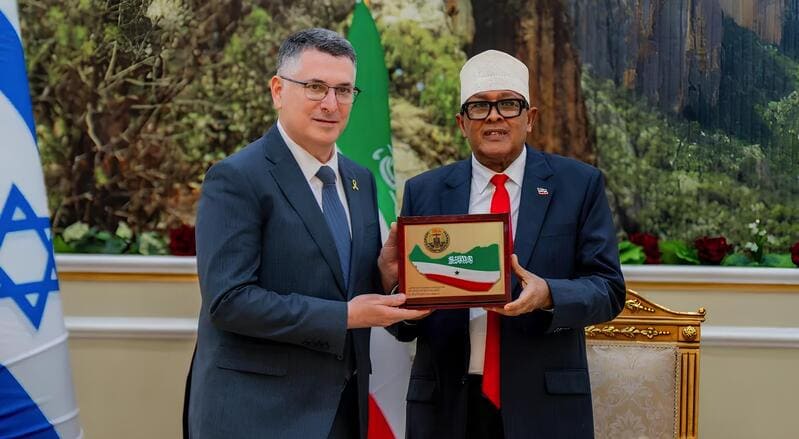
The Horn of Africa, a region already burdened by fragile politics and strategic rivalries, has once again found itself at the center of an unexpected diplomatic storm. This time, the trigger is Israel’s decision to recognize Somaliland as an independent state, a move that has sent shockwaves far beyond the region.

While Somaliland has long sought international recognition after breaking away from Somalia in 1991, no country had formally recognized its statehood until now. Tel Aviv’s step, therefore, is not just symbolic; it raises uncomfortable questions about intent, timing, and consequences, especially in a region where borders, sovereignty, and external interference remain deeply sensitive issues.
Those questions become even more pressing when the nature of Israel’s decision is examined closely. Israel’s controversial recognition of Somaliland appears less an endorsement of self-determination than a calculated act of geopolitical opportunism. Announced on December 26, the surprise declaration jolted the region at a moment of heightened political fragility. What makes the move particularly striking is that it comes from Israel, a country whose territorial policies and unresolved status in parts of the international system remain a subject of contention due to its prolonged occupation of Palestinian lands. That such a state would unilaterally recognize a breakaway region only deepens the controversy. The recognition appears to serve as a pretext for advancing Israel’s broader strategic vision of “Greater Israel,” while Somaliland, eager for international legitimacy, risks being drawn into a geopolitical trap where recognition masks dependency and external control rather than genuine sovereignty.
The US response further exposes the political selectivity behind this move. Washington has defended Tel Aviv’s right to recognize Hargeisa, despite having firmly opposed Ethiopia when it pursued a similar path by seeking recognition of Somaliland in exchange for access to the Berbera Port. At the time, the US objections were framed in terms of respect for Somalia’s sovereignty and the risks of regional destabilization. Those concerns appear to have evaporated when a close ally pursues the same outcome. By endorsing Israel’s decision while rejecting Ethiopia’s, the US sends a troubling message: that international rules are applied differently depending on who is acting, undermining their credibility and weakening the norms meant to safeguard regional stability.
Looking at the broader strategic picture, Washington’s defense of Israel’s recognition of Somaliland confirms a pattern I highlighted in my earlier paper, “The Berbera Port Deal: A Geopolitical Development and its Implication in the Horn of Africa.” There, I argued that Somaliland could one day be leveraged to advance America’s strategic interests, and that scenario is now unfolding. Washington’s backing of Tel Aviv reflects a calculated attempt to counter China’s expanding global influence, using Somaliland as a geopolitical lever. In this context, the territory risks being treated less as a political community and more as a “Taiwan of Africa,” used to check China’s rise and safeguard American dominance. The move also fits into wider attempts to undermine initiatives such as the China-Pakistan Economic Corridor (CPEC), which have strengthened Beijing’s strategic reach and unsettled long-standing Washington dominance. Amid competing global ambitions, Somaliland risks becoming an object of strategy rather than a subject of its own political destiny.
The consequences of these maneuvers are already being felt. The global backlash was swift and obvious, indicating that this is far from a routine foreign policy move. At the United Nations Security Council (UNSC), most members rejected Israel’s recognition of Somaliland, warning that the move could be tied to plans for the forced transfer of Palestinians from Gaza and an expanded Israeli military presence in the Horn of Africa. The African Union (AU) and the Arab League raised similar concerns, calling it an unwelcome outside intervention in Africa’s political affairs. A group of OIC countries, including Pakistan, described the step as a violation of the UN Charter and a threat to the peace in the Horn of Africa and the Red Sea region. Beyond these legal objections lies a more troubling possibility. When recognition is tied to security access and strategic interests, real independence can quickly turn into absolute dependence. In such a scenario, Somaliland risks becoming less a sovereign actor and more a territory shaped and politically controlled by external powers, repeating patterns of influence that Africa knows all too well.
For now, Somaliland’s president has welcomed Israel’s recognition, and many Somalilanders are celebrating what they see as a long-awaited breakthrough. However, this excitement risks overlooking the potential costs of such recognition. When recognition comes from a state driven by strategic and territorial interests, it often brings influence and control along with it. History offers a warning: powerful states frequently act in their own interest, and what looks like support today can limit a nation’s independence tomorrow. Somalilanders should now ask themselves: are we truly gaining independence through Israel’s recognition, or are we opening the door to external control over our land and future?
Author: Shahzadi Irrum – Assistant Research Fellow (Balochistan Think Tank Network, Quetta), Pakistan.
(The opinions expressed in this article are solely those of the author and do not necessarily reflect the views of World Geostrategic Insights).
Image Credit: Somaliland Presidential Office/AFP (Somaliland’s President Abdirahman Abdullahi Mohamed, right, with Israel’s Foreign Minister Gideon Saar, left, at the Presidential Palace in Hargeisa, on January 6, 2026).