



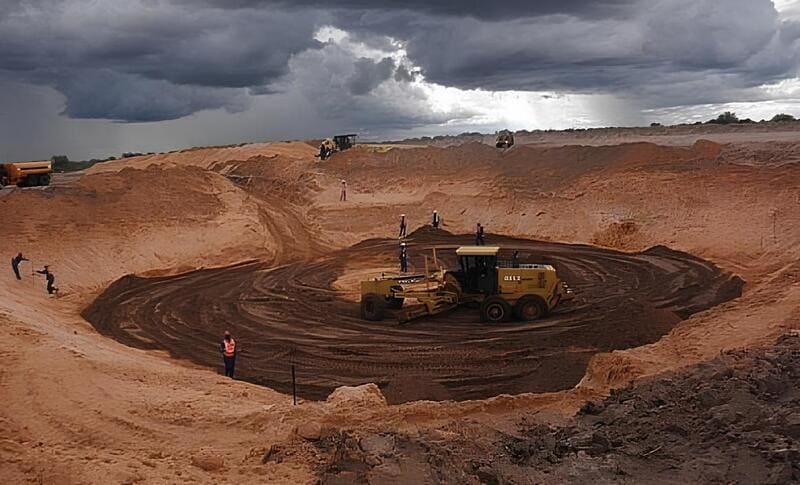
World Geostrategic Insights interviews Stevie Hamilton on how to ensure investment stability in Africa’s critical minerals sector, manage uncertainty, leverage global competition, and develop local capacity.

Stevie Hamilton is an executive in the field of global strategy and risk management with over 20 years of experience in US diplomacy, national security, and international trade. His current work focuses on enabling US companies to thrive in emerging markets, particularly in sectors such as critical minerals, infrastructure, and digital ecosystems. He helps bridge the gap between the public and private sectors, ensure supply chain security, and counter foreign influence with sustainable, locally rooted solutions.
Q1 – Based on your work advising investors and governments, what are the core factors that determine investment stability in Africa’s critical-minerals sector today.
A1 – Stability depends less on geology and more on governance. Africa holds extraordinary mineral potential, especially in the DRC and broader East Africa, but the decisive factor is whether governments can build predictable rules, coherent licensing processes, and credible institutions. Investors don’t need perfection. They need clarity, continuity, and a reasonable expectation that commitments made at the beginning of a project will survive changes in leadership. When those fundamentals exist, capital flows. When they are absent, capital hesitates no matter how rich the deposits are.
Q2 – Many African markets face rapid policy or regulatory changes. What practical steps can investors and operators take to manage uncertainty and maintain continuity in long-term projects.
A2 – Sophisticated investors design for volatility. That means structuring agreements that include dispute-resolution pathways, aligning with national development priorities, and embedding compliance from the beginning rather than treating it as a box-checking exercise. It also means having local partners who understand the political dynamics beneath formal regulations. The most resilient projects are those that combine strong legal frameworks with genuine government alignment and long-term incentives on both sides.
Q3 – There is increasing global attention on Africa’s minerals—from the United States, China, the EU, and Gulf partners. How is this competition reshaping opportunities and risks for African governments and local operators?
A3 – Competition can create leverage for African states, but only if it’s managed through coherent national strategies rather than fragmented bilateral deals. The real risk is not competition itself, but the absence of institutional capacity to negotiate and sequence agreements in a way that maximizes national benefit. Countries that build capable negotiating teams and clear long-term plans will gain from this moment. Those that don’t could find themselves signing agreements that look attractive in the short term but undercut long-term sovereignty and economic value.
Q4 – What does a credible pathway from raw-material extraction to value-added processing look like in practice, and what capabilities need to be built locally to achieve it.
A4 – It requires more than policy declarations. You need infrastructure, energy reliability, workforce development, and regulatory environments that reward long-term investment rather than short-term extraction. In the DRC, for example, the opportunity is to move from exporting raw cobalt to refining and eventually manufacturing components. But that requires industrial planning, power generation, and skills development at scale. The countries that succeed will be those that build industrial capacity step by step rather than trying to leap directly to high-end manufacturing.
Q5 – In your experience, what governance structures or partnership models help align investor interests with host-nation development priorities.
A5 – The most effective models balance national control with transparent investment frameworks. They include clear revenue-sharing structures, strong national oversight bodies, and mechanisms to ensure that infrastructure and social investment commitments are actually delivered. When governments and investors share a long-term stake in a project’s success, the partnership becomes less transactional and more developmental. That alignment is what transforms mineral extraction into national wealth rather than temporary revenue.
Q6 – What role can private-sector platforms—such as advisory firms, local partners, or blended-finance vehicles—play in strengthening transparency, compliance, and long-term risk management.
A6 – Private platforms can bridge gaps that governments or investors struggle to address on their own. They can help build compliance systems, structure financing, integrate ESG standards, and create the frameworks that allow international capital to move confidently. In the DRC, for example, we are seeing new models that combine local ownership, international oversight, and project-level governance mechanisms. These structures are still emerging, but they’re essential for reducing risk and ensuring long-term stability.
Q7 – Looking ahead to the next decade, where do you see the strongest opportunities emerging across Africa’s minerals and infrastructure landscape?
A7 – The most significant opportunities will come from projects that combine minerals, energy, and logistics into integrated economic corridors. Countries that can link mining, processing, power, and transport will move from commodity exporters to industrial actors. The DRC has a unique opportunity given its resource base, and East Africa is emerging as a strategic corridor connecting minerals, manufacturing, and global markets. The question is not whether the opportunity exists, but which countries will build the institutional capacity to capture it.
Stevie Hamilton – Global Strategy and Risk Executive, Co-founder of CLP, Former U.S. Diplomat.
Image Source: Botswana Chamber of Mines .