



By Barrira Gul Kakar
Pakistan signed a MoU of $500 million with the U.S on 8, September 2025 with the United States Strategic Metals (USSM), recycler and processor of vital minerals and rare earth elements.

Through such an agreement, the U.S aims for collaboration in minerals including copper, gold, tungsten, antimony and rare earth elements to be imported from Pakistan, that are vital for the manufacturing of military and defense technology. After years of inactivity and stagnation since the U.S withdrawal from Afghanistan, Pakistan’s diplomatic ties with Washington have entered into a period of gradual revival.
The recent development of the U.S.-Pak mineral deal has sparked criticism about its implications for Pakistan’s longstanding and time-tested partnership with China. However, this may not potentially affect the Pakistan-China relationship. States often deal with many rivals, such as India with both Russia and the US at the same time. Many analysts argue that Pakistan’s increasing economic ties with the United States could deteriorate or disrupt its partnership with China. However, Pakistan should utilize this opportunity for its economic recovery and promote its broader Geo-economic goals in the region, without compromising on its principled stance.
The meetings between U.S President Donald Trump and Pakistan’s COAS General Asim Munir, and the official visits of Prime Minister Shahbaz Sharif to Washington show the revival trend. Trump’s public appreciation of Pakistan’s contribution in facilitating a ceasefire in the Israel-Palestine conflict and especially thanking Field Marshal Asim Munir for his assistance and efforts, highlighted Pakistan’s renewed diplomatic ties.
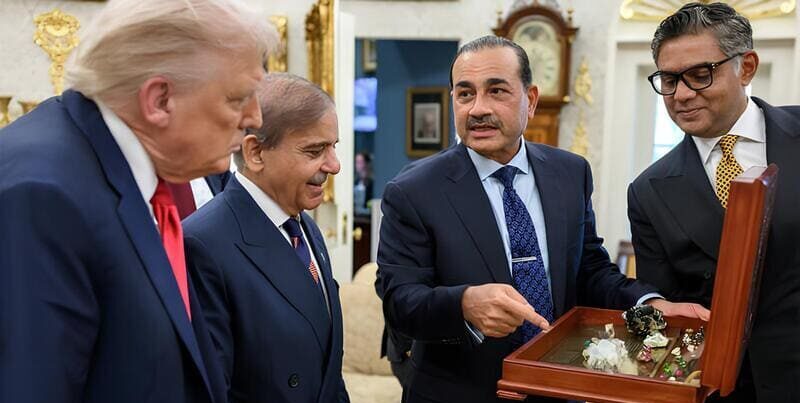
The U.S. seeks to build secure and transparent mineral supply chains for American industry amid Washington’s growing concerns over China’s upper hand in global rare-earth materials; an imputable technological race between China and the United States has driven an increased demand for rare earth elements and other critical minerals. The firm has sent its first consignment of mineral samples, including antimony, copper concentrate, and rare earth elements (such as neodymium and praseodymium), to the U.S. for further evaluation. Such initiatives mark a shift from Pakistan’s previous neglect and marginalization in U.S. foreign policy to renewed cooperation based on economic potential rather than security dependency.
Since the 1960s, Islamabad has viewed Beijing as, all-weather strategic cooperative partner, offering consistent diplomatic support, massive investments in minerals, and energy sectors and providing defense technology. Although China is Pakistan’s leading export market for minerals, annually exporting nearly $1.2 billion worth of copper ore, also securing long term raw material and energy supplies under BRI, investment in Thar Coal, Saindak Copper-Gold mine, Lithium & REE projects and Reko Diq (copper and gold mine), illustrates expanded Chinese cooperation in the mining and mineral sector.
However, some Chinese analysts have expressed concern over increasing U.S involvement in Pakistan’s resources sector, that it might undermine Beijing’s influence or expose sensitive supply chain data and lead towards new mineral Cold War. Yet, Pakistan has clearly stated that its engagement with the U.S will never harm China’s interest or cooperation. Rather, Pakistan aims for complementary, not competitive ties with both powers. As shown in the Pakistani leaders’ dictum, this new type of mineral diplomacy with the United States will not jeopardize Pakistan’s relations with China.
The Global economic situation underscores its practicality despite being embroiled in a long-standing competition and trade war, the U.S.-China trade volume reached nearly $658.9 billion in 2024, while China reported $688 billion in trade of goods. In the same way, India and China have engaged in bilateral trade for decades, from 2023-24 their bilateral engagements increased over $118.4 billion, despite having decades long border clashes over the Galwan region and a lasting race to position itself as regional power. These figures demonstrate a most powerful reality that states despite having strategic rivalry and competition are engaged economically. From policy overview, Pakistan should also adopt a policy of Strategic autonomy in its foreign policy, to maintain strong diplomatic, economic, and political ties with both Washington and Beijing, while protecting its own sovereignty and national interest instead of any external pressure or influence.
While the China-Pakistan Economic Corridor (CPEC) is essential and central to Pakistan’s economic growth, collaboration with other developed states, such as the U.S., can attract investment, improve technological skills, and speed up export-driven growth of Pakistan. However, U.S interest in Pakistan’s critical minerals demonstrates the broader goal to reduce Beijing’s dominance or monopoly in the global rare earth supply chains, and to establish its own secure and transparent supply chain but also try to reduce China’s influence within Pakistan. As per the report of the Atlantic Council, such minerals are very crucial for state power. Minerals such as lithium, cobalt, and rare earth elements play a vital role in the manufacturing of automatic cars, defense systems and advanced technologies.
Pakistan in the emerging global world order, is consistent with Neo-Marxist thoughts that economic power determines states power. So Pakistan is also trying to diversify its economy by building manufacturing and processing capabilities domestically to transform itself from being an exporter of raw materials to a sophisticated manufacturer.
Pakistan’s strengthening ties with U.S through mineral diplomacy and at the same time growing economic ties with China through CPEC, could serve as a corner stone for Pakistan Geo-economic revival, because such an initiative will not only generate employment, but also improve Pakistan’s balance of payment crisis and reduce dependence on foreign aid and assistance.
The Dual Strategy Approach of Pakistan provides opportunities for sustainable growth, attracts foreign investments, and strengthens regional stability via such engagements; however, in the contemporary global economic system, such collaborations should be parallel, not at the expense of others. Pursuit of this new balanced approach in relation to great powers competition reflects Pakistan’s shift to a broader regional outlook.
In a contemporary multipolar world order where there is great power competition, the real challenge for Pakistan is how it can capitalize on global opportunities and great power rivalry to pursue its own national interest and catalyze its own economic recovery and promote its broader Geo-economic goals in the region.
Author: Barrira Gul Kakar – Research Intern at BTTN, BUITEMS, Quetta, Pakistan.
(The opinions expressed in this article are solely those of the author and do not necessarily reflect the views of World Geostrategic Insights).
Image Source: White House (Pakistan’s Army Chief Field Marshal Asim Munir presents mineral samples to US President Donald Trump at The White House in Washington DC, US, on September 26, 2025.