



In ancient China, the phrase “pointing at a deer and calling it a horse” (指鹿为马) became synonymous with power’s ability to force people to deny obvious reality. During the Qin Dynasty, the powerful official Zhao Gao brought a deer before Emperor Qin Er Shi and proclaimed it a horse.

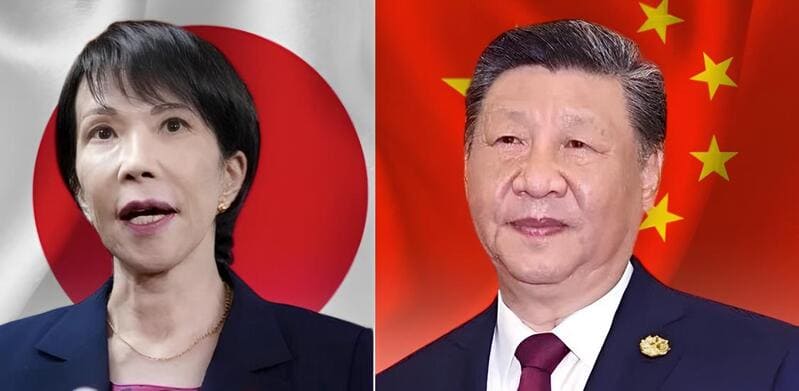
When courtiers who valued truth agreed with the emperor that it was indeed a deer, Zhao Gao marked them for elimination. Those who feared his power nodded and called it a horse, passing his loyalty test. Today, Beijing employs this same tactic against Japanese Prime Minister Takaichi Sanae, transforming her pragmatic warning about Taiwan contingencies into evidence of resurgent Japanese militarism. Yet this latest propaganda offensive reveals less about Japan than about China’s strategic calculations and vulnerabilities.
Understanding Beijing’s motives requires recognizing two fundamental truths. First, China’s primary adversary is the United States, not Japan, and its core obsession remains Taiwan’s sovereignty as Beijing defines it. Within this framework, Takaichi’s straightforward acknowledgment that forced reunification would constitute a “survival-threatening situation” for Japan, potentially justifying collective self-defense measures, represents an intolerable shift from strategic ambiguity.
Her statement wasn’t hawkish, it was deterrent diplomacy, articulating what every serious analyst already knows. Taiwan produces 60-70% of the world’s semiconductor manufacturing capacity, with TSMC alone controlling 64% of the global contract chipmaking market and producing nearly 90% of the most advanced chips. The sea lanes around Taiwan carry virtually all of Japan’s energy imports, making Chinese control an existential threat.
China’s immediate response revealed its propaganda playbook. State media didn’t engage with Takaichi’s legitimate security concerns but instead branded her statements as evidence of “militaristic ambitions” and “warmongering.” The Global Times called her remarks “dangerous provocation,” while Chinese diplomats summoned Japan’s ambassador for a dressing-down. A Chinese diplomat’s social media post featuring what many interpreted as a thinly veiled threat against Takaichi personally demonstrated Beijing’s willingness to blur the line between state criticism and intimidation.
Beijing’s response follows a calculated playbook designed to achieve four specific objectives over the next six to twelve months. First, China seeks to economically punish Japan for abandoning ambiguity on Taiwan, signaling to other nations that similar clarity will carry steep costs. The pattern is familiar: when Australia called for a COVID-19 investigation, Beijing imposed punitive tariffs; when Lithuania allowed Taiwan to open a representative office, Chinese customs erased the country from its system. Japan now faces the same economic blackmail.
Second, and most critically, Beijing aims to engineer Takaichi’s rapid political downfall through character assassination, hoping to restore Japan’s pattern of revolving-door prime ministers that has historically weakened Tokyo both domestically and internationally. Between 2006 and 2012, Japan cycled through six prime ministers in six years, paralyzing policy continuity. Beijing clearly prefers this instability to facing a strong, clear-eyed Japanese leader who articulates uncomfortable truths about regional security.
Third, China attempts to fracture regional alliances by portraying Japan as a revisionist power returning to its imperial past. This narrative specifically targets Southeast Asian nations with historical memories of Japanese occupation, attempting to drive wedges between Tokyo and potential security partners. By painting defensive preparations as offensive ambitions, Beijing hopes to isolate Japan diplomatically.
Fourth, Beijing desperately needs external enemies to distract from mounting domestic crises. Youth unemployment exceeds 20% in major cities, the property sector hemorrhages value daily, and local government debt approaches unsustainable levels. Xi Jinping’s zero-COVID policy shattered economic confidence, while his crackdowns on private enterprise have chilled innovation. Anti-Japanese nationalism provides a pressure valve for public frustration while reinforcing CCP legitimacy through historical grievance narratives.
The economic dimension of this conflict reveals Beijing’s tactical sophistication and strategic constraints. While Chinese tourists continue flooding Japanese temples and restaurants—ironically exercising freedoms in Japan they lack at home—Beijing’s Ministry of Culture and Tourism has already issued travel advisories warning against Japan. This could impact Japan’s tourism sector, which now represents 3-5% of GDP with Chinese visitors historically comprising a significant portion.
The threat of rare earth embargoes looms larger. China controls over 60% of global rare earth production and 85% of processing capacity. Yet executing such measures would accelerate Japan’s cooperation with the Quad nations on alternative supply chains, potentially breaking Beijing’s stranglehold permanently. Similarly, targeting Japanese businesses operating in China through regulatory harassment, spurious inspections, or informal boycotts could backfire by accelerating the “China Plus One” corporate strategies already underway.
History suggests Beijing will calibrate its economic warfare carefully. Past campaigns have yielded mixed results: South Korea maintained THAAD deployment despite Chinese pressure; Australia found alternative markets for its exports; Lithuania received EU support against Chinese coercion. Each failed campaign damaged China’s reputation as a reliable economic partner, pushing targets closer to American security guarantees rather than forcing compliance.
Japan’s peaceful transformation since 1945 stands as an empirical refutation of Chinese propaganda. For nearly eight decades, Japan has maintained unbroken peace—a record unmatched by any other major power, including China, which has fought wars with India (1962), the Soviet Union (1969), and Vietnam (1979). Japan’s constitution contains Article 9, explicitly renouncing war as a sovereign right. Since 1967, Japan has upheld three non-nuclear principles: not possessing, producing, or permitting nuclear weapons on its territory.
While Beijing’s military spending surged 59% over the past decade to $318 billion, Japan’s defense spending has risen modestly to 1.4% of GDP in 2024, with plans to reach 2% by 2027—still below NATO standards. Japan’s Self-Defense Forces have never fired shots in anger during international deployments, focusing exclusively on disaster relief, peacekeeping, and reconstruction. Japan ranks among the world’s top providers of Official Development Assistance, contributing over $200 billion globally since the 1990s.
Regional sentiment validates Japan’s concerns while exposing China’s isolation. The 2024 ISEAS survey found 73.5% of Southeast Asian elites worry about China’s growing influence, with 45.5% fearing Beijing will use its strength against their sovereignty. Meanwhile, Japan consistently ranks as the most trusted major power in Southeast Asia, with its infrastructure projects, unlike China’s debt-trap Belt and Road initiatives, genuinely benefiting local populations.
Four strategic responses can neutralize Beijing’s propaganda while exposing its contradictions:
First, institutional fact-checking networks: The Digital Agency of Japan should partner with Taiwan’s Digital Ministry and South Korea’s Korea Communications Commission to create real-time, multilingual disinformation alerts. When China distorts Takaichi’s statements, coordinated responses across LINE, KakaoTalk, and regional platforms can provide context within hours. AI-powered analysis can identify coordinated inauthentic behavior patterns in Chinese information operations.
Second, minilateral economic resilience: The Supply Chain Resilience Initiative linking Japan, Australia, and India must expand to include formal mutual support mechanisms. When Beijing targets one member’s tourism or exports, others should automatically provide compensatory market access, special procurement preferences, and public solidarity—turning Chinese punishment into economic opportunity.
Third, Track 1.5 strategic communications: The Quad Senior Cyber Group should establish a public diplomacy working group, combining government resources with think tanks like CSIS, ASPI, and the Japan Institute of International Affairs (JIIA). This network should produce accessible, shareable content in multiple regional languages highlighting Japan’s peaceful contributions versus China’s aggressive behaviors, distributed through trusted local media partners.
Fourth, cultural counter-narratives: The Japan Foundation should triple funding for Southeast Asian youth exchanges, bringing 10,000 students annually to experience Japanese democracy firsthand. Partnership with the U.S.-Japan Council, Australia-Japan Foundation, and EU-Japan Centre should create a multiplier effect. These young leaders, experiencing Japan’s peaceful society directly, become living rebuttals to Chinese propaganda in their home countries.
Beijing’s campaign illuminates a profound irony captured in another Chinese saying: 掩耳盗铃 (yǎn ěr dào líng)—covering one’s ears while stealing a bell, believing that if you can’t hear it, neither can others. China’s massive military buildup, territorial expansionism in the South China Sea, border clashes with India, and authoritarian crackdowns from Xinjiang to Hong Kong are the clanging bell that no amount of anti-Japan propaganda can silence.
As this manufactured crisis unfolds, Japan must resist the trap of rhetorical escalation while maintaining policy clarity. Takaichi’s political survival may depend less on answering Chinese accusations than on demonstrating steady leadership amid artificial turbulence—especially notable given she had met with Xi Jinping just two weeks before making these statements. Beijing clearly wants another weak, rotating Japanese prime minister who will return to strategic ambiguity on Taiwan. Delivering that victory would only encourage more aggressive campaigns against other democracies.
The deer remains a deer. No amount of Chinese media manipulation, economic coercion, or diplomatic pressure can transform Japan’s defensive preparations into militaristic aggression. The international community’s willingness to name reality—to see the deer as a deer despite Beijing’s insistence—will determine whether truth or power shapes the Indo-Pacific’s future trajectory. In this ancient test of integrity versus intimidation, the stakes encompass not just bilateral relations but the fundamental question of whether the 21st century Indo-Pacific will operate by rules or by force.
Author: Stephen R. Nagy – Professor of politics and international studies at the International Christian University in Tokyo and concurrently a visiting fellow for the Hungarian Institute for International Affairs (HIIA) and a Distinguished Fellow at the Corvinus Institute for Advanced Studies (CIAS). He holds strategic appointments as Senior Fellow at the MacDonald Laurier Institute, Research Fellow at the Canadian Global Affairs Institute, and Visiting Fellow at the Japan Institute for International Affairs. His expertise is further recognized through affiliations with the Institute for Security and Development Policy, the East Asia Security Centre, and the Research Institute for Peace and Security. From 2017-2020, he served as Distinguished Fellow at the Asia Pacific Foundation. His forthcoming monograph is entitled: “Navigating U.S. China Strategic Competition: Japan as an International Adaptor Middle Power.” (Link to Dr. Stephen R. Nagy website: https://nagystephen.com/).
(The views expressed in this article belong only to the author and do not necessarily reflect the views of World Geostrategic Insights).