



World Geostrategic Insights interview with Jinghan (Michael) Zeng on the growing competition between China and the United States in the field of artificial intelligence (AI), Chinese chip regulations, the AI Plus initiative, and prospects for global AI governance and collaboration between the two countries.
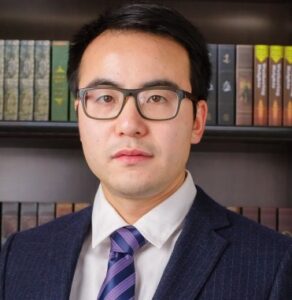
Jinghan (Michael) Zeng is a professor in the Department of Public and International Affairs at City University of Hong Kong, and the Founding Editor-in-Chief at the Cambridge Forum on Technology and Global Affairs. Professor Zeng spent 13 years in the UK, where he built his academic career, becoming one of the youngest full professors in Britain, and serving also as Director of the Confucius Institute at Lancaster University (UK). He is a leading expert on AI and global affairs. He is the author of the books “Memoirs of a Confucius Institute Director”, “Artificial Intelligence with Chinese Characteristics: National Strategy, Security and Authoritarian Governance”, “Slogan Politics: Understanding Chinese Foreign Policy Concepts”, “The Chinese Communist Party’s Capacity to Rule”.
Q1 – Nvidia CEO Jensen Huang said on the sidelines of the Financial Times Future of AI Summit in London that “China will win the race for artificial intelligence.” Huang believes that the Chinese are already only “nanoseconds” behind the Americans and well positioned to overtake them, although US artificial intelligence could still prevail. What is your opinion? Has artificial intelligence become a major battlefield between the US and China? Is the AI race between the two countries entering into a new and more intense phase aimed at AI supremacy?
A1 – It is certainly true that AI has become a major battlefield that is not only affected by US-China competition but also actively shaping it. I also agree that their race has entered a more intense stage especially after the release of ChatGPT, which started a new generative AI race – it consists of a race for innovation in best generative AI and a race for governance on who writes the future rules for AI. However, I do not think that China will win for sure. In the US, the AI industry is tempted to say this as the China win narrative is in their favor to get more support and resources.
Q2 – China’s access to advanced artificial intelligence chips is a critical point in its technological rivalry with the United States. The Chinese government has just issued guidelines requiring new data center projects that have received state funding to use only domestically produced artificial intelligence chips. What are the reasons behind this new regulation? Would it negatively affect US chip manufacturers Nvidia, AMD, and Intel, while favoring Chinese manufacturers of artificial intelligence chips such as Huawei? In general terms, are US controls on exports of advanced semiconductors and other artificial intelligence hardware effectively slowing down the progress of Chinese artificial intelligence, or are they instead inadvertently promoting China’s self-sufficiency and domestic innovation?
A2 – It is mostly driven by the idea of self-reliance that views relying on foreign technology as a risk. Chinese domestic actors have also lobbied for this for their own interests as a protected market certainly helps. In the short term, the US chip restrictions certainly slowed down China’s AI progress, however, it also forced China to create an independent AI eco-system, which has made considerable progress. In the long run, American policies are likely to backfire.
Q3 – The “AI Plus” initiative is a comprehensive strategic plan launched by the State Council of China in August 2025 to promote the deep integration of artificial intelligence (AI) across all sectors of its economy and society, to accelerate the development of an intelligent economy and society, boost productivity, modernize industries, and enhance the country’s global competitiveness in AI. How relevant could this initiative be for China’s economic and technological progress?
A3 – This is indeed a slogan that aims to mobilize Chinese domestic actors to adopt AI. It is not a clear strategy, but it does help to arouse awareness of the importance of Ai across China.
Q4 – What role does China play in international AI standards bodies, and how does it attempt to shape global AI governance norms?
A4 – For sure, China wants to write rules for global governance in not only AI and technology. However, my previous research indeed argues that its influence is limited and hardly matches its ambition.
Q5 – Could it be possible for the United States and China to find a common ground on AI governance? And if so, which specific areas might offer the most promising prospects for bilateral dialogue and potential cooperation?
A5 – I think it is not only possible but also a must. The risk of not having cooperation will be very dangerous to human society. When you think about the integration of AI in nuclear weapons systems and biotechnology, the US and China need to work together to avoid the worst from happening. I would go for nuclear weapons systems and biotechnology first.
Q6 – You served as Director of the Confucius Institute at Lancaster University and are recounting your experience there in an autobiographical trilogy, Memoirs of a Confucius Institute Director, the first volume of which was published in August 2025. The Confucius Institute is the most important Chinese cultural institution abroad. In your opinion, will artificial intelligence change the way cultural diplomacy is conducted?
A6 – Maybe in the long run but not in the short term.
Jinghan (Michael) Zeng – Professor in the Department of Public and International Affairs at City University of Hong Kong.