



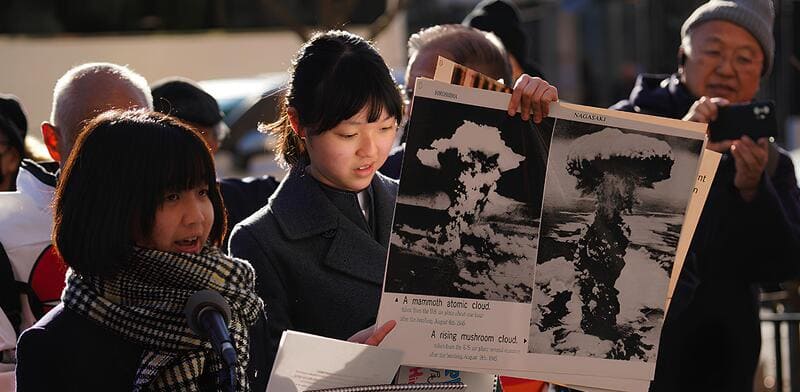
The year 2025 marks the 80th anniversary of the atomic bombings of Hiroshima and Nagasaki and the end of World War II.

It also marks the 70th anniversary of the founding of Nihon Hidankyo, the Japanese Confederation of A- and H-Bomb Sufferers Organizations, winner of the 2024 Nobel Peace Prize. In the 70 years since its founding, Nihon Hidamkyo has upheld the fundamental goals of preventing nuclear war, banning and completely abolishing nuclear weapons, and providing solidarity to support the victims of the atomic bomb. Together with survivors of the nuclear holocaust, it has appealed to the world about the inhuman nature of atomic weapons and raised public awareness in favor of a movement to abolish nuclear weapons. Now, 80 years after Hiroshima and Nagasaki, this movement has become a national consciousness for a world without nuclear weapons and a peaceful Japan.
Japanese citizens and anti-nuclear movements in particular have committed themselves to: 1) responding to the growing international sympathy and national support following the award of the Nobel Peace Prize to the Japanese Council Against Atomic and Hydrogen Bombs and working with atomic bomb survivors to promote the anti-nuclear movement and transform it into a national movement; 2) significantly promote the struggle to realize a world without nuclear weapons and a peaceful Japan free of nuclear weapons, both nationally and internationally; and 3) create opportunities for younger and future generations to play an active role in all activities and build a leading organization in the movement.
The Treaty on the Prohibition of Nuclear Weapons, the testimonies of survivors of the atomic bombs dropped on Hiroshima and Nagasaki, and the humanitarian approach are exerting great power in countering the supporters of nuclear weapons. If this trend can be further expanded, the prospect of nuclear abolition will open up. The Treaty on the Prohibition of Nuclear Weapons was adopted by a UN conference on July 7, 2017, opened for signature in New York on September 20, 2017, and entered into force on January 22, 2021, 90 days after ratification by at least 50 states.
The war in Ukraine, the fighting in Gaza and the Middle East, and Russia’s revision of its nuclear doctrine pose dangerous threats because they imply the possibility of an escalation involving the use of nuclear weapons. East Asia is also the focus of attention: with relations between Taiwan, the United States, and the People’s Republic of China; the current tensions on the Korean peninsula; the movement of the military bloc led by Washington and the massive military buildup that includes Japan. These conflicts between blocs and the dangerous military versus military vicious circle are dividing the world and threatening peace.
On January 20, 2025, the Trump administration took office; in his inaugural address, the president upheld the principle of ‘America First’ and pledged to build the strongest military in the world. During his first term, in 2017, he withdrew from the 1987 Intermediate-Range Nuclear Forces Treaty, and in 2018, in the Nuclear Posture Review (a process aimed at determining what the role of nuclear weapons should be in the security strategy of the United States of America), he proposed nuclear retaliation against non-nuclear attacks, including cyberattacks, and proposed the development of a more compact and easier-to-use nuclear warhead. Given the current critical situation, there is a risk that the Trump administration will further accelerate these actions. However, today’s world is not determined solely by the words and actions of the US president. The main path to global peace is the peaceful resolution of conflicts on the basis of the UN Charter and international law, as well as the abolition of nuclear weapons.
As indicated by the G20 Declaration in Rio de Janeiro (November 18-19, 2024), whether it be the war in Ukraine or the situation in Gaza and the Middle East, most countries on the international political scene have joined together in calling for an end to the threat or use of force in international conflicts, the safeguarding of sovereignty and territorial integrity, and peace, and are increasingly siding with the United Nations Charter rather than military blocs or nationalism.
To resolve military tensions on the Korean Peninsula and issues in Northeast Asia, a popular movement has emerged that combines nuclear disarmament and peace, with the goal of building peace in East Asia.
A beacon of hope is the aforementioned Treaty on the Prohibition of Nuclear Weapons, which embodies the cause of humanity. Despite obstructionism by nuclear powers and other parties, the number of signatories to the Treaty on the Prohibition of Nuclear Weapons has increased to 95, and the number of countries that have ratified it has risen to 74. Even in a dangerous situation where the use of nuclear weapons is being discussed, the Treaty, public opinion, and the movements that support it have normative power and act as a barrier preventing the use of nuclear weapons.
On December 10, 2024, as already mentioned, Nihon Hidankyo received the Nobel Peace Prize. The Nobel Committee praised the contribution of the atomic bomb survivors—who experienced nuclear hell—in recounting their experiences and thus helping to create public opinion that discourages the use of atomic weapons.
What matters is that the continued insistence of the atomic bomb survivors—that nuclear weapons are weapons of absolute evil that cannot coexist with humanity has shifted nuclear disarmament negotiations, previously conducted exclusively from the perspective of national security, toward a discussion focused on the inhumanity of these weapons of mass destruction, leading to the creation of the aforementioned Treaty on the Prohibition of Nuclear Weapons. As a humanitarian approach focused on the inhumanity of nuclear weapons, it has become a fundamental critique of the theory of nuclear deterrence and represents a force that is putting pressure on states with nuclear arsenals. The voices of the bomb survivors have played a decisive role.
The power of a humanitarian approach was also demonstrated by the new resolutions of the 79th UN General Assembly, which began on September 22, 2024. The resolution to promote a treaty banning nuclear weapons was passed by a large margin of 127 votes in favor and 44 against, despite resistance from the nuclear powers. The resolution on the consequences of nuclear war and scientific research, which aims to clarify the consequences of nuclear war using the latest scientific knowledge, was approved by 144 votes in favor, 3 against, and 30 abstentions: Russia, the United Kingdom, and France voted against, the United States abstained, and the People’s Republic of China voted in favor. The resolution on assistance to victims and environmental remediation from nuclear use and testing was approved with 169 votes in favor, 4 votes against (Russia, the United Kingdom, France, and the Democratic People’s Republic of Korea [North Korea]), and 6 abstentions, including the United States and the People’s Republic of China. Against this backdrop, movements within nuclear-powered countries and their military allies are taking new measures to peacefully resolve conflicts, oppose military blocs, and abolish nuclear weapons.
Last fall, tens of thousands of people participated in a peace demonstration in Germany and Sweden (which joined NATO on March 7, 2024), and a campaign was launched against the construction of US military bases. In the US, support for a treaty banning nuclear weapons is also growing among civil society movements, local governments, parliaments, and federal legislators.
Last December, Democratic Representative Jim McGovern (Massachusetts) announced in Congress that he had drafted Resolution 77 (co-sponsored by 43 of his colleagues) calling on President Trump to support the objectives and provisions of the Treaty on the Prohibition of Nuclear Weapons and to place nuclear disarmament at the center of Washington’s security policy. He also cited the Nobel Peace Prize awarded to Nihon Hidamkyo and called for a congressional debate on the issue of nuclear test victims in the United States of America.
In the Republic of Korea (South), hundreds of thousands of citizens rebelled in response to President Yoon Suk Yeol’s declaration of a state of military emergency (May 10, 2022-April 4, 2025), foiling the coup and forcing the president to be impeached. The citizens who demanded democracy won.
Just as the Treaty on the Prohibition of Nuclear Weapons recognizes that the equal participation of women and men is essential for sustainable peace and security and aims to support and strengthen the effective participation of women in nuclear disarmament, women’s and national movements in Japan and around the world, which have integrated peace and gender equality, are making progress in the fields of peace and disarmament.
The delegation to promote the voices of atomic and hydrogen bomb survivors and the Treaty on the Prohibition of Nuclear Weapons, sent to Spain and France starting on January 15, 2025, by the Japan Council Against Atomic and Hydrogen Bombs (Gensuikyō) – a Japanese NGO founded in 1955 – has attracted attention everywhere, and the testimony of atomic bomb survivor Tanaka Shigemitsu, representative of Nihon Hidamkyo, about his experiences at the time of the bombing has caused a great stir.
The delegation’s activities included a speech by atomic bomb survivor Tanaka about his experience during the atomic bombing to all citizens, including children and students, as well as to the government, political parties, parliamentarians, and local governments, in order to spread awareness that nuclear weapons and humanity cannot coexist and to call on the governments of Paris and Madrid to join the Treaty on the Prohibition of Nuclear Weapons. The pacifist movements in both countries were surprised by the large number of citizens who participated in the demonstrations and attracted media attention, and the delegation managed to reach an unprecedented number of people, including politicians and local leaders, both nationally and locally.
Another noteworthy aspect of the delegation’s visits was that many local governments welcomed them and organized meetings to hear the testimonies of atomic bomb survivors. Not only Tanaka’s testimony, but also Gensuikyō’s appeal to governments to adhere to the Treaty on the Prohibition of Nuclear Weapons and the appeal by the vice president of the Japanese Trade Union Confederation (Zenroren), Toshiaki Ishikawa, for a peaceful and diplomatic resolution of conflicts, rather than nuclear versus nuclear or military versus military, had the opportunity to speak and were well received on every occasion. This joint action with Spain and France had an impact on public opinion and politics in both countries, contributing to the promotion of the Treaty on the Prohibition of Nuclear Weapons.
The third conference of the parties to the Treaty on the Prohibition of Nuclear Weapons was held in New York from March 3 to 6, 2024, coinciding with Nuclear Weapons Prohibition Week. The event reinforced the commitment to the total abolition of nuclear weapons, criticizing the theory of nuclear deterrence and emphasizing the need for greater adherence to the treaty. The conference also announced the first Treaty Review Conference, to be held at the United Nations headquarters in New York from April 29 to May 9, 2026. These opportunities will be used to promote joint international action and to unite in spirit with the First World Conference Against Atomic and Hydrogen Bombs held in Hiroshima in 1955 and the Second held in Nagasaki in 1956, with a commitment to realize a world free of nuclear weapons.
On the 80th anniversary of the atomic bombing, attention is focused on ensuring that the Japanese government plays a role befitting the only country to have suffered nuclear attacks. New conditions are also emerging for the development of public opinion and a movement aimed at achieving this goal. It is necessary to literally overcome ideological and political differences and take a leap forward in the national and global movement.
However, the Japanese government has strengthened its dependence on the US nuclear umbrella and, under the pretext of strengthening its deterrent power, has pushed forward with historic changes in the military alliance between Tokyo and Washington, including massive military expansion, the acquisition of strike capabilities against enemy bases, the militarization of Okinawa and the southwestern islands, support for the US nuclear strategy, including the holding of a Japan-US ministerial meeting on extended nuclear deterrence, and the creation of a joint operational command to unify the command of the land, sea, and air self-defense forces, placing the self-defense forces under the command of the US military.
The government of Shigeru Ishiba (October 1, 2024-October 21, 2025) inherited in its entirety the pro-US policy of the administrations of Shinzō Abe (September 26, 2006-September 26, 2007, December 26, 2012-September 16, 2020) and Fumio Kishida (October 4, 2021-October 1, 2024) and pursued an extraordinary military expansion, greatly strengthening Japan’s ability to directly attack enemy bases in other countries, which violates the Constitution, and furthermore, allocating military spending of over 8.7 trillion yen in the 2025 budget, the highest ever recorded.
In order to strengthen the US nuclear umbrella, or nuclear deterrence, the Japan-US Extended Deterrence Dialogue was held on June 5 and 6, 2025. The meeting focused on strengthening cooperation and joint deterrence, particularly in response to growing regional tensions, such as threats from the Democratic People’s Republic of Korea (North Korea) and the military activities of the People’s Republic of China (China). The bilateral talks focused on: strategic coordination to respond to potential threats, strengthening military and intelligence cooperation, and improving the joint defense posture through military exercises and information sharing. Japan and the United States of America also pledged to support non-proliferation efforts and maintain a stable and secure Pacific region.
It was noted that the Ishiba administration’s attitude of turning its back on the Treaty on the Prohibition of Nuclear Weapons is evident. On January 24, 2025, in his policy speech at the 217th regular session of the Diet, Prime Minister Ishiba did not say a single word about the Nobel Peace Prize awarded to Nihon Hidamkyo or the Treaty on the Prohibition of Nuclear Weapons, instead announcing the further strengthening of the Japan-US military alliance (the nuclear umbrella). Furthermore, the Japanese government was not officially present at the aforementioned third conference of the States Parties to the Treaty on the Prohibition of Nuclear Weapons. Instead, the following Japanese organizations were present: Hidankyo/Hibakusha Organization of Japan, Hiroshima Prefectural Government, Japanese Congress Against Atomic and Hydrogen Bombs, Japanese NGO Network for the Abolition of Nuclear Weapons, Japanese Liaison Council of Second-Generation Atomic Bomb Survivors, Know Nukes Tokyo, New Japan Women’s Association, Nihon Hidankyo, Japan Council Against Atomic and Hydrogen Bombs (Gensuikyo).
The government has taken a servile stance, following the United States of America, tacitly accepting President Trump’s statements to further strengthen extended deterrence and substantially enhance defense capabilities beyond fiscal year 2027.
To ensure that the Japanese government plays a role befitting a country that has suffered atomic bombings, it must end its dependence on US nuclear deterrence and ensure compliance with the Treaty on the Prohibition of Nuclear Weapons.
The October 27, 2024 general election saw the ruling Liberal Democratic Party’s share of the vote fall from 34.66% in 2021 to 26.73%. This has ushered in a new political process in which citizens are exploring and seeking new paths. There is now an opportunity to prevent the path to war by promoting peaceful diplomacy based on Article 9 of the Japanese Constitution, in force since May 3, 1947:
(a) Sincerely aspiring to international peace based on justice and order, the Japanese people forever renounce war as a sovereign right of the nation and the threat or use of force as a means of settling disputes with other nations.
(b) In order to realize the aspiration set forth in the preceding paragraph, the maintenance of land, sea, and air forces, as well as other war potential, will never be authorized. The right of the State to wage war shall not be recognized.
In Japan, public opinion is moving away from the theory of nuclear deterrence and toward a political system that will sign and ratify the Treaty on the Prohibition of Nuclear Weapons. The key to unlocking this potential lies in the development of public opinion, movements, and a national coalition.
Author: Giancarlo Elia Valori – Honorable de l’Académie des Sciences de l’Institut de France, Honorary Professor at the Peking University, and President of the Foundation for International Studies and Geopolitics. He plays a leading role in fostering dialogue and cooperation between countries.
(The opinions expressed in this article are solely those of the author and do not necessarily reflect the views of World Geostrategic Insights).
Note: This article, like all articles published on World Geostrategic Insights, cannot be republished without the written permission of the editor of World Geostrategic Insights.
Image Credit: OSV News/Gregory A. Shemitz