



By Sean Philip-Corbett Nottoli
KEY POINTS:
– Misunderstanding of Global Dynamics: China’s leadership is misreading the geopolitical landscape, focusing on competition with the U.S. while failing to recognize its deteriorating relationships with other nations, particularly in Europe, which are increasingly driven by ideological commitments to democracy.
– Failed Expectations in Diplomacy: Beijing’s expectations for cooperative relations with Europe were dashed during the recent China-EU summit, revealing significant disagreements, especially on issues like human rights and the Ukraine war, which caught Chinese representatives off guard.
– Economic vs. Ideological Focus: The U.S. approach to China under the Trump Administration prioritizes economic concerns over ideological battles, with many Americans viewing China as a competitor rather than an ideological enemy, contrasting with China’s framing of the rivalry as a Cold War-like ideological struggle.
– Implications for Future Relations: As China miscalculates the nature of its competition with the U.S. and the EU’s ideological stance, it faces a strategic misalignment that could hinder its foreign policy and economic ambitions, while the U.S. and Europe continue to prioritize pragmatic economic and security interests.
China’s leadership has a grave misunderstanding of the reality of the world and the current geopolitical situation.
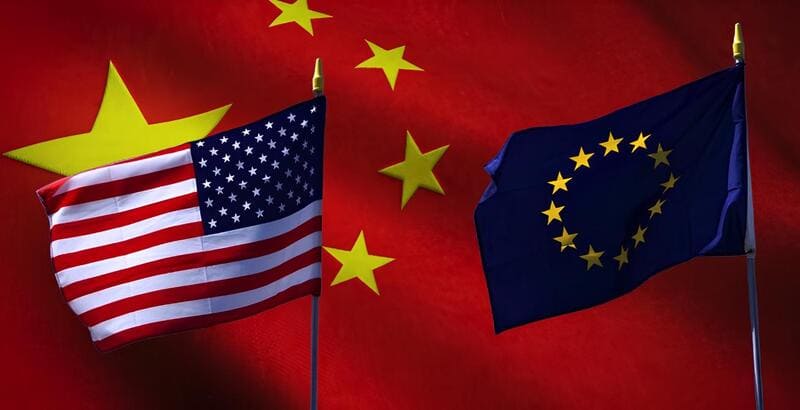
Being so focused on its competition with the United States, it has blinded itself to the true nature of its standing with nations around the world. In preparation for its race with the US in attempts to replace it as the dominant global power, it has prepared for an ideological competition reminiscent of the Cold War: Communism vs Capitalism. It has gambled that while it wages an ideological battle with the United States, it would find pragmatic partners in Europe. In reality, Beijing has found the opposite to be true. Under the current Trump Administration, it has found a pragmatic US focused on correcting what it has perceived as horrendous trade imbalances and a Europe that is ideologically dedicated to the spread of democracy and downfall of authoritarianism worldwide.
This should not be a surprise for anyone, least of all Beijing. With Americans growing tired of foreign entanglements overseas and Brussels having to contend with an aggressive Russia waging war in Ukraine, it should be apparent that Europeans are becoming more ideologically driven against what they perceive as autocracy, and that Americans just want a sound foreign policy.
This misconception ultimately led to the disastrous summit between China and the EU this past summer, which ended early due to significant disagreements. The affair should have been extremely cordial, as Beijing had expected, as the summit coincided with the 50th anniversary of EU-Chinese relations under the PRC. By all accounts, it seems that Chinese representatives present at the meetings were taken off guard by European Commission President Ursula von der Leyen and European Council President Antonio Costa and their hawkishness on the Ukraine war and human rights concerns, particularly in Xinjiang and Tibet.
Beijing should not have been so surprised. As early as 2021, factions within the EU have been demanding that investment agreements between China and the EU should be placed on hold as they investigate allegations that the current regime in China was committing crimes against humanity. These views were reinforced by a press release issued by the EU after the collapse of the 25th EU-China Summit, in which it cited serious concerns about human rights and the erosion of fundamental freedoms in Hong Kong.
At the same time, President Trump has kept the conversation pragmatic. While the Trump Administration has aggressively pursued an “America First” policy to rebalance trade between the US and China, it can’t be compared to the ideological struggle between the US and the USSR during the Cold War, which is precisely what Beijing has prepared for. President Xi Jinping has long highlighted this ideological struggle since the beginning of his tenure as leader of China, and has worked to make this struggle a central theme of China’s competition with the United States.
As far back as 2013, President Xi has publicly decried what he’s described as Western attempts to ideologically infiltrate China and divide it from within. In his now-famous August 9 speech, President Xi laid out the threats to the CCP from Western ideological infiltration into China and stressed the necessity to not only safeguard China from these ideas but also to confront what he described as “Anti-China forces.” In 2022, he reaffirmed the necessity for the ideological struggle, pointing out what happened to the Soviet Union. He stated, “Once ideological defenses are breached, other defenses become very difficult to hold,” as reported by Foreign Policy.
Beijing has prepared for the wrong race and has got the script flipped. The emphasis from the United States on the issues facing the US-Chinese relationship is not about ideology but rather about dollars and cents. From the general American perspective, there isn’t any contention with China because it is a Communist state, but rather because Americans believe that China has been taking advantage of the US economically, and they want to correct that imbalance. This is exemplified in a recent study conducted by the Pew Research Center, where 61% of American adults under 30 stated they saw China as a competitor, not an enemy. That same study concluded that the unfavourability of the perception of China among both Republicans and Democrats fell by 8 and 5 points, respectively, this past year.
This isn’t to say that there aren’t serious problems to contend with in the US-Chinese relationship. The concerns of China’s explosive naval growth and growing aggression in the South China Sea, its pressure campaigns on Australia, such as the surprise live fire exercises in the Tasman Sea this past February, and the continued threat to militarily invade Taiwan are major points of contention, to say the least.
However, it’s clear that the primary motivation for the US’s policies towards China is the pragmatic desire to achieve greater economic prosperity for the American people and ensure the peace and stability of the Indo-Pacific region. There is nowhere near the ideological drive on Communism vs. Democracy that existed during the Cold War between the United States and the Soviet Union, as Beijing has assumed there would be. In this context, China has hedged its bet incorrectly and now faces an ideologically driven Europe that has married its principled-based concerns with its economic ones, and a United States driven by practical economic and security concerns.
Only time will tell how long Beijing will continue to be guided by these misperceptions of reality and how quickly it will adapt. For the moment, it seems we will continue to see China focus on safeguarding its ideological strength from phantom menaces from America. Meanwhile, the US will continue to pursue its America First policies and rebalance its trade partnerships with the world.
Author: Sean Philip-Corbett Nottoli – Expert in American and conservative politics with over a decade of experience in campaign management and consulting across the United States. He served as a director in Trump’s last presidential campaign. He has also worked for five years with civil society organizations to promote democracy around the world. Sean has published articles on a variety of global topics in various formats, ranging from security policy in the Baltic region to Russian military strategy and events on the Korean peninsula in China, Japan, and other regions. His research interests include global security issues, state sovereignty, and great power competition. He is currently a Visiting Fellow at the Danube Institute in Budapest, Hungary.
(The views expressed in this article belong only to the author and do not necessarily reflect the views of World Geostrategic Insights).