



By Muhammad Naseem
China’s agreement to sign the Protocol to the Southeast Asia Nuclear-Weapon-Free Zone (SEANWFZ/“Bangkok Treaty”) marks a significant policy shift in regional non-proliferation politics, especially in relation to the U.S. Indo-Pacific strategy.

The SEANWFZ Treaty (1995) requires ASEAN members to disarm their territories of nuclear weapons, while the Protocol encourages the five NPT nuclear-weapon states to commit not to use or threaten to use nuclear weapons in the zone. China’s foreign ministry has clarified that China is willing to become the first signatory to the Protocol of the SEANWFZ Treaty and has expressed its commitment to the development of SEANWFZ.
There are three key arguments that guide us in understanding the Beijing move and its implications for Washington’s Indo-Pacific strategy. They are as follows:
Firstly, the action acts as a normative and diplomatic signal that enhances China’s soft power in Southeast Asia and challenges the idea of a purely military-based balance of power. Publicly supporting a regional nuclear-free instrument without reservations positions China as a cooperative major power in arms control. China’s role aligns with its long-standing support for nuclear-weapon-free zones in Beijing and is consistent with its no-first-use policy. This normative leadership could influence diplomacy within ASEAN forums, where major-power rivalry is often moderated by the preferences of smaller states. The repeated statements by ASEAN emphasising their interest in elevating the profile of SEANWFZ strengthen this dynamic.
Second, the operational consequences of China’s accession to the region have a tangible impact on U.S. military and deterrence calculations. If the five nuclear-weapon states sign, the SEANWFZ Protocol would impose an illegitimate ban on the placement or transit of nuclear weapons over the EEZs and continental shelves of coastal states, which would include parts of Southeast Asian waters and airspace. This could potentially restrict certain U.S. force postures or operational flexibility. While Washington may see their current extended deterrence guarantees as compatible with such a Protocol, political and allied concerns about limiting U.S. presence could complicate alliance management. It is to be noted that the United States is also reassessing the treaty, while China has shown willingness to sign, presenting a diplomatic opening that Washington cannot afford to ignore.
Third, the formation presents a set of risks and opportunities for arms-control diplomacy between Washington and Beijing. On one hand, the fact that SEANWFZ is accepted by China but not by other P5 members may allow Beijing to portray the U.S. as less committed to regional non-use agreements, which could undermine the U.S. normative credibility in Southeast Asia. Conversely, SEANWFZ provides a pragmatic and cost-effective confidence-building space: if the U.S. were to adopt a constructive role, such as clarifying legal interpretations, negotiating texts, or offering assurances consistent with its alliance commitments, the treaty could serve as a platform for crisis management and transparency between the U.S. and China, reducing the risks of misperception. This paradox makes SEANWFZ both a diplomatic instrument and a potential avenue for limited cooperation on arms control.
What should the response of the United States entail under its strategy in the Indo-Pacific? The above-mentioned strategic logic of alliance management leads to the three measured policy lines based on the above facts.
1 – Debate, don’t instinctively object: To recognise that ASEAN owns SEANWFZ and that China publicly expresses its desire to sign, a reactive U.S. refusal would give Beijing and ASEAN-promoting states the upper hand in completing the treaty. Positive engagement, such as legal consultations, clarification and consensus-building with allies, and participation in protocol negotiations, sustains U.S. influence. The U.S. Indo-Pacific strategic documents emphasise deterrence and alliances; arms-control diplomacy can support these aims when well-calculated.
2 – Reassure allies on long-range deterrence and legal arrangements: The United States should also reassure its treaty allies (especially the Philippines, but also those with close security ties) that deterrence and conventional access will remain unaffected. At the same time, Washington should consider formulating legal statements or interpretive insights that balance alliance commitments and Protocol requirements, such as narrowly defined declarations that can support routine non-nuclear operations and affirm non-use within ASEAN states.
3 – Rely on SEANWFZ as a credibility builder: In every possible case, Washington should view Protocol negotiations as a tool to institutionalise transparency measures (notification, hotlines, practices compatible with verification) that can reduce the risks of crisis escalation. This approach turns the potential limitation into a strategic asset: norms that reduce nuclear ambiguity can help lower tensions in other areas.
The prominence of Chinese experts in leading the development of SEANWFZ is crucial because it changes the rules of normative competition, shows the dynamics that could limit the freedom of movement within Southeast Asia, and establishes practical channels such as limited arms-control diplomacy. For the United States, the tactical challenge is to ensure that credible deterrence and reassurance capabilities are paired with proactive diplomacy, effectively depriving Beijing of an easy discourse advantage and supporting the operational and political foundation of U.S. presence in the Indo-Pacific.
Author: Muhammad Naseem – Researcher and analyst, graduate in International Relations from NUML, Islamabad, Pakistan.
(The views expressed in this article belong only to the author and do not necessarily reflect the views of World Geostrategic Insights).
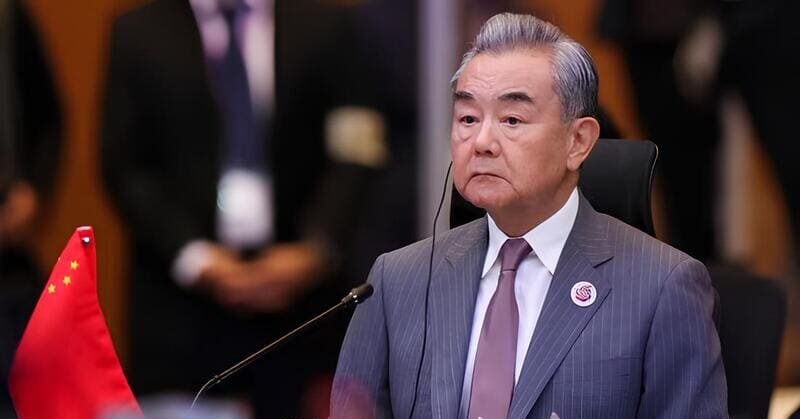
Image Credit: AFP (China’s Foreign Minister Wang Yi is attending the ASEAN meeting in Kuala Lumpur).