



By Muhammad Naseem
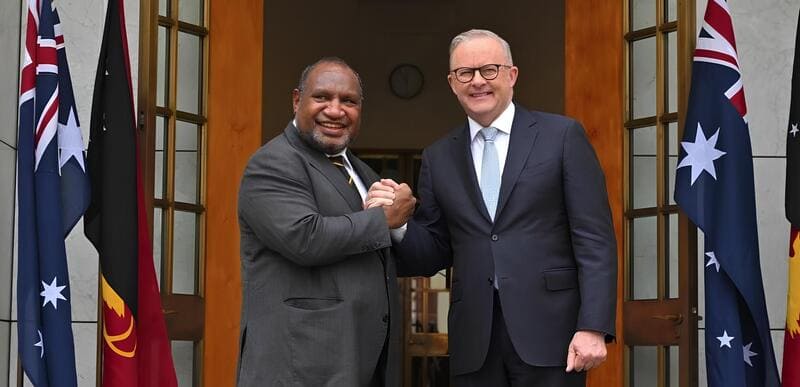
The declaration of the Pukpuk Treaty between Papua New Guinea and Australia can be seen as a significant shift in the security order in the Pacific.

Where small states have traditionally been regarded as passive players in the competition among larger states, PNG’s role in initiating, shaping, and negotiating this treaty indicates the growing agency of small states in the Asia-Pacific. In PNG, the Pukpuk Treaty not only strengthens its defence relationship with Australia but also prompts a realignment of Australian strategy and influences how major powers like China, the United States, and others engage in the regional security structure. The treaty demonstrates that small states are not merely reactive; they can take the initiative to defend their interests and manage the challenges of superpower competition.
The Pukpuk Treaty reflects how PNG is repositioning itself strategically due to limited capacity, geographic vulnerability, and internal security pressures. PNG has recognised its weaknesses in defence forces, including border patrol, sea patrols, internal security. police, and the equipment and software of its defence (training, doctrine, etc.). The treaty will address these gaps by enhancing capacity, fostering interoperability with Australia, exploring recruitment of PNG staff into the Australian Defence Force (ADF), promoting joint training, and modernisation efforts. By requesting the treaty, PNG is not merely accepting foreign assistance but choosing a partner and clearly defining the nature of cooperation, with its sovereignty as a central concern.
The political elite in PNG is using the treaty as a tool to influence the broader competition between the great powers. Part of the treaty’s design is a clear strategic counter-pressure by Australia against the rising Chinese influence in the Pacific. Canberra is concerned that China’s growing influence through trade, investment, infrastructure, or even security arrangements with Pacific nations could pose a threat to Australia along its northern borders.
The Pukpuk Treaty thus becomes a key part of Australia’s strategy to secure its neighbourhood. However, PNG has not simply been passive: its foreign affairs ministry has explicitly stated that the treaty will not include a third-party cooperation exception, and that PNG retains its constitutional right to engage in defence cooperation with other countries. This balancing act allows PNG to welcome Australian protection and investment while also trying to preserve flexibility in its foreign policy.
The Pukpuk Treaty shows how legal, constitutional, and domestic political constraints can serve as practical tools for small states to influence great powers. In Papua New Guinea, there is an ongoing debate: recently, retired Major General Jerry Singirok has questioned concepts of sovereignty, non-alignment, and constitutionality, specifically whether integrating the PNG Defence Force into ADF structures or adopting Australian military doctrine would be unconstitutional under PNG law. Papua New Guinea also issues warnings that public consultation, parliamentary ratification, and legal safeguards are practical considerations. These constraints suggest that Australian strategic ambitions are not pursued unconditionally but require negotiation and moderation. PNG is leveraging its internal political processes to ensure its interests are protected. This demonstrates that small states are not merely vassals but hold significant agency through institutional rules, constitutional mechanisms, and civil-military relations.
The treaty reshapes how we view alliances and security in the Pacific. Currently, Australia has only a few formal mutual defence treaties; the Pukpuk Treaty will be the first new treaty-level defence alliance in Australia in over 70 years. This indicates a shift from informal security cooperation, training, aid, and soft security towards more formalised mutual defence commitments. For the Pacific, this means smaller states seeking or open to such formal agreements gain greater bargaining power, more reliable security arrangements, and improved access to resources. It also increases the stakes in the power competition: any formal alliance is likely to provoke counter-measures by other major powers. In fact, China has already warned PNG not to sign a treaty that restricts collaboration with other nations and stressed the importance of maintaining sovereignty and decision-making independence.
Being this close to Australia will limit PNG’s options, potentially tying it to Australia’s strategic interests, which may not align with those of PNG and leaving PNG vulnerable to diplomatic repercussions in its dealings with China or other global powers. There is also a constitutional risk: PNG’s legal framework might have to balance issues such as dual staffing, foreign military doctrine, foreign operational control, or access to bases. The treaty must protect PNG’s sovereignty while enabling productive cooperation. Additionally, there is a domestic political risk: a perception of lost sovereignty or involvement in an unwanted conflict could provoke public and political instability.
The case of PNG signals that small states are no longer just battlegrounds, but active creators of regional order. By taking the lead and signing such a treaty, PNG clarifies what it requires regarding defence cooperation, sovereignty safeguards, and strategic balance. Using domestic legal procedures (parliamentary ratification, constitutional review, popular debate), PNG ensures that any potential arrangement is stronger than past cooperation and aligns with its long-term interests. Other Pacific small states will observe this: it may encourage them to pursue more formal engagements and specific defence partnerships instead of informal or ad hoc arrangements.
Author: Muhammad Naseem – Researcher and analyst, graduate in International Relations from NUML, Islamabad, Pakistan.
(The views expressed in this article belong only to the author and do not necessarily reflect the views of World Geostrategic Insights).