



By Muhammad Naseem
The signing of a mutual defense agreement between Saudi Arabia and Pakistan on September 17, 2025, is the inevitable consequence of a long-standing strategic relationship.
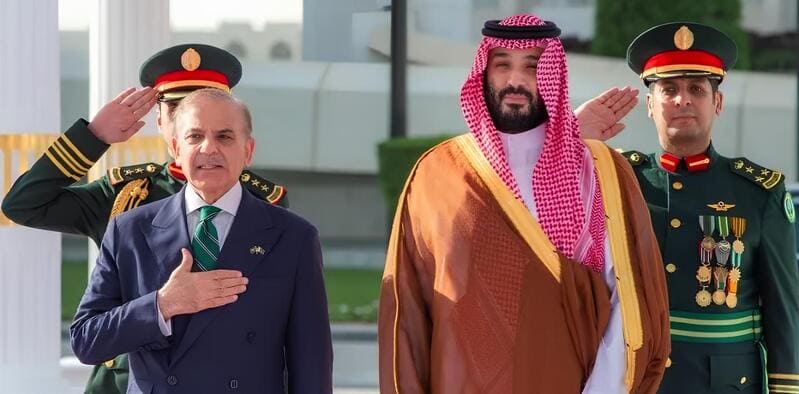
On paper, the agreement appears to be a mutual deterrence pact: it states that aggression directed against either of the two countries will be regarded as an aggression against both, and it is committed to evolving relevant aspects in the area of defence cooperation and enhancing mutual deterrence in case of any aggression. They are words of deliberate choice, and they are intended to send signals outside Riyadh and Rawalpindi. It is not just an issue of whether the treaty alters the tricky balance of power in South Asia, but how India should react to the political and diplomatic fallouts of a Saudi-Pakistan security convergence.
The interpretation of the pact as a bilateral memo in isolation gives it a regional logic too little credit. Pakistan’s relationship with Saudi Arabia has been developed over several decades of military co-operation, financial transfers, training activities and intermittent security assurances – a relationship that has long pre-dated this formalisation.
Gulf concerns about the permanence of US security guarantees in the wake of shocks in the region, such as the airstrike against Doha and other incidents that have led to an escalation in recent months, have intensified Gulf efforts to diversify security arrangements. To Riyadh, an open and institutionalised relationship with Islamabad would provide a political declaration of Sunni unity as well as the practical value of preventing the destabilisation of a volatile neighbourhood. To Pakistan, the deal unites a patron whose economic and diplomatic support is the centre of the stability of Islamabad.
However, the optics and the plausible strategic implications of this to India are acute. Pakistan is an asymmetric country, in both traditional capability and one with nuclear arms. The revisioned treaty thus creates both acute normative and diplomatic concerns within New Delhi: will the security assurances of Riyadh in any way be viewed as needing direct interdiction in a South Asian conventional confrontation? Would the closer security commitments with an influential power in the Gulf influence the Pakistani nuclear posture? In both respects, solemn thought warns us not to jump at an alarm, but it is no reason why we should not take our clothes off. The language of the agreement reflects that of collective-defence formulations, and even a declaratory commitment can change crisis perceptions in such a way that complicates the management of escalation.
It is convenient to differentiate between symbolic and operational effects. Symbolically, the agreement redefines political signalling: it is restoring the negative stance of Islamabad, linking it to a Gulf kingdom with economic power and diplomatic weight. On the military side, the short-term military consequences of the pact are more limited. Riyadh has been categorical in conceptualising the notion that the accord changes its relationship with New Delhi; Saudi officials have reiterated that the relationships with India are more stable than ever before. Riyadh had a good economic relationship with India, which in turn is a relationship that Riyadh is not going to risk easily. To put it finely, symbolic and risk transference has increased; there is no immediate likelihood of coalition warfare in South Asia.
This duality is represented in the early diplomatic line adopted by the Ministry of External Affairs; it has stated that it would examine the ramifications of the pact as to the national security of India, whilst stating that it had been aware of such arrangements in the meantime. That considered reaction is right; a deliberate overreaction would benefit the aim of the pact by turning up the rhetoric and creating more convergence between Islamabad and foreign forces. Yet “study” must not mean drift. India has three discreetly challenging issues: deterrence credibility, contingency planning and diplomatic hedging. Both require a cautious, plausible and measured policy response.
First, the credibility of deterrence. India has to give an indication that its defence stance is strong, but not destabilising. That implies additional investment in operational preparedness, modernisation of the forces, and command-and-control resilience – particularly those that minimise the incentives to fast escalation. It also implies more open channels of managing crises. The 2025 cycle of crises in South Asia demonstrated how quickly local events may be turned into wider confrontation; institutionalising hotlines, further development of military-to-military rules and mechanisms of confidence-building will help lessen inadvertent escalation despite the efforts of India to reinforce deterrence. The reassurance of the conventional and nuclear doctrine of India, which is to be received independently and in the framework of a defensive strategy and stabilisation, will help to dull the anxieties of an offensive course, without losing the heads of opponents.
Second, contingency planning. The agreement presents novel political permutations which planners need to add up into new scenarios. What precisely would provoke the political will of Riyadh to convert the pledge into operating support? Would Saudi assistance be monetary, logistical, diplomatic, or (least probably) military? These dissimilarities are vital to the Indian force stance and to escalation ladders. New Delhi then needs to rejuvenate war-gaming, intelligence judgments, and diplomatic back-channels with the Gulf interlocutors to chart probable courses between words and deeds. It will make those situations less obscured and more manageable by developing further information-sharing with partners that have leverage over Riyadh, such as Washington, and states in the Indo-Pacific. The capitals, Washington and others, will want to adopt a measured Indian policy as opposed to being trapped in panic militarisation.
Third is diplomatic hedging. The economic relations of India in the Gulf have intensified over the last few years; Riyadh is a major supplier of energy, an investor and a diversification partner in supply chains. New Delhi ought to, at the same time, assure Riyadh that the bilateral relations will not be affected, but quietly pressurise to seek clarifications on the limits of the pact. The diplomacy of silence—which led to the promises made by the Saudis to India, included in the agreement—is a very powerful tool. India should also leverage its growing relations with Israel, the US, and other Gulf states to have balanced clout and not be marginalized in regional security structures. Riyadh will limit itself to defending itself from bombastic public statements, and calculated engagement will protect India’s interests.
India should not allow a security agreement between two other states to serve as the excuse for domestic politicisation. In India, the pact will be predictably contextualised through the opposition statements; the government will have to reply with policy content but not with party rhetoric. Security is a long game. The Indian mission should aim at transforming the possible liabilities into manageable strategic facts: enhance deterrence, diversify partnership and institutionalise crisis-management mechanisms. That alliance leaves space to work on diplomacy and minimises the possibility that both symbolic relationships become complex military alliances.
The Saudi-Pakistan defence agreement is not a curtain-raiser to an imminent war in the region but a definite sign of an evolving relationship in the strategic calculation of West Asia and South Asia. It is an expression of Gulf demands to diversify assurances, Pakistan’s search for more influential sponsors, and a wider tendency of increasing regional powers to hedge as the U.S. shrinks and the complicated politics of 2025. In the case of India, the trick is to react without emotion: strengthen valid deterrence, modernise contingency planning and engage the quiet diplomacy needed to maintain channels of communication with Riyadh and other Gulf allies. India will have better sailing through the new crescent of security, the more stable the strategy.
Author: Muhammad Naseem – Researcher and analyst, graduate in International Relations from NUML, Islamabad, Pakistan.
(The views expressed in this article belong only to the author and do not necessarily reflect the views of World Geostrategic Insights).
Image Source: AFP