



The idea of reviving the Anglo-Japanese Alliance, which bound London and Tokyo from 1902 until 1922, is making the rounds in policy circles.

The notion has been spurred by Britain’s post-Brexit “Global Britain” ambitions and by Japan’s search for reliable partners in an era of growing U.S. unpredictability under Donald Trump’s second presidency. The symbolism is rich: two island nations, maritime powers, once great allies, rediscovering each other as if history might repeat itself. Yet this is less strategy than fantasy. The supposed “revival” of the Anglo-Japanese Alliance reveals more about nostalgia, illusion, and Britain’s search for relevance than about Japan’s actual security needs.
Tokyo has welcomed London’s overtures with enthusiasm. For Japan’s foreign policy establishment, the alliance label has a certain cachet: it hearkens back to the golden moment when Tokyo, buoyed by victories in the Russo-Japanese War and World War I, first secured recognition as a global power. The partnership with Britain was then a gateway to status, prosperity, and security. Today, Japan finds comfort in the idea that aligning again with Britain complements its alliance with the United States, especially since Britain remains Washington’s closest partner. To Japanese officials, it looks like a safe extension of their decades-long practice of bandwagoning with the U.S. globalist line. But illusions of continuity are dangerous.
Britain is not what it once was. Yes, London still holds a permanent seat on the U.N. Security Council, retains a minimum nuclear deterrent, and wields impressive soft power. Its intelligence services, financial reach, and diplomatic networks—amplified through the Commonwealth and overseas territories—give it more voice than raw force would suggest. Yet this cannot disguise the long decline of British hard power. Through two world wars, the Cold War, and decolonization, Britain steadily shrank from a global hegemon to a mid-sized European power. Today, it must rely heavily on American preponderance to achieve its international aims. The “special relationship” is not a partnership of equals, but Britain’s lifeline to influence.
The consequences are obvious in Britain’s military posture in Asia. Take the recent visit of the U.K. carrier strike group led by HMS Prince of Wales to Japan this August. On the surface, this looked impressive: a symbol of Britain’s global reach. But look closer. The carrier group was padded out with ships from Canada, Spain, Australia, and New Zealand. Its 2021 counterpart, led by HMS Queen Elizabeth II, carried U.S. Marine F-35Bs on board. Britain cannot sustain an independent naval presence in East Asia. Its navy, though boasting two large carriers and nuclear submarines, has only about half as many surface and subsurface combatants as Japan’s own Maritime Self-Defense Force. It also lacks reliable logistical bases of its own in the region. In blunt terms, these deployments are not deterrence but theater—a 21st-century reprise of gunboat diplomacy. They offer little genuine protection against China, whose navy now dwarfs Britain’s and rivals America’s. At best, such gestures serve to showcase “collective will” and amplify political pressure on Beijing, but they do not change the military balance.
Tokyo should not fool itself into thinking otherwise. This is not an alliance, nor even an effective quasi-alliance focusing on fighting a major war. At best, it is an entente—a flexible, temporary understanding in which Britain gains more from Japan than the other way around. London leans on Tokyo to magnify its globalist pretensions and to hedge against U.S. unpredictability. Japan, meanwhile, risks diverting attention and resources from its real priority: shoring up the alliance with Washington against an increasingly assertive China.
The defense industrial partnership offers no better case. The Global Combat Air Program, a joint fighter jet project between Japan, Britain, and Italy, has been heralded as proof of a new Anglo-Japanese bond. Yet here too the imbalance is striking. Tokyo lacks the organizational expertise to steer a complex multinational R&D project and has been unable to secure a leading role. Britain and Italy, bound since 2015 by the Tempest program, already share institutional muscle memory and may sideline Japan when decisions matter. Because contributions are split equally, Tokyo cannot buy itself greater influence. The result is likely to be less technology transfer, fewer industrial gains, and less strategic autonomy than Tokyo hopes. In the name of partnership, Japan risks suffering a relative loss.
Why then pursue this mirage? The answer lies in political theater. Britain, suffering economic stagnation and the political fallout of globalist mismanagement—most recently on full display in the Ukraine war—seeks new stages to project relevance. Japan, anxious about Trump’s wavering defense commitments, clutches at additional partners, even if they offer only symbolic reassurance. London emphasizes globalist values, while Trump’s Washington often repudiates them; Tokyo, caught in the middle, indulges Britain as a hedge. Yet this is a hedge made of paper.
The hard truth is that Japan has neither the capacity nor the interest to overextend itself into European disputes, nor to bankroll Britain’s quest for global stature. Its security environment is overwhelmingly Asian, dominated by China’s rise and North Korea’s unpredictability. Washington remains the only partner with the hard power to matter in East Asia. Britain’s role can be supplemental at best—useful in diplomacy, technology cooperation, and signaling solidarity, but not in delivering actual deterrence.
Sooner rather than later, Japan must strip away the romantic veneer of the “Anglo-Japanese revival” and admit the reality. This is not an alliance; it is a historic fantasy. Tokyo must rigorously evaluate what it gives and what it gets from London, and downgrade its expectations accordingly. Otherwise, Japan risks confusing nostalgia for strategy—and in today’s dangerous world, that is a luxury it cannot afford.
Author: Masahiro Matsumura – Professor of International Politics and National Security at St. Andrew’s University in Osaka (Momoyama Gakuin Daigaku), Japan.
(The views expressed in this article belong only to the author and do not necessarily reflect the views of World Geostrategic Insights).
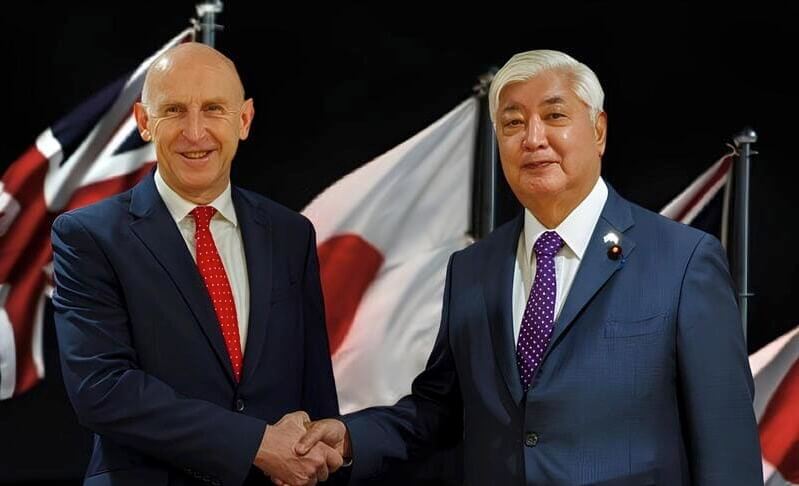
Image: Rt Hon John Healey MP, Secretary of State for Defence of the United Kingdom and H.E. Mr Nakatani Gen, Minister of Defense of Japan.