



Relations between China and India have always oscillated between consonance and dissonance.
Consonance

Among the former, a history that from ancestral times has shown the presence of reciprocal influences. A good example of it was Buddhism’s arrival to China from India. Moreover, the similitude of their historical processes is quite unique. During 1,800 of the last 2,000 years, their economies were the largest of the planet and, as recently as 1820, their combined economic strength represented almost 50% of the world’s GDP. Moreover, in 1750 China and India combined manufacturing production was responsible for 57.3% of the global output, while Europe just accounted for 23.2%.. At that point in time, they represented the “central” region of the world.
However, under the impact of colonialism in India and the “century of humiliation” in China, by 1900 both countries together just accounted for 7% of the world manufacturing output, while by 1950 their combined share of the global GDP just reached 8.8%. Not surprisingly, the leading role played by both countries in the decolonization process and in the emergence of the Non-Aligned Movement in the 1955 Summit of Bandung. (Mahbubani, 2011; Golub, 2006; Gunder Frank, 1994; Srinivasan, 2011).
Moreover, their routes have much in common in this 21th century. As Anil K. Gupta and Haiyan Wang wrote more than a decade ago: “Starkly put, China and India are changing the rules of the global game. They are the two fastest growing economies. Thus, they account for the two biggest growth opportunities for almost any product or service…They are the world’s two largest producers of science and engineering graduates…And finally, they are the breeding ground for a new cohort of ambitious, aggressive, and fast-moving global champions”. (Gupta and Wang, 2009, pp. 2, 3).
Not surprisingly, Jairam Ramesh coined the term “Chindia” when referring to their huge economic potential, geographical proximity, cultural affinity and immense percentage of the world’s population. (Wensham, 2016). And indeed, as the U.S.’ National Intelligence Council recognizes, by 2040 China will be the number one global economy and India the number three, with a combined GDP of almost 30% of the world’s total. (National Intelligence Council, 2021).
Dissonance
But between China and India there is also dissonance. A huge one that expresses itself in borders and geopolitics. Both countries maintain a long-standing territorial dispute in the Aksai Chin and Arunachal Pradesh areas, which have led to periodical high tensions. In 1962, this led to a short war between them, with a minor scale war also in 2017. In 1975, 1987, 2014, 2015, 2017, 2020, 2021 and 2022, military skirmishes also erupted, with multiple casualties in the last of these occasions. Meanwhile, China’s close links with Pakistan are seen as a threat by India who, in its turn, deeply offends Beijing by providing a “government-in-exile” to the Dalai Lama in Dharamshala.
Moreover, China is deploying a blue water navy, which by 2030 could include as much as five or six aircraft carriers. As a matter of fact, with already two operational aircraft carriers, the country possesses the largest war navy in the world, having surpassed that of the U.S. in number of ships and submarines. An important part of it has being deployed in the Indian Ocean, where 80% of China’s oil supplies pass through. This is consistent with China’s official 2015 White Paper in military strategy. According to it, the PLA Navy moved its focus from the near-coasts to “open seas defense”. This includes the concept of “active defense”, whereby operational/tactical offense is an important component. Moreover, the whole nature of China’s military strategy is to prepare for “military struggle”. Meaning, being “able to fighting and win” wars. (The State Council of the People’s Republic of China, 2015).
This, needless to say, is seen as a security threat by India. Especially so, as it directly interacts with the so-called China’s “String of Pearls” strategy, which involves a growing network of military and commercial infrastructures across the Indian Ocean region. Among such infrastructures are China’s built ports of Gwandar in Pakistan, Hambatota in Sri Lanka, Kyaukpyu in Myanmar, and Chittagong in Bangladesh. Fear is that a China hidden agenda might aim at transforming these commercial ports into naval bases. This, in turn, is tied to the notion of “debt-trap diplomacy”, whereby Beijing extends debts to certain borrowing nations with the intention of increasing its political leverage upon them, as exemplified by Sri Lanka’s forceful lease of the Hambanota port to China for 99 years. India’s primary concern, thus, is the potential for strategic encirclement. (Chellaney, 2017, Kumari, 2025).
India’s strategic alignment with the U.S.
Within the correlation of consonance/dissonance factors, the latter ended up prevailing for India. This, undoubtedly, presented a significant strategic benefit for the U.S., within its ongoing Cold War with China. Being able to count India amid its Asian regional allies, within the context of its strategic containment of China, is a fundamental plus for the United States. As Kurt M. Campbell and Jake Sullivan put it: “India’s desire to ensure a free and open Indo-Pacific has led to a strategic alignment with the United States that has effectively disincentivized reckless Chinese adventurism”. (Campbell and Sullivan, 2025).
However, a strategic alignment with India, in relation to China, is by no means an easy task. This, by the simple reason that India has always emphasised its right to maintain an independent and sovereign foreign policy in pursuit of its plural interests. Hence, it can pair with Washington in its containment of China while pursuing other policies that directly contradict America’s interests. Dealing with India, thus, requires political maturity. This was exemplified by the splendid reception offered by President Biden to Prime Minister Modi in June 2023. Notwithstanding the fact that by being an important buyer of Russian oil, India was supporting Moscow’s war effort in Ukraine, Biden decided to put the emphasis where the country’s priority lay: China.
Handling India to China
Asking for that kind of political maturity in Donald Trump is, of course, out of the equation. Imposing a 50% tariff (the largest worldwide jointly with Brazil) on India’s products, because of its buying of Russian oil, is like putting the cart ahead of the horse. Meaning, a complete distortion of America’s priorities. Especially so, when China is not being penalized for being Russian oil’s largest consumer, or when Trump himself was responsible for removing Putin’s pariah status by hosting him in U.S.’ soil. Moreover, humiliating in such a way an old and proud civilization-State, which as recently as the eighteenth century was a “central region” of the world, carries much weight. Especially so, as Western arrogance was responsible for bringing the country to its knees. Indian sensitivities towards that kind of strong-handed bullying cut deep into its national tissue.
However, attributing political reasons to Trump’s decision, notwithstanding how mistaken this could have been, implies giving him too much credit. According to Luke Broadwater and David E. Sanger: “In open pursuit of a Nobel Peace Prize, Mr. Trump claimed that he had ‘solved’ the military conflict between India and Pakistan, angering New Delhi, which denies he had anything to do with a recent cease fire between the two countries. It’s long been of the utmost importance in Indian politics that outside countries play no role in the delicate relationship between New Delhi and Islamabad”. Indeed, by not performing the ritual tributary submission that Trump demands, and that other world leaders have willingly put on, Modi entered into a collision course with the American President. (Broadwater and Sanger, 2025).
Things seem to have unfolded as follows: “During a phone call on June 17, Mr. Trump brought it up again, saying how proud he was of ending the military escalation. He mentioned that Pakistan was going to nominate him for the Nobel Peace Prize, an honor for which he had been openly campaigning. The not-so-subtle-implication…was that Modi should do the same. The Indian leader bristled. He told Mr. Trump that the U.S. involvement had nothing to do with the cease-fire. It had been settled directly by India and Pakistan. Mr. Trump largely brushed off Mr. Modi´s comments, but the disagreement -and Mr. Modi refusal to engage on the Nobel- has played an outsize role in the souring relationship between the two leaders…But to many officials and observers, the colossal penalties imposed on India appear to be punishment for not falling in line”. (Mashal, Pager and Das, 2025).
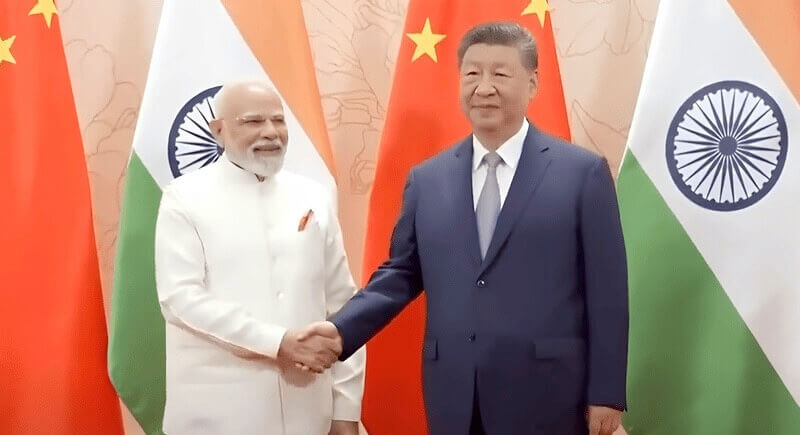
Indeed, it seems that Trump’s wounded ego was the leading cause of the gigantic tariff imposed on India. The result of which has been no other than making India overcome its dissonances with China and presumably jump into its sphere of influence. As Kurt Campbell and Rush Doshi wrote: “But after the tariffs were applied on India, Prime Minister Narendra Modi last week visited China for the first time in seven years, where he and President Xi Jinping agreed to move past a recent history of tense relations and work as partners, not rivals”. (Campbell and Doshi, 2025).
Handling India to China on a silver plate is, no doubt about it, a colossal geopolitical blunder. Moreover, an incomprehensible one when it simply results from frivolous considerations.
References:
Broadwater, Luke and Sanger, David E. (2025). “How Trump’s Blunt-Force Diplomacy Is Pushing His Rivals Together”, The New York Times, September 5.
Campbell, Kurt M. and Sullivan, Jake (2025). The Case for a Alliance with India”, Foreign Affairs, September 4.
Campbell, Kurt and Doshi, Rush (2025). “America Alone Can’t Match China. But With Our Allies, It’s No Contest”, The New York Times, September 7.
Chellaney, Brahma. (2017). “China’s Debt Trap Diplomacy”, Project Syndicate, January, 23.
Golub, Philip S. (2006). “Quand la Chine et l’Inde dominaent le monde”, Maniere de Voir, París, Janvier-March.
Gunder Frank, Andre (1994). “The World Economic System in Asia before European Hegemony”, The Historian, Vol. 56, Issue 2, December.
Gupta, Anil K. and Wang, Haiyan (2009). Getting China and India Right. New Jersey: Jossey-Bass.
Kumary, Reeta (2025). “China’s String of Pearls Policy: Implications for India”, Swadeshi Shodh Sansthan, May 26.
Mahbubani, Kishore (2011). “The seesaw of power: a conversation with Joseph Nye, Dambisa Moyo and Kishore Mahbubani”, International Herald Tribune Magazine, June 24.
National Intelligence Council (2021). “Global Trends 2040”, March.
Mashal, Mujib, Pager Tyler and Das, Anupreeta (2025). “The Nobel Prize and a Testy Phone Call: How the Trump-Modi Relationship Unraveled”, The New York Times, August 30.
Srinivasan, T.N. (2011). Growth, Sustainability, and India’s Economic Reforms. Oxford: Oxford University Press.
The State Council of the People’s Republic of China (2015). “China’s Military Strategy”, May 27.
Wensham, Jia (2016). “intercultural Neologism for a New Revolution”, Center for Intercultural Dialogue”, March, 7.
Author: Alfredo Toro Hardy, PhD – Retired Venezuelan career diplomat, scholar and author. Former Ambassador to the U.S., U.K., Spain, Brazil, Ireland, Chile and Singapore. Author or co-author of thirty-six books on international affairs. Former Fulbright Scholar and Visiting Professor at Princeton and Brasilia universities. He is an Honorary Fellow of the Geneva School of Diplomacy and International Relations and a member of the Review Panel of the Rockefeller Foundation Bellagio Center.
(The views expressed in this article belong only to the author and do not necessarily reflect the views of World Geostrategic Insights).