



South Asia has long been a theatre where geography, history, and power converge, but in recent years its strategic weight has deepened against a backdrop of turbulence and fragmentation. The region faces a convergence of crises that underscore its volatility and importance. India and Pakistan remain locked in a cycle of hostility that has kept regional institutions like SAARC paralyzed.

Afghanistan, following the U.S. withdrawal, struggles with political isolation, economic implosion, and the threat of militant resurgence. Sri Lanka has only recently emerged from a devastating debt crisis, Bangladesh confronts the pressures of political transition and climate vulnerability, and Nepal remains trapped between domestic instability and external tug-of-war.
Across the board, South Asian states are grappling with mounting debt, currency depreciation, and supply shocks aggravated by global economic downturns and U.S.-China trade frictions. Geo-economic pressures are no less acute. Pakistan and Sri Lanka’s debt profiles remain fragile and tethered to external bailouts.
India is experiencing tariff shocks from the U.S. at a moment when its export-led growth model needs stability, and Afghanistan’s economy has collapsed under sanctions, leaving humanitarian needs unmet. Regional trade integration is minimal, meaning that instead of cushioning shocks, South Asian economies absorb them directly.
On the geopolitical side, U.S. tariffs and sanctions against China and India have disrupted supply chains, leaving space for Beijing to maneuver, while Washington’s Indo-Pacific strategy has focused more on the maritime theater than on South Asia’s continental core. Add to this a worsening climate crisis – record floods in Pakistan, extreme heat in India, cyclones hitting Bangladesh and South Asia emerges as a region exposed to multiple vulnerabilities but also central to future connectivity and great-power rivalry.
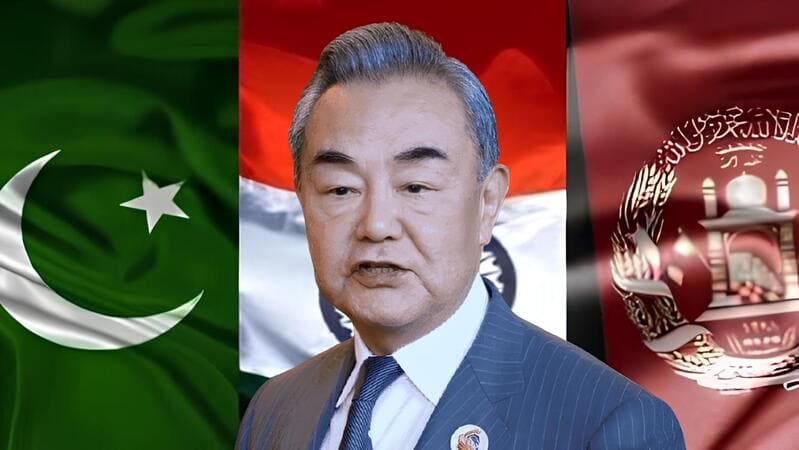
It is into this environment that China has moved to recalibrate its South Asia strategy. Foreign Minister Wang Yi’s August 18-21 tour of India, Afghanistan, and Pakistan was no ceremonial exercise. It was a deliberate sequence of engagements designed to project Beijing’s role as both stabilizer and convenor, repositioning China as the pivotal actor in shaping the region’s emerging order. The underlying message was clear: freeze risks with India, securitize Afghanistan, and deepen the anchor partnership with Pakistan.
In New Delhi, Wang Yi signaled a pragmatic rather than conciliatory tone. By reactivating the Special Representatives’ dialogue on the boundary issue and linking it with the easing of trade irritants, restoration of visas, and reactivation of people-to-people contacts, Beijing offered India an option to manage disputes without needing to resolve them outright.
For Beijing, the goal is to lower the risk of escalation along the contested frontier while keeping the door open for selective economic normalization. For India, facing U.S. tariff shocks and a more complicated trade relationship with the West, the attraction lies in hedging: avoiding outright confrontation with China while protecting its economic arteries. Neither side is conceding on core disputes, but both see merit in controlled stability, which frees political bandwidth for larger strategic aims.
Kabul was a different theatre altogether. There, Wang Yi carried a familiar but sharpened template – “economics for security”. China offered infrastructure, mining, and potential Belt and Road connectivity in exchange for concrete counter-terror guarantees from the Taliban. Afghanistan, in Beijing’s calculus, is not just a neighbor – it is simultaneously a security liability for Xinjiang and a strategic land bridge connecting Pakistan with Central Asia.
By explicitly tying investment to measurable security outcomes, Beijing is trying to shift Afghanistan from being a chronic source of instability to a node of leverage. The gamble is high. Taliban assurances have historically been inconsistent, and militant activity remains active. But China’s conditionality reflects a strategic calculation: better to test and price risk through limited economic pilots than to leave Afghanistan as an ungoverned vacuum vulnerable to rival influence.
Islamabad, the final stop, offered the most confident chapter of the tour. The sixth China-Pakistan Strategic Dialogue reaffirmed the “all-weather” partnership, but significantly, it expanded its scope. Beyond traditional CPEC projects, cooperation was extended into digital technologies, renewable energy, climate resilience, and education. This marks the gradual evolution of CPEC from a hardware-heavy initiative centered on roads and ports to a broader framework of social, technological, and environmental integration.
For Pakistan, which remains under severe fiscal pressure and dependent on IMF bailouts, Chinese support provides not just immediate relief but also a narrative of long-term alignment. For Beijing, the diversification ensures that the partnership is not merely transactional but deeply embedded, offering resilience even against political destabilization in Pakistan and insulating CPEC from fatigue.
Taken together, the three stops constitute a triangular strategy. By cooling tensions with India, Beijing narrows New Delhi’s room for escalation, particularly as the U.S.-India partnership faces strain under the weight of tariff disputes. By binding Afghanistan’s access to development to counter-terror performance, Beijing creates leverage over Kabul while also offering Islamabad a role in monitoring outcomes. By expanding the scope of cooperation with Pakistan, Beijing strengthens its most dependable partner while addressing vulnerabilities that could otherwise undermine long-term projects.
The broader implication of Wang Yi’s tour is that South Asia is no longer defined primarily by Washington’s strategic initiatives. The United States, distracted by tariff politics and an Indo-Pacific framework focused more on maritime Asia, has left space for China to project itself as the indispensable convenor.
By engaging India, Afghanistan, and Pakistan in a single sweep, Beijing has demonstrated that it can operate across rivalries and conflict lines in ways Washington cannot. It is not offering a vision of resolution but of managed risk – stability where escalation is costly, conditionality where fragility is acute, and deepened partnership where loyalty is assured.
This is not a sprint but a positional game. With one carefully choreographed shuttle tour, China has managed to freeze risks with India, price risks in Afghanistan, and deepen bets in Pakistan. Each of these moves addresses a different layer of South Asia’s complex chessboard, but collectively they point toward an emerging order in which Beijing sets the tempo and others respond.
For regional actors, the choice is no longer whether to engage China, but how to navigate a landscape where Beijing has already positioned itself at the center. For Washington, the challenge is sharper: the United States cannot match China’s geography, nor can it convene across rivalries with the same agility. Unless it rethinks its South Asia approach, it risks ceding the tempo of play to Beijing.
Ultimately, the significance of Wang Yi’s tour lies not in the optics of photo opportunities but in the architecture of influence it represents. If the initiatives seeded in these visits mature over the coming months – be it incremental confidence-building with India, conditional development pilots in Afghanistan, or expanded CPEC 2.0 projects in Pakistan then August 2025 will be remembered as the month when China quietly but decisively reset South Asia’s strategic geometry.
In an era of global fragmentation, Beijing is not simply reacting to events in South Asia; it is actively scripting them, one calculated move at a time. If these tracks hold even after the upcoming Shanghai Cooperation Organization (SCO) Tianjin Summit 2025, the visit will be remembered not as symbolic diplomacy but as a pivot that redefined South Asia’s strategic tempo where China has already positioned itself at the center of the chessboard.
Author: Mirza Abdul Aleem Baig – President of Strategic Science Advisory Council (SSAC) – Pakistan. He is an independent observer of global dynamics, with a deep interest in the intricate working of techno-geopolitics, exploring how science & technology, international relations, foreign policy and strategic alliances shape the emerging world order.
(The views expressed in this article belong only to the author and do not necessarily reflect the views of World Geostrategic Insights).