



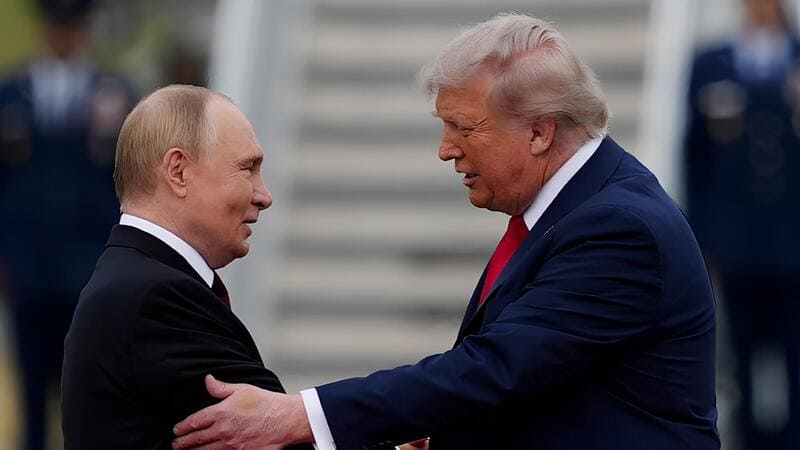
On August 15, U.S. President Donald Trump and Russian President Vladimir Putin met in Anchorage, Alaska, to negotiate an end to the war in Ukraine. The summit, held on American soil despite years of entry bans against Russian officials, marked a dramatic reversal of U.S. policy.

While no final truce agreement was reached, the two leaders made substantial progress toward one — progress largely mischaracterized by mainstream Western media, which framed the meeting primarily as a failure.
The Alaska summit was far more consequential than most analysts admit. Its symbolism alone cannot be overstated. By welcoming Putin and his entourages — many of whom had been barred from U.S. territory under the Biden administration — Trump effectively nullified a key pillar of the sanctions regime that had isolated Moscow since 2022. This single gesture signaled not only the reopening of high-level exchanges but also the beginning of a broader thaw that could require dismantling much of the sanctions architecture painstakingly built by Washington and its allies. In effect, Trump legitimized Russia’s presence in the global order and implicitly endorsed Moscow’s Ukraine policy.
Trump’s Silence as Endorsement
The joint press conference that followed the summit was telling. Putin spoke first, outlining Russia’s view of Ukraine as a “brotherly nation” and insisting that Moscow’s vital security interests are inseparable from its influence there. Trump, who spoke after him, offered no objections, caveats, or clarifications. The silence was deafening. In diplomacy, failure to contest a point made in such a high-profile setting amounts to tacit agreement. Trump, by omission, accepted Putin’s framing — one that categorically rules out Ukraine’s accession to NATO and repudiates decades of Western “globalist” strategy in Europe.
Trump’s position was consistent with his public remarks before the summit: “This is Biden’s war, not my war.” For Trump, the Ukraine conflict is not a battle for democracy or the rules-based order but a partisan inheritance of his predecessor. Within this logic, President Volodymyr Zelenskyy is not a heroic defender of sovereignty but Biden’s proxy in a globalist war. Their acrimonious White House meeting in February — ending in a shouting match — underscored this antagonism. By contrast, their second meeting on August 18 was calmer, with Zelensky agreeing to meet Putin for truce talks after Trump pledged to explore a “security guarantee” for Ukraine with U.S. involvement.
Europe on the Sidelines
The Alaska summit also revealed Europe’s diminished role. Just days after Trump and Putin met, seven European leaders — European Commission President Ursula von der Leyen, NATO Secretary-General Mark Rutte, German Chancellor Friedrich Merz, French President Emmanuel Macron, British Prime Minister Keir Starmer, Italian Prime Minister Giorgia Meloni, and Finnish President Alexander Stubb — gathered with Trump. They postured toughness in private but were deferential in Trump’s presence.
The Europeans lacked leverage. Merz’s cautious statement — opposing Russia’s annexation of Ukrainian territories but implicitly conceding Moscow’s effective control — epitomized Europe’s constrained agency. Lacking strategic dialogue with Trump and unable to project meaningful military power without U.S. backing, European leaders found themselves reduced to spectators in negotiations that will define Europe’s future security order.
Competing Visions of “Security Guarantee”
At the heart of the post-summit debate lies a deceptively simple phrase: “security guarantee for Ukraine.” Its meaning diverges sharply depending on who defines it.
For Europe, it implies something NATO-like — a multinational peacekeeping force on Ukrainian soil, serving as a tripwire against future Russian aggression. But such a scheme requires U.S. leadership and American boots on the ground, neither of which Trump is willing to provide. Instead, he offered only limited U.S. air support for peacekeeping missions, while insisting that Europe shoulder the burden of ground deployments. The problem is obvious: European militaries lack the capacity, capability, and political will for such operations without heavy American backing, especially in intelligence and logistics.
For Russia, however, “security guarantee” points to an entirely different model: one similar to the United Nations Security Council, where Moscow enjoys veto power alongside Washington, London, Paris and Beijing. This framework would institutionalize Russia as a legitimate guarantor of European security rather than treating it as a threat to be contained. Whether Trump and Putin fully aligned on this interpretation in Alaska remains unclear, but if they did, European visions of NATO-led security guarantees would amount to little more than wishful thinking.
A Broader Bargain?
The composition of the delegations in Alaska suggests that Trump and Putin discussed more than Ukraine. Trump was accompanied by Secretary of State Marco Rubio and Special Envoy to the Middle East Steven Witkoff, but not by his special envoy to Ukraine, retired General Keith Kellogg. Putin, for his part, brought Foreign Minister Sergey Lavrov and senior adviser Yuri Ushakov. The absence of Kellogg and the inclusion of Middle East expertise on the U.S. side hint at broader negotiations — not only about Ukraine, but about postwar regional orders in both Europe and the Middle East.
This fits with Moscow’s recent diplomatic choreography: active coordination with Beijing and New Delhi before and after the summit, signaling a shift toward a multipolar framework in which Russia, China, India, and the U.S. play decisive roles while Europe is sidelined.
The End of Value-Based Foreign Policy
The Alaska summit signaled the effective end of U.S. value-based foreign policy. Trump made clear that his vision for global order prioritizes power, not principles. The liberal international order, premised on democracy, human rights, and international law, has been discarded in favor of transactional bargains among great powers. This is consistent with Trump’s broader economic philosophy — protectionist tariffs, rejection of globalization, and hostility toward supranational institutions. The message is stark: values no longer underpin U.S. strategy; power does.
For Europe, this is a devastating blow. For decades, European governments — often run by elites aligned with globalist ideals — depended on Washington’s commitment to liberal norms. Now they face both declining economies and dwindling political influence, left to absorb the costs of a conflict Trump is eager to end on terms favorable to Moscow.
Japan’s Dilemma
The Alaska summit also reverberates in Asia. Japan, long a cautious supporter of Western globalist diplomacy, now finds itself under pressure from Europe to take a more active role in defending liberal values abroad. The recent launch of a Japan-Germany Foreign Ministerial Strategic Dialogue underscores Europe’s hope that Tokyo might significantly supplement, if not substitute for, waning American commitment.
Yet such expectations may be unrealistic. Japan faces immediate threats from China, North Korea, and a militarizing Russia in its own neighborhood. Tokyo’s priority must remain strengthening the U.S.-Japan alliance and enhancing deterrence in East Asia, not overextending itself in Europe’s wars. For Japan, the lesson of Alaska is clear: recalibrate foreign policy to the emerging multipolar reality. Quietly abandon conspicuous “value-based diplomacy” designed to align with a globalist Washington, and instead double down on pragmatic security cooperation with the U.S. to counter Beijing.
Toward a New Yalta
In many ways, Alaska resembled Yalta in 1945, when Roosevelt, Churchill, and Stalin carved up spheres of influence in postwar Europe. Then, as now, the fate of smaller nations was decided not in their capitals but in negotiations among great powers. Just as Yalta sidelined Poland’s independence in service of broader stability, Alaska may consign Ukraine to a future that reflects not its aspirations but the bargains of great powers.
The “New Yalta” differs, however, in one key respect: the global ideological struggle is gone. What remains is pure realpolitik, a transactional world of multipolar power-balancing. For Trump and Putin, this is not a bug but a feature. For Europe’s globalists, it is an existential crisis.
Author: Masahiro Matsumura – Professor of International Politics and National Security at St. Andrew’s University in Osaka (Momoyama Gakuin Daigaku), Japan.
(The views expressed in this article belong only to the author and do not necessarily reflect the views of World Geostrategic Insights).
Image Credit: AFP