



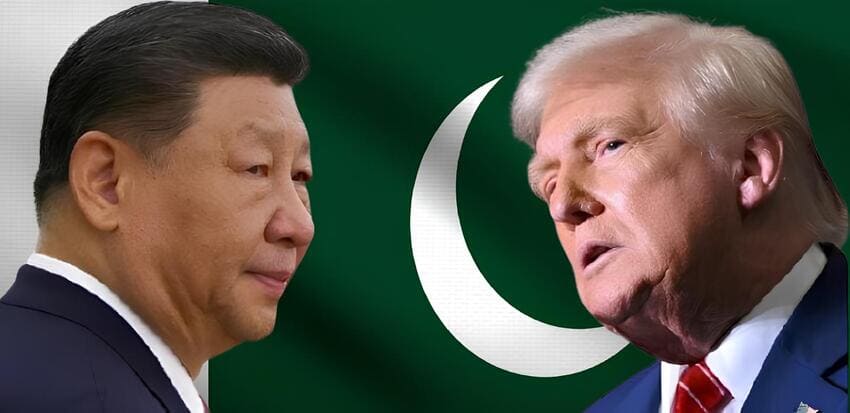
The shifting tides of global trade and power have put South Asia at the heart of a new contest. As U.S. tariffs and sanctions on China and India disrupt supply chains, new openings for regional economic realignment are emerging. Yet, for Pakistan, these same disruptions raise sharper questions: can it recalibrate its strategy to secure long-term economic resilience, or will short-term alignments tie it further to volatile geopolitical currents?
 Islamabad today stands at a delicate juncture. With Field Marshal Asim Munir’s two high-profile visits to Washington, Pakistan’s strategic inclination towards the United States is increasingly visible. This tilt reflects security dependencies, the lure of renewed military and financial assistance. It also exposes Islamabad to new vulnerabilities at a moment when regional trade corridors – from China’s Belt and Road Initiative (BRI) to India-Middle East-Europe Corridor (IMEC) – are redrawing the map of the Asian Century.
Pakistan’s flagship project within the BRI, the China-Pakistan Economic Corridor (CPEC), once hailed as a “game-changer,” has struggled with delays, financing disputes, and governance challenges. Power projects and road networks were delivered in the first phase, but the industrial and export-driven second phase remains stalled.
The gap between ambition and execution has eroded confidence, while debt sustainability concerns and policy inconsistency have further constrained progress. Against this backdrop, Pakistan’s pivot towards the U.S. risks being read not as strategic diversification, but as an admission that the promised dividends of CPEC have not fully materialized.
At the same time, Pakistan’s relationship with China has evolved from the rhetoric of “all-weather friendship” into something more complex. Beijing, once seen as an unconditional partner, is increasingly cautious, recalibrating its approach by demanding greater accountability and return on investments. Political instability in Islamabad, coupled with persistent security and governance risks, has made China wary of offering blank cheques.
For Pakistan, this shifting dynamic means that reliance on Beijing alone is no longer a safe bet, even as Washington beckons with opportunities. The delicate balance between sustaining CPEC, managing China’s evolving expectations, and courting the U.S. defines the core of Pakistan’s current strategic dilemma.
Meanwhile, the government’s much-publicized “SIFC and Uraan Pakistan” plans, designed to leapfrog the country into a modern digital and investment hub, has also stumbled. Announced with great fanfare as a blueprint for innovation and growth, it has been mired in lack of funding, and limited investor trust.
The failure of these plans to take off underscores the deeper structural weaknesses that no external alignment – whether with Washington or Beijing – can alone resolve. The contrast with India and China is instructive. Both face American pressure but are exploring selective cooperation and offshore supply chains to insulate trade from tariffs.
India’s bet on IMEC through Chabahar, and China’s recalibration of BRI projects, show adaptation to the realities of sanctions and shifting markets. Pakistan, however, risks being left on the sidelines of these regional maneuvers if it cannot leverage its geographic centrality.
Here, Pakistan’s complex relationship with India becomes an equally decisive factor. The rivalry has historically locked Islamabad into a security-first mindset, where defense imperatives overshadowed economic planning. Even as India experiments with new alignments, deepens trade ties with the Gulf States, and strengthens its position in BRICS+, Pakistan remains constrained by mistrust, border tensions, and the absence of sustained dialogue.
Opportunities for economic connectivity through South Asia have thus remained underexplored, despite Pakistan’s geographic advantage as a natural transit hub. India’s growing global stature only heightens Pakistan’s anxieties of marginalization, pushing Islamabad to hedge harder between Beijing and Washington.
Yet, paradoxically, long-term economic resilience for Pakistan also depends on lowering barriers with India, at least selectively, to unlock trade complementarities and access broader regional markets. Without recalibrating this dynamic, Pakistan risks being perpetually reactive in the Asian Century, rather than shaping it.
That centrality remains undeniable. Pakistan is positioned as a gateway between South Asia, Central Asia, and the Middle East. Its ports, energy corridors, and land routes could anchor a broader geo-economic role, linking BRI with IMEC and even offering alternate lanes for Sino-India spillover cooperation in third markets.
But to realize this, Pakistan must fix the domestic plumbing: project execution, energy security, investment climate, and digital readiness. Without these, its geographic promise remains just that – a promise. Leaning towards the U.S. can bring short-term relief – financial aid, defense ties, and global legitimacy but overreliance risks alienating Beijing at a time when Pakistan cannot afford to undermine CPEC, however imperfect.
Conversely, clinging solely to China leaves Islamabad overexposed to a partner whose own global standing is under sustained Western challenge. The strategic sweet spot lies in maintaining a functional balance, hedging wisely, and keeping economic policy focused on connectivity and regional peace and stability.
For Pakistan, the lesson is stark; missed opportunities in CPEC’s stalled phase, the evolving complexities of its ties with China, the failure of SIFC and Uraan Pakistan, and the unresolved hostility with India all illustrate that grand visions mean little without consistent delivery.
If Islamabad is to secure a viable place in the Asian Century, it must resist the temptation of transactional alignments and instead invest in structural reforms that make it a credible partner for both East and West.
The tariff wars and sanctions shaking the region have opened rare space for recalibration. India and China may yet find narrow lanes of cooperation despite rivalry. Pakistan, too, has a fleeting window to reposition itself as a connector, not a pawn. Whether it seizes that moment or once again lets vision fall prey to execution – will determine whether its future lies in the corridors of power, or at their margins.
Author: Mirza Abdul Aleem Baig – President of Strategic Science Advisory Council (SSAC) – Pakistan. He is an independent observer of global dynamics, with a deep interest in the intricate working of techno-geopolitics, exploring how science & technology, international relations, foreign policy and strategic alliances shape the emerging world order.
(The views expressed in this article belong only to the author and do not necessarily reflect the views of World Geostrategic Insights).