



By Tahira Mushtaq
On August 6, 2025, US President Donald Trump announced an additional 25% tariff on imports from India, bringing the total tariff to 50%, which he justified by stating that India is still importing Russian oil.

Such an inflammatory decision puts India back at the center of a trade firestorm similar to the earlier tariff war Trump had unleashed against China. Indeed, the measure goes far beyond trade and instead touches on issues of sovereignty, strategic autonomy, and the fragility of global alliances in the current geopolitical situation.
India has become one of the major importers of Russian crude oil, accounting for 36-40% of its total oil imports in the first half of 2025. New Delhi’s reason is simple: It is cheaper than other options, benefiting Indian refineries by roughly \$1 billion per month. In a country with a population exceeding 1.4 billion and rising energy needs, affordability is not merely economic, but also political. The Modi government has framed these purchases as a sovereign decision in line with national interest, not as a support for Russian aggression towards Ukraine. Additionally, Indian authorities have claimed the oil is for domestic consumption, not for re-exports as some Western critics have claimed.
The United States continues to be India’s primary trading partner, with bilateral trade approximately $129 billion in 2024. A large share of India’s exports to the U.S. is in labor intensive industries, for example, textiles, gems, and pharmaceuticals, which now face heavy restrictions.
The Federation of Indian Export Organizations (FIEO) estimates that 55% to 87% of India’s exports to the U.S. would be affected by the new tariff regime, which is up to $66 billion annually. For India’s small and medium enterprises (SMEs) which are the backbone of export-led production, this is more than just an obstacle; it is an existential challenge. Consequently, there was a visible decline in the Indian equity markets, with the Sensex and Nifty indices each declining more than 0.3 percent the day following the announcement. Investor confidence has also eroded, which is also reflected by the India-focused shares MSCI ETF recording its sixth consecutive weekly decline.
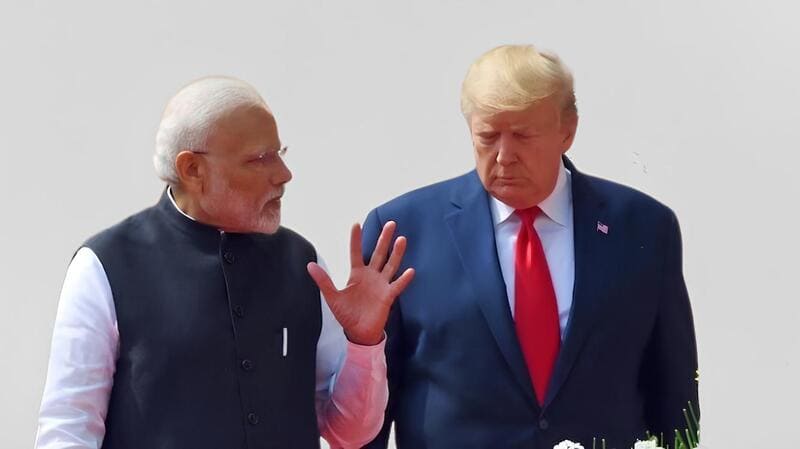
As far as Prime Minister Modi is concerned, the issue is particularly intense. He recently appeared alongside Trump in a summit showcasing “Mission 500,” a plan intending to increase trade to $500 billion by 2030. Fred Weir suggests that the optimism surrounding the deal has now faded, painting a far bleaker picture. Modi and Trump seem to be at an impasse with each other’s worldviews and deep-set political egos. Indian officials feel that they are the unwilling victims of a politically motivated unilateral coercion, while a Trump with an eye towards the 2026 Midterms seems to be doubling down on his “America First” narrative. Clearly, there is far more at play here than trade.
As is often the case, Trump’s policies target a wider scope than simply India. These policies appear designed to shift the compass of global energy power, impose U.S. exports of LNG and crude oil to a starving Asian market, and project power to a domestic base that favors a more reclusive policy. It is interesting to note that the U.S. did increase oil exports to India in 2025 by more than 50%, and is captured by the American firms reaping the rewards of India’s expanding economic and militaristic infrastructure. With this said, painting India as a passive geopolitical bystander is a dangerous strategy that risks unravelling years of strategic cooperation nurtured between the two democracies.
India has alternatives. Although it has considerable trade exposure with the U.S., India has also deepened cooperation with other international stakeholders, particularly within BRICS as well as the India-Middle East-Europe Economic Corridor (IMEC).India may pursue faster trade agreements with the EU, ASEAN, and Gulf countries while simultaneously increasing the consumption and production of goods domestically. This would help to offset the losses from exports. Some diplomats speculate that India might make some concessions like increasing U.S. energy imports or lowering tariffs on American goods to ease tensions. These concessions, however, must be counterbalanced with the perception that India is capitulating to economic pressure.
Most critically, the Indian government has yet to budge. The Ministry of External Affairs has countered the U.S. action by branding it as “unfair and unjustified,” and trade officials are said to be preparing to challenge the move at the WTO. Internally, the opposition has capitalized on the moment. Congress party member Rahul Gandhi labeled the Trump policy as “economic blackmail” and accused Modi of remaining silent due to pressure. Regardless, most analysts conclude that India’s response, albeit measured, is resolute and thus indicative of maturity in foreign policy. The cycle of reflexive appeasement is over.
It remains uncertain whether or not Trump’s tariff policy will be effective. While it may fire up his base, it risks stoking inflation, supply chain complications, and loss of cooperation from allies. India suffers the damage more immediately, but it does have the opportunity to accelerate diversification and gain more strategic autonomy on the global stage. Economists are cautious that the GDP growth—7.4% in the first quarter of 2025—might see downward pressure if the standoff continues. Regardless of the sparring, inflation in the country is anticipated to stay low as India’s consumer price index is predominantly determined by food, which is domestically produced and not reliant on imports.
This clash between India and the United States, once regarded as likely allies in democracy, appears to reveal a more profound global geopolitical rupture. It is a narrative of changing bonds—alliances, contract-based diplomacy, and the peril of policy that stems from an individual. From the world’s gaze, India is put in a peculiar situation—defend national interests without inducing an escalation, assert autonomy but not lose the opportunity to engage. Should India succeed in that balance, it could not only resist the trap set by Trump’s tariffs, but also emerge from it with greater confidence.
Author: Tahira Mushtaq – Student of International Relations at the University of Sargodha, Pakistan.
(The views expressed in this article belong only to the author and do not necessarily reflect the views of World Geostrategic Insights).