



By Muhammad Azam Tariq
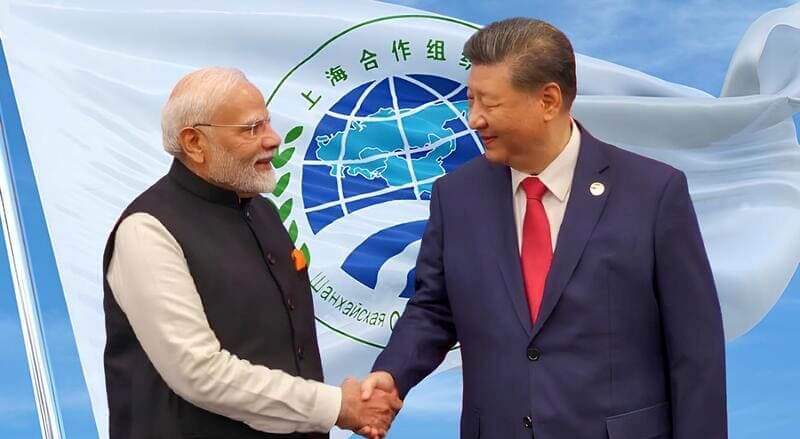
Indian Prime Minister Narendra Modi’s expected visit to China could signal a notable shift in the geopolitical currents of Asia. If confirmed, this will be his first trip to China in seven years, coming after the deadly 2020 Galwan Valley clash. Beyond bilateral matters, this visit must be read within a broader strategic context: a recalibration in India’s regional diplomacy amidst competing alignments and evolving power dynamics.

India and China, the two largest nations in Asia by population and military strength, have long shared a relationship marred by historical mistrust, border disputes, and strategic rivalry. Since their brief but bitter war in 1962, the unresolved boundary question has been a recurring source of tension, culminating in periodic confrontations, most recently in eastern Ladakh. Yet, both capitals understand that complete estrangement is neither sustainable nor beneficial in a multipolar world where economic interdependence, trade corridors, and security arrangements remain fluid.
Modi’s potential presence at the Shanghai Cooperation Organisation (SCO) Summit, scheduled from August 31 to September 1, 2025, in Tianjin, People’s Republic of China, would be more than diplomatic symbolism. It may well be an act of strategic hedging, an effort to preserve manoeuvring space as global alignments harden. For New Delhi, attending an SCO meeting under Chinese chairmanship without diluting its security concerns sends a subtle message: India will engage where it must, and resist where it chooses.
This prospective re-engagement comes at a time when both New Delhi and Beijing face distinct internal and external pressures. China is grappling with an economic slowdown, waning investor confidence, a property market slump, and growing youth unemployment. Internally, Beijing’s strict regulation of its tech sector has signalled a tightening of state control over innovation and private capital. Externally, China remains locked in a strategic contest with the United States, facing tariffs, semiconductor restrictions, and increasing military pushback in the South China Sea and Taiwan Strait.
India, by contrast, is navigating its own set of strategic challenges. It seeks to maintain strategic autonomy while deepening economic ties with the United States, strengthening defence cooperation with Russia, building connectivity with Iran through the Chabahar Port, and expanding energy partnerships with Gulf states. Balancing these relationships requires nimbleness; leaning too heavily on one side risks alienating the other.
In such a context, Modi’s visit should not be read as a dramatic pivot toward China, but rather as a pragmatic recalibration. The timing is notable: while India’s involvement in the Quadrilateral Security Dialogue (QUAD) has deepened its engagement with the U.S., Japan, and Australia, it continues to participate actively in SCO and BRICS—platforms where China and Russia set much of the agenda. This multi-vector diplomacy is not a contradiction but a calculated posture. India is signalling that it will not be confined to a single strategic camp, but instead will operate across multiple, and sometimes competing, forums.
The SCO Summit provides a diplomatic stage on which both Modi and Xi can engage without appearing to make concessions. India remains opposed to the Belt and Road Initiative (BRI) on sovereignty grounds, particularly regarding the China-Pakistan Economic Corridor (CPEC) passing through Gilgit-Baltistan. Yet, it recognises the value of Eurasian cooperation on counterterrorism, regional stability, climate change, and energy security. By showing up, India portrays itself to smaller regional actors—from Central Asia to Southeast Asia—as a flexible power, capable of engaging all sides without being tethered to one.
For Washington, however, such a move could introduce a note of uncertainty. The United States has invested heavily in positioning India as a strategic counterweight to China in the Indo-Pacific. Modi’s engagement with Xi could complicate this narrative, suggesting that India—like Turkey within NATO—may pursue an independent course when it suits its interests. For India, such ambiguity is not indecision but a deliberate tool to reinforce strategic sovereignty.
For Pakistan, the optics of such a visit will be closely scrutinised. China’s traditionally close partnership with Pakistan—anchored in defence cooperation, infrastructure investment, and diplomatic support—has been a cornerstone of Islamabad’s regional strategy. However, Beijing’s growing economic and security interests in India could prompt subtle recalibrations. If China seeks to balance ties with both South Asian rivals, it may be compelled to take a more nuanced stance on sensitive issues such as Kashmir, trade corridors, and regional security arrangements. This, in turn, could have ripple effects on Pakistan’s diplomatic leverage.
The implications extend beyond South Asia. In the broader Eurasian landscape, an India-China thaw, however temporary, would alter the calculus for Russia, which has positioned itself as a bridge between the two powers in multilateral forums. It could also affect Central Asian states, many of which seek diversified partnerships to avoid overdependence on any single power. In Southeast Asia, where smaller nations are navigating the U.S.-China rivalry with caution, India’s engagement with Beijing could reinforce its image as a power willing to bridge divides rather than exacerbate them.
Still, the road to meaningful rapprochement is fraught. Deep-seated mistrust remains. The border issue is far from resolved, and both militaries continue to fortify positions along the Line of Actual Control. Economic cooperation is also constrained by protectionist tendencies and mutual suspicion over technology transfers and market access. Even in multilateral settings like the SCO, sharp divergences over strategic projects like the BRI persist.
In conclusion, Modi’s anticipated China visit represents less a softening of animosities and more an exercise in realpolitik. It is about managing contradictions, not resolving them; navigating complexity, not eliminating it. India’s goal is to ensure that it has a seat in every room where regional and global decisions are shaped—even when those rooms are designed by rivals. For China, the engagement offers a chance to temper hostilities with a major Asian power at a time of mounting Western pressure. For the region, it signals that in the emerging world order, alliances may be fluid, alignments temporary, and strategic space fiercely contested.
If the visit takes place, it will not mark the end of the India-China rivalry. But it could redefine how that rivalry is managed—and that, in the shifting chessboard of Asian geopolitics, is a significant move in itself.
Author: Muhammad Azam Tariq – Pakistani researcher, writer, and socio-political analyst. He writes on economics, governance, foreign policy, and regional affairs.
(The views expressed in this article belong only to the author and do not necessarily reflect the views of World Geostrategic Insights).