



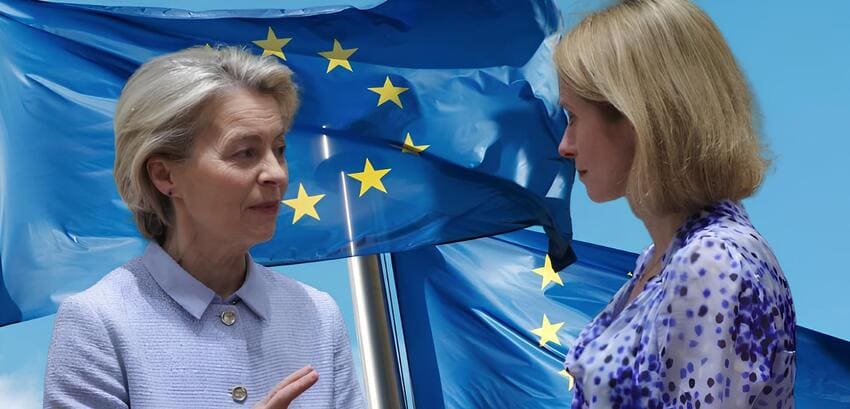
In the Gaza conflict, the clash with Iran, and the Ukraine-Russia war, the European Union has only a role as a foreign observer.

These crises largely reveal the irrelevance of the Union and its inability to influence the course of events, let alone put an end to them.
Among the reasons for this is US President Donald Trump’s aversion to the European Union. Unlike his predecessor, former President Biden, Trump does not see the Union as allies and partners to be employed or consulted. Therefore, the European Union and its member states have no choice but to settle for mere statements. The common denominator of most of these statements includes the terms de-escalation, moderation, and diplomacy as a means of ending the conflict: just words.
In 2020, following the election of President Biden, the EU countries, after four years of Trump, were able to breathe a sigh of relief when he declared that “America is back.” In doing so, Biden wanted to make it clear that the US was returning to the principles that had guided its foreign and security policy in the decades following the end of World War II: a return to the liberal order, the expansion of the circle of democracies, the importance of alliances, support for international institutions, and more.
Trump’s arrival in the White House represents a paradigm shift in US conduct and, consequently, in transatlantic relations.
In effect, we are witnessing an “ideological” clash between two worldviews on the nature of international relations. While the EU seeks to preserve the liberal international order, which includes maintaining existing international institutions and the norms that guide international conduct, Trump does not feel obliged to do so, except for the ambitious task he has set himself, namely to restore America to its former greatness. In his view, to achieve this goal, all means are permissible, including the destruction of the existing order and, if necessary, the use of force, with all that this entails.
In the global order that Trump will help shape, which will be based on a balance of power between the major powers, on military, economic, and technological strength, and on a possible division into spheres of influence, the EU countries (and the EU itself as an institution) are at a disadvantage. In addition to differences of opinion on how to respond to Trump’s expected policies and everything he stands for, technological and economic gaps reduce the EU’s bargaining power vis-à-vis the US. Added to this is Europe’s dependence on US assistance for its security.
In this state of affairs, the EU will be forced to adapt to the new rules of the game that are being defined. Therefore, in order to circumvent Trump’s various threats (the imposition of tariffs and the reduction of security support), the EU (which does not want to end up in a conflict) will have to contribute in such a way as to satisfy at least some of the US president’s demands—no easy task given the lack of unity among member countries. This situation could play into Trump’s hands, as he will seek to bilateralise relations with countries that agree to meet his conditions.
A difficult period of adjustment is expected for the EU, which has failed to take advantage of the wake-up call it received to prepare itself adequately for the second Trump era.
As for Europe’s weak foreign policy, let us give a few examples. During the current months of popular protests against the Serbian regime, the European Union has consistently supported President Aleksandar Vučić. But now, Vučić’s increasingly brutal repression of peaceful protests has brought EU policy to a turning point: continue to appease Vučić with the utmost seriousness, or accept uncertainty.
Judging by the lack of reaction from Paris, Berlin, and the European Commission, the European Union will try to remain neutral for as long as possible. But the acceleration of events on the ground may soon force the European Union to take a stand.
At the end of a large protest held in Belgrade on June 28, which brought together over 100,000 people, speakers declared that the student movement was now a broader civil movement and called for peaceful disobedience.
The protest was accompanied by clashes and violent police repression in Belgrade and, immediately afterwards, by traffic blockades across Serbia. In the following week, police officers and their assistants in uniform and masks (including, according to eyewitnesses, members of the Republika Srpska in neighboring Bosnia-Herzegovina) were involved in brutal beatings and dispersals of protesters, sparking public outrage over the violence, compounded by Vučić’s statement that he was “satisfied” with the police. Despite the state violence, the sieges and protests show no signs of abating.
What began as a student protest against a corrupt system, triggered by the collapse of the Novi Sad railway station canopy, in which sixteen people lost their lives, has turned into a widespread popular movement.
In April and May, student delegations cycled to Strasbourg and ran an ultramarathon in Brussels to pressure the European Union to change its policy towards Serbia.
EU officials avoided the cyclists, while the European Commissioner for Enlargement and Neighborhood Policy, Slovenian Marta Kos, and the European Commissioner for Intergenerational Equity, Youth, Culture, and Sport, Maltese Glenn Micallef, met with the runners in May.
Kos made a rhetorical shift, acknowledging that the goals and values of the student movement for change in Serbia are fully consistent with the EU’s stated values and the requirements of the acquis. But to most Serbs and observers, it seemed weak. The commissioners achieved nothing, and EU policy remained disorganized.
Vučić resisted public rebukes from EU officials. His defiance was “rewarded” a few days later with a visit to Belgrade by the President of the European Council, Portugal’s António Costa, followed immediately by a visit from the EU’s High Representative for Foreign Affairs and Security Policy, Estonia’s Kaja Kallas.
Kallas, who called on Serbia to make a “strategic choice” regarding its geopolitical orientation, made her disappointment public, but the two visits alone conveyed a power dynamic in which Brussels is the supplicant.
There have been no political consequences, nor any evidence that the Commission is redefining its policy towards Serbia, which is a notable exception among the Western Balkan countries aspiring to EU membership, with a consultation rate on common foreign and security policy of around 50-60 percent.
At the end of June, following harsh public criticism from Russia’s foreign intelligence service, the SVR, for Serbia’s “betrayal” in selling arms to Ukraine via third countries, Vučić announced the suspension of arms sales abroad, including to Ukraine.
Adding to the pressure on Ukraine’s defenses, US shipments of Patriot missiles and 155 mm artillery shells (also produced in Serbia) were halted in early July.
It is worth considering the possibility that these moves are coordinated. While Vučić was attending the Ukraine-Southeast Europe summit in Odessa on June 11, he refused to sign the declaration condemning Russian aggression and later tried to claim that he was not a “traitor to Russia.” The committee nevertheless praised his participation.
Afterwards, the president of the European Commission, Germany’s Ursula Gertrud Albrecht, married von der Leyen, held a half-hour bilateral meeting with Vučić, a rare event.
The content of their meeting is unclear. But if it was intended as a rebuke or warning after the violence on June 28, it certainly had no effect. The longer EU policy remains unchanged, the more Serbs will conclude that it has effectively given Vučić a license to crack down.
The Commission (with the apparent support of most member states) seems to believe that agreements with financial incentives – while ignoring difficult questions of value – can protect EU interests in Serbia and, by extension, in the Western Balkans as a whole.
This tendency to delegate political problems to money has become unsustainable and is accelerating the decline of the EU’s popularity among Serbian citizens. This fact leads the EU to cooperate with Vučić, whose goal is to exploit his media dominance to diminish the value of the EU among Serbs and increase that of Russia and the People’s Republic of China.
Even more damaging is the fact that the EU’s timid messages have actually encouraged Vučić to intensify the repression. He has unleashed violent thugs against protesters and launched a relentless media campaign denouncing students as “terrorists” paid by Serbia’s enemies (i.e., Western governments) to overthrow the government—a rehash of a “color revolution” aimed at regime change.
Vučić clearly interprets the agreements with the EU as a license to maintain and even strengthen his ties with Moscow. Vučić’s increasingly brutal repression should finally lead to a redefinition of the EU’s values-based policy. But even if this is a transactional approach, there is a strong motivation for policy change. If a “geopolitical union” has demonstrated a willingness to tie Serbia’s enlargement path to the provision of short-term strategic and security benefits, then it is logical to conclude that Vučić’s active efforts to undermine these interests will result in an equally destructive political reaction.
Given the EU’s entrenched institutional inertia, member states are the most credible agents of change. Denmark is initiating a long-overdue recalibration of the EU’s autopilot policy toward Serbia and the region, so that it is not only strategically sound but also consistent with the Union’s democratic values.
This will only be possible if a coalition of other member states is formed. It should start with a clear definition of what Denmark and like-minded countries expect including not only harmonization of foreign policy, but also a concrete commitment to respect the full set of Copenhagen commitments. It is essential to show support for those in Serbia who are taking risks in the name of the European Union’s fundamental values.
The risk to the European Union, not only in Serbia but in all the countries of the Western Balkans, is serious. Instead of winning Serbia over, the EU’s policy of supporting Vučić risks losing it for the next generation, regardless of the success or failure of the protests. Let me be clear: the EU’s choice of “stability” at this moment effectively means supporting violent repression in Serbia. This policy therefore betrays both the EU’s fundamental democratic values and its short- and long-term interests in the face of challenges from the East, West, and within.
It should also be noted that the rise of the right in Europe is a process that has been gathering momentum over the past decade, against the backdrop of the 2015 refugee crisis, concerns about globalization, and dissatisfaction with EU policy on a range of issues.
The European Parliament elections in June 2024 increased the power of traditional right-wing parties and the populist-nationalist right, sometimes referred to as the far right. This trend is also reflected in national and regional elections in European countries such as Denmark, Finland, Italy, the Netherlands, Slovakia, Sweden, and Hungary, where populist-nationalist right-wing parties are part of the governing coalition or support the government itself.
In France and Germany, right-wing populist parties are opposition parties with significant power. In Belgium, right-wing parties achieved great success in the June elections, forcing the liberal prime minister to resign, and in March this year a populist party called Chega! (“Enough!” in Portuguese) also emerged in Portugal with 18% of the vote, a very unusual result for this country. Polls in Austria ahead of the September elections point to a strengthening of the Freedom Party, a right-wing populist-nationalist party.
The traditional right and populist-nationalists constitute the majority in the new European Parliament. Of the 720 MEPs, 407 belong to blocs that can be defined as right-wing and right-wing populist-nationalist. It is important to note that the European Parliament is composed of blocs, not parties. However, polls had predicted a larger majority. The question is: what impact will this composition of the parliament have on European politics?
It should be emphasized that the main power of the Parliament lies in the approval of the European budget. It is not a legislative authority in the sense known to national parliaments and has no legislative initiative. Its power in all matters relating to foreign policy is virtually non-existent; it is the European Commission that proposes legislative initiatives, which are then discussed in the European Council of Ministers or the European Council, a body composed of prime ministers or heads of state, especially when it comes to foreign policy decisions, which are taken only by unanimous consent.
At the same time, the composition of the parliament can certainly influence the ministers and heads of state who meet to take decisions by exerting political pressure. It should also be borne in mind that there is no coalition discipline in the sense that is familiar in several countries around the world. Voting patterns are therefore not always predictable.
Furthermore, on some issues, especially in foreign policy (attitudes toward the People’s Republic of China, toward Russia, etc.), there is no unanimity of opinion on the right, and especially not on the populist-nationalist right, which has varying degrees of extremism. In any case, the populist-nationalist right is generally characterized by uniform positions on fundamental issues concerning European politics, as follows:
1 – The populist-nationalist right is Eurosceptic to varying degrees, which means that it seeks to reduce the power of EU institutions to control the lives of individual EU member states, with the most extreme position aiming to dismantle the EU. It is understood that Eurosceptics oppose the expansion of the EU through the addition of new countries.
2 – The populist-nationalist right is reluctant to panic about the “climate threat” and invest billions in “green energy.” In Germany, for example, the populist-nationalist party Alternative für Deutschland (AfD) is calling for a return to nuclear and carbon-based energy sources.
3 – The populist-nationalist right is strongly calling for a tougher policy to prevent illegal immigration. Already in 2015-2016, several EU members joined Hungary in calling for a more aggressive and effective policy to prevent illegal immigration, and it therefore seems likely that the growing power of the right in parliament will push other members to join this initiative.
4 – Right-wing government representatives in the European Council will certainly veto any proposal to impose sanctions or adopt punitive policies against third countries for what would be defined as human rights violations or war crimes by those countries. This approach has already been expressed in the past, when Hungary (and other countries) vetoed draft resolutions concerning the People’s Republic of China, Russia, etc.
Yet, despite the rising tide of the right, both in the European Parliament and in national parliaments and executive bodies, it does not appear that we should expect any far-reaching changes in EU policy on the key issues mentioned above.
On July 18, 2024, von der Leyen presented her work plan for the next five years to the European Parliament. This was part of her bid to be elected for a second term. The messages von der Leyen conveyed to Parliament reflected the spirit of the previous legislature and not the electoral shift to the right.
On the contrary, while mentioning her disappointment at the rise of the populist-nationalist right (which she considers extreme), von der Leyen began by stating that she would not renounce the European values that emerged after World War II and that she would never accept attempts by demagogues and extremists to destroy the European way of life. She said: “I am convinced that the version of Europe after World War II, despite all its flaws, is still the best in human history. I will never allow this version to be torn apart, either by internal or external factors […] I will never allow demagogues and extremists to destroy the European way of life.” In doing so, she hinted that, from her point of view, coalitions with right-wing populist-nationalist parties are out of the question.
She was certainly not referring to the fury of radical Islam in the western part of the continent. In this regard, she stressed that EU budget funds would be withheld from member states that do not “respect the rule of law,” alluding not only to Hungary under the nationalist Orbán government, which has already experienced financial sanctions, but also to other countries that do not comply with European human rights standards, such as Poland with its conservative abortion law. In her speech, von der Leyen reflected a trend towards continuity in the progressive liberal line that has characterized European rhetoric and legislation for years.
The dominant ideology in Europe, and more precisely in Western Europe, on issues such as immigration and environmentalism, as well as on other issues such as the enlargement and deepening of the Union, which is identified with the values of the left, will continue, as far as von der Leyen is concerned, to influence the path of the Union.
Reducing greenhouse gas emissions by 90% by 2040 and 100% by 2050 remains a stated goal. It is estimated that achieving this goal will require an investment of several trillion euros with significant political and economic consequences, which will also increase the European Commission’s powers of control at the expense of the sovereignty of member states, in clear opposition to the interests of right-wing and populist-nationalist circles.
On the issue of immigration, von der Leyen has not taken a right-wing line either. Although she has announced a significant increase in resources for FRONTEX, the agency responsible for protecting Europe’s borders from illegal immigration, the problem is not one of staffing, but of the powers conferred on the agency’s staff. In practice, the agency’s staff have no legal means to prevent the invasion of migrants from the Mediterranean Sea and, in fact, find themselves assisting in rescue operations and transferring migrants to centers for examination of their eligibility for political asylum.
Von der Leyen even repeated the human rights mantra in the context of immigration, in the spirit of the European left: “We will always respect human rights and absorb those who are entitled to them, helping them to integrate into communities.” It should be noted that the European Court of Human Rights has ruled that an illegal immigrant intercepted at sea by European ships, even when the North African coast is in sight, has the right to disembark on a European coast and undergo a procedure to determine their eligibility for political asylum.
The political map of the European Union reflects that of its two main members, Germany and France, and in both countries the rise of the populist right has not caused political upheaval. The right has submissively accepted the approach of the left.
In Germany, this was already evident during the term of Angela Merkel, who ruled as chancellor on behalf of the conservative party and whose voice was the voice of the right and her hands those of the left. There, the left-wing media play an important role in shaping the political landscape. The budget for public radio and television in Germany is close to ten billion euros per year, and according to a survey, around 80% of its employees have a left-wing political outlook. In both Germany and France, the conservative right, defined as moderate, does not dare to form a governing coalition with right-wing populist parties, which are nationalist in Germany and nationalist in France. Franz Josef Strauss, who was Prime Minister of Bavaria and Minister of Defense of Germany, said at the time that there was no place on the right for a legitimate party other than the Christian Democratic Party, or in other words: “To our right, there is only the wall.”
Since World War II, the European far right has not enjoyed such a resurgence, yet European citizens accept left-wing policies, and even (as seems to be the case in France) those of the far left. Von der Leyen’s plan flatters the left-wing “green” bloc in the European Parliament with its 53 members, and not the center-right bloc with its 188 members (in the previous legislature, von der Leyen was the center-right candidate), and this constitutes a departure from democratic decency, and perhaps even goes further, as it creates a vicious circle: the left entrenches itself in government positions, which further strengthens right-wing populist tendencies in public opinion that tend to lean to the right, further distancing the possibilities of coalitions with the moderate right. In such cases, the normative democratic game could be replaced by open violence, the result of which will be on the right.
Freeing the policies of EU institutions from the chains of words, political correctness, do-goodism, and a political entity that does not even have a common army (and delegates to “others”) seems an almost impossible task in the near future.
The heavy cloud of the dark history of the first half of the 20th century still hangs over the European consciousness and subconscious, blurring the distinction between healthy patriotism and arrogant nationalism. Europe believes it can save itself from the danger of falling into the abyss of totalitarianism by not reaching out to right-wing coalitions.
In conclusion, the rise of right-wing parties in Europe marks a significant change in the continent’s political landscape. Although the immediate impact on EU politics may be limited, this trend points to possible long-term changes on issues such as immigration, climate policy, and foreign relations.
Giancarlo Elia Valori – Honorable de l’Académie des Sciences de l’Institut de France, Honorary Professor at the Peking University.
(The opinions expressed in this article are solely those of the author and do not necessarily reflect the views of World Geostrategic Insights).
Note: This article, like all articles published on World Geostrategic Insights, cannot be republished without the written permission of the editor of World Geostrategic Insights.