



World War II was undoubtedly a highly costly undertaking for the United States. Especially so in human lives, where it lost more than 400,000 combatants. However, this pales when compared to the losses faced by the countries that were in the first line of combat.
More significantly, while the latter were confronted with utter devastation, the U.S. emerged from that conflict as the richest and most powerful nation on earth.
Indeed, its GDP, which in 1939 had been of around one billion dollars, soared to 135 billion in 1945. In those six years, it doubled its productive capacity. The war allowed for the creation of 17 million new jobs, multiplied by two the nation’s wages, and made it possible for savings to multiply sevenfold. The country’s standard of living rose and unemployment virtually vanished. Meanwhile, America topped the world militarily. Its navy was larger than the combined fleets of the rest of the planet, its air force commanded the skies, and it was the only nation that possessed the atomic weapon. (Bremmer, 2013, pp. 40, 41; Herring 2008, pp. 597, 598).
Conversely, on top of its staggering human costs, the material and territorial losses of the nations that had been in the first line of combat were catastrophic. Japan lost more than 80 percent of its pre-war Asian territory and 80 percent of its textile machinery, while its coal production fell to one-eight of pre-war levels. In Germany, war destroyed 40 percent of its buildings within the country’s 50 largest cities, while its productive capacity melted down. In France, 20 percent of its buildings, half of its livestock, two-thirds of its railway system, and around 40 percent of its national wealth were destroyed. Great Britain, which had been the world’s largest creditor in pre-war times, found itself with a gigantic debt, while the sterling pound lost its international reserve status and its trade was cut up to just 30 percent of what it had been. In China, devastation prevailed at every level, while in the Soviet Union twenty-five million lives and 70,000 towns and villages were destroyed. (Bremmer, 2013, pp. 38-40).
Paradoxically, what should have been a time of supreme confidence in itself and in its international towering presence, became a moment of much insecurity and uncertainty for the United States. Having felt protected by two great oceans before the war, the conflict had shown its citizens the extent of its interconnection with the rest of the world. Isolationism was no longer an option. As a result, Americans understood that protection could only be found through an international environment favorable to their values and interests. Their fear was mainly directed towards an aggressive Stalin, whose country’s gigantic suffering during the war had not prevented its emergence as a military juggernaut.
The most articulated response to the perceived Soviet threat -what Churchill called the predominant strategic objective- would curiously come from a relatively minor figure within the American bureaucratic establishment. In 1946, the young Chargé d’Affaires of its Embassy in Moscow wrote an eight-thousand-words telegram to the State Department that would become the primary guide for the United States’s foreign policy for the next four decades.
In this telegram, George Kennan argued that the ancestral Russian expansionism had been reinforced by the missionary impulse of the communist ideology. As a result, if a resolute stance was not taken against it, the United States ran the risk of seeing one after another of the countries of the international community, being swallowed by communism. This would progressively reduce the United States to a situation of impotence and abandonment. The only answer to this threat was a systematic, firm and long-term effort to keep Soviet expansionism at bay. That is, a policy of containment. (Gaddis, 1982, Chapter 1).
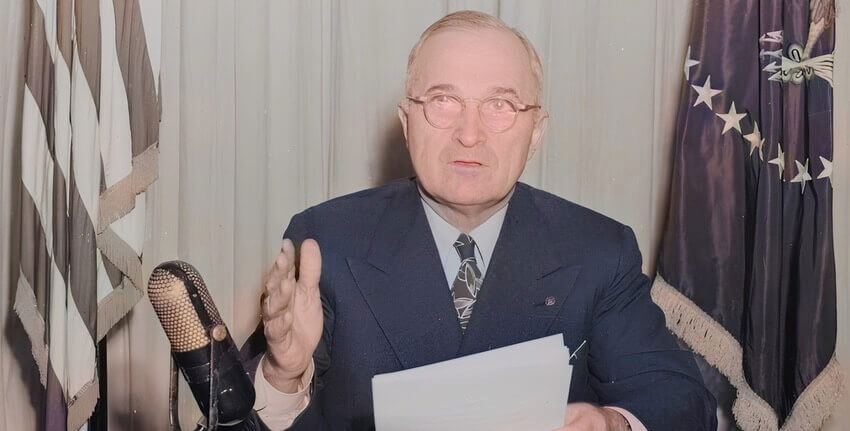
Containment was subsequently conceptualized even further by the 1946 Clifford-Elsey Report, commissioned by President Harry Truman to two of his closest aides. Borrowing heavily from Kennan’s long telegram, the report not only saw Soviet expansionism as the greatest threat to America’s vital interest around the world, but insisted on the need to stand firm against it.
In order to put teeth to containment, the 1947 National Security Act was enacted. This would become the Magna Charta of the U.S.’ national security architecture, creating a group of fundamental institutions to address the Soviet threat. Among them, the Defense Department that gathered under its stewardship the departments of Army, Navy and Air Force; the National Security Council, which coordinated within the White House policy-making in this area; or the Central Intelligence Agency (CIA) that replaced the defunct wartime OSS in foreign intelligence matters. (Herring, 2008, Chapter 14).
The 1947 Truman Doctrine would put the presidential seal to containment, by declaring that the United States would provide political, military, and economic assistance to all nations under the threat of external or internal totalitarian forces. As an offspring of such doctrine, the Marshall Plan for European economic recovery would promptly follow. This, in order to avoid that Moscow could take advantage of the dire economic situation of former combating countries in Europe. Multiple initiatives of different nature followed the same track.
The predominant U.S. strategic objective that would prevail until 1991, when the USSR collapsed, was thus defined in 1946 and 1947. A strategic objective born out of insecurity. That, paradoxically, at a point in time when America’s international towering presence was at its peak and complacency would have seemed a natural outcome.
References:
Bremmer, Ian (2013). Every Nation for Itself. New York: Portfolio, 2013.
Gaddis, John Lewis (1982). Strategies of Containment. Oxford: Offord University Press.
Herring, George C. (2008). From Colony to Superpower. Oxford: Oxford University Press.
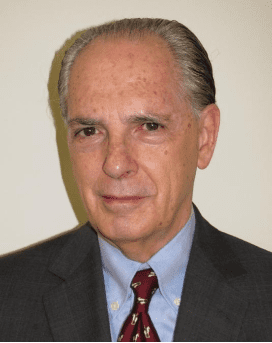
Author: Alfredo Toro Hardy, PhD – Retired Venezuelan career diplomat, scholar and author. Former Ambassador to the U.S., U.K., Spain, Brazil, Ireland, Chile and Singapore. Author or co-author of thirty-six books on international affairs. Former Fulbright Scholar and Visiting Professor at Princeton and Brasilia universities, as well as academic advisor to the University of Westminster. He is an Honorary Fellow of the Geneva School of Diplomacy and International Relations and a member of the Review Panel of the Rockefeller Foundation Bellagio Center.
(The views expressed in this article belong only to the author and do not necessarily reflect the views of World Geostrategic Insights).