



By Fawad Khan Afridi
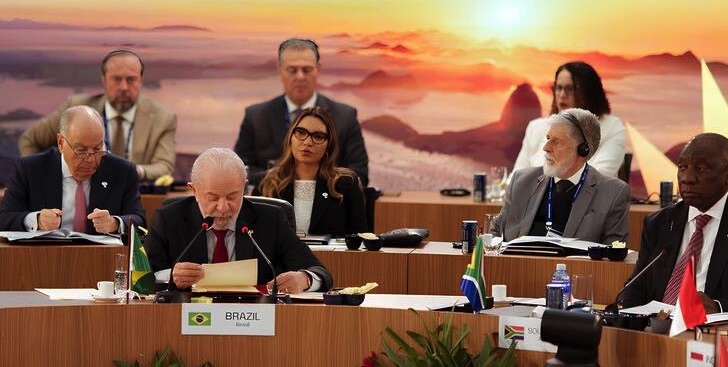
The 17th BRICS Summit took place in Rio de Janeiro in July 2025 under the theme of “Strengthening Global South Cooperation for a More Inclusive and Sustainable Governance.”
The gathering of heads of state of 11 countries, including newcomers such as Indonesia, Egypt, Ethiopia, Iran and the United Arab Emirates, heralded a decidedly strategic shift. Under Lula da Silva of Brazil, leaders of India, South Africa, virtually Russia, Indonesia, Egypt, Ethiopia, Iran and China through its premier Li Qiang and the UAE vowed to do more than talk. After months of diplomacy that included more than 200 preparatory meetings, they signed the Rio Declaration to provide practical mechanisms that would transform the ways the world is governed.
BRICS has gained nearly half of mankind the total value (4.45 billion or about 55-56 percent of the world population) and constitutes between 40 and slightly under 44 percent of the world GDP depending on the exchange-rate or purchasing power parity (PPP). It now comprises 11 states, overtaking the G7 in population and economic weight by approximately $20 trillion. It is not symbolic weight, it is shared common economic strength to say that it can have a voice of the south in the global institutions.
Power was seen full-blown in Rio. Finance ministers revealed a common campaign to transform the world financial institutions-quotas allocated by the U.S treasury at the IMF favored wealthier economies, but BRICS is demanding new calculation measures involving the real sizes and purchasing powers in the emerging economies. Closer calls were renewed to empower the UN Security Council and the Bretton Wood institutions with sweeping reforms.
The aim is obvious: to transform these institutions, which would protect the sovereignty and even more thunder of the Global South. The same sense of sovereignty applies to finance too. Leaders signed on the need to switch intra BRICS trade to national currencies: Russia says 90 percent of its bilateral trade with BRICS now uses neither the U.S. dollar nor the euro. Beijing and Moscow together with others are developing common infrastructure such as cross‐border CBDC systems and central bank plumbing to avoid dollar dependence, e.g. BRICS PAY. The New Development Bank decided to finance more than US 32 billion in 96 projects, and the Contingent Reserve Arrangement is ready to shape up liquidity cushions outside IMF conditionality. This is strategic architecture: i.e. parallel financial regimes with teeth.
Marker fields also came out as climate and environmental policy fields. The group loudly called on rich countries to invest in a fair, global rollback on fossil fuels and threw its support behind Brazil’s “Tropical Forests Forever Facility”, a focused climate-mitigation finance to be contributed by BRICS with the support of China and UAE, and advocated to COP30. They condemned the EU carbon tax and carbon border adjustments, which they termed as discriminatory. BRICS with 40% of global emissions and population is imperative for South-South cooperation.
Supply chain and technology resilience also played an important role. Indian Prime Minister Narendra Modi, at his maiden summit after taking over presidency of BRICS, came up with a new acronym of BRICS: “Building Resilience and Innovation for Cooperation and Sustainability.” He advocated the control of responsible AI and safe supply chains of critical minerals. The tech ecosystems in emerging markets, digital infrastructure, and green technology, are in a sharp upward curve where BRICS will determine the norms to govern the technology.
Beyond the meeting room things are tense. Trump threatened countries with additional 10% tariffs for the “anti-American policies of the BRICS.”His rhetoric was the response to the growing Western worries over the increasing independence of BRICS. The retort was sharp and monolithic. Lula termed it as misguided and irresponsible, Ramaphosa spoke against punitive economic blackmail and Lavrov dismissed it as a symbol in collapsing U.S. driven globalization. In a remonstration against the use of unilateral sanctions, BRICS was more explicit than at any other previous communique, indicating a firm position regarding the sanction as a weaponization strategy.
However, the enlargement of the bloc has found fault lines too. Five of the leaders were present, with Xi choosing to send Premier Li, and Putin joining online because of the issue of possible prosecution of war crimes. The mix of democracies (India, Brazil, South Africa, Indonesia) and autocracies (China, Russia, Iran, UAE, Egypt, Ethiopia) makes it hard to reach an agreement concerning values and diplomacy.
Despite all the collective vision on climate and finance, the statement left Ukraine and Russia out of the picture, meanwhile it mentioned the April 22 terrorist attack in Jammu & Kashmir, which was widely considered as a thinly veiled criticism of Pakistan. Conflicting geopolitical perspectives and national security issues, including conflicts between Israel and Hamas, Russia and Ukraine, India and China, lead to short-lived strategic solidarity.
The finance ministers call for IMF reform and de-dollarisation, radical change in action requires follow up. The launching of the NDB guarantee fund, instrumentalization of BRICS PAY infrastructure, stabilization of CBDC interconnections, funding of the Tropical Forests Forever Facility, drafting AI policy documents, and the convergence of supply-chain diversification will mean what will happen in Rio: A turning point of declarations or an echo of words of statements or resound of a phrase.
The past helps a person look objectively. In 2014, IMF allocated BRICS quotas of the order of 10 percent. Its members have been able to catapult themselves out of the periphery into the core of the international economic discussion. The NDB has grown as a young project to one of multi billion dollar lenders to up to a hundred projects.
The CRA offers an emergency line of liquidity. These are constructive accomplishments not pronouncements. However, the most important thing is mobilizing them adequately under pressure rather than building them. Ambition is something that has pressure attached to it. Even the G7 (with the nominal GDP of approximately US $45 trillion) overshadows BRICS in total. The Geopolitical response from the West to BRICS’ is represented by the need to use the U.S. dollar zone – tariff threats positioned by Trump following the Rio Summit. In contradiction between democracies and autocracies implies that political solidarity can weaken in case the world shocks or large scale crisis seizes the bloc.
Momentum counts though. BRICS is no longer only the critique of Western-led multilateralism, but it also has working institutional alternatives. The South-South cooperation assumes the form of the “Credibility of the Development Bank, Currency Settlement Infrastructure, and Joint Political Statements”. To make that transition to power, the bloc has to swing it to action focus from words to action: disbursement of funds, implementation of projects, and integration of policies.
The rejuvenated BRICS is determined to influence and not merely respond to world governance. It is constructing entities that are based on “Economic Heft, Demographic Weight, South-South Cooperation, and Institutional Ingenuity.” Its voice was demanding climate financial funds, UN reformations, financial sovereignty and de-dollarization. It was also exerting its boundaries, inner-tension and outer resistance.
In the upcoming year, it will become clear whether BRICS will cease to be a coalition of convenience and become a unified international player. In case the bloc is good in mobilizing resources and taking actions following their declarations and creating interoperable institutions then Rio will serve as a turning point in multipolar governance. In case it fails, it will fall victim and join the list of talk shops with big dreams and empty achievements.
Regaining strategic agency is not a defiance itself, it is a challenge to reconstruction of global governance with more inclusive focal points. BRICS is challenging the rules based order: not in the sense that it is opposed to globalization because it wants a more even handed and multiple centers. Whether such a challenge transforms the political landscape of power or fades away under the pressure of geopolitical tension is determined by its ability to act on the copious resolutions in the summit with focused intensity.
Author: Fawad Khan Afridi– MPhil student at the National Defense University, Islamabad, Pakistan.
(The opinions expressed in this article are solely those of the author and do not necessarily reflect the views of World Geostrategic Insights).