



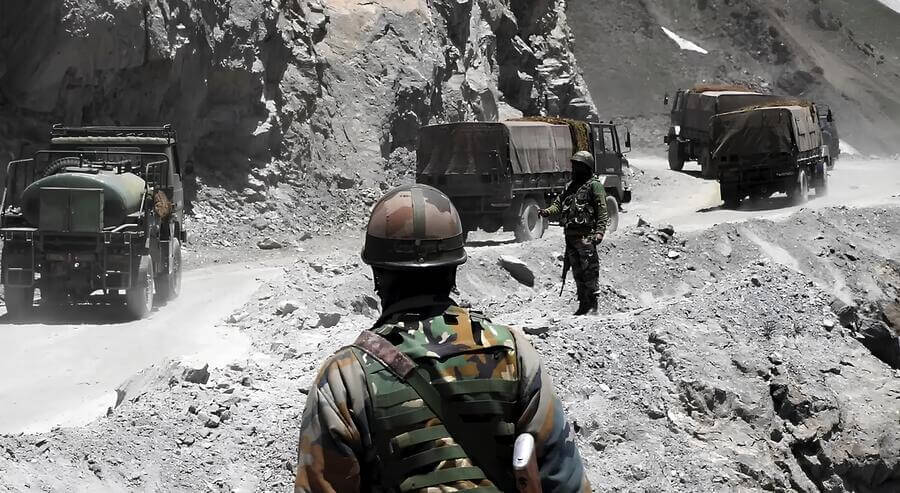
World Geostrategic Insight interview with Raj Verma on the border dispute between China and India, its roots in colonial history, how it affects bilateral relations, and the prospects for a diplomatic resolution.

Dr. Raj Verma is a non-resident scholar at the Sigur Center for Asian Studies, the Elliott School of International Affairs, George Washington University. He is the author of four books, the editor or co-editor of seven special issues or sections, and the author of over 45 articles. His research focuses on the economic, foreign, and security policies of India and China; relations between China, India, the United States, Russia, and Pakistan; Asian security; the Global South; the world order; and international relations theory. Dr. Verma has received fellowships from universities and research institutes in India, China, the United Kingdom, Taiwan, and the Philippines. He has also worked as an economist and consultant on emerging markets in Asia, particularly India and China.
Q1 – The border dispute between China and India concerns the Line of Actual Control, a demarcated border stretching 3,488 km, and dates back to colonial claims by the British Empire when it ruled India. Especially since the clashes in 2020, it has had a significant negative impact on bilateral relations. You are the author of the book “Why Did China Intrude along the Disputed Border with India in May 2020”, can you summarize here the historical context of the dispute and the strategic interests at stake?
A1 – India–China spatial rivalry is due to the dispute over Arunachal Pradesh in the eastern sector, in the central sector across the states of Uttarakhand and Himachal Pradesh (where the differences are minor and considered manageable), and Ladakh and Aksai Chin (including the Shaksgam Valley ceded by Pakistan to China in 1963) in the western sector along the disputed border.
As I mentioned in the first chapter of the book, the India-China border dispute is a legacy of the British Empire. In the Eastern sector, the dispute is over Arunachal Pradesh (referred to by China as Zangnan or southern Tibet). This is because the McMahon Line in the eastern sector, which was drawn in 1914 during the Simla Convention between British India and Tibet was never accepted by China because it believed it had sovereignty over Tibet. Due to a number of complications, the McMahon Line did not appear on British maps 20 years after the Simla Convention, but it bears significance after India became independent in 1947.
The dispute over Aksai Chin (which is occupied/administered by China) is because of the Johnson line proposed in 1865 by William Johnson, a British official of the Survey of India. The Johnson Line placed the region of Aksai Chin inside Kashmir. The Johnson Line has undergone constant revisions based on the international environment. In 1899, the revised version was named the Macartney-Macdonald Line.
The Macartney-Macdonald Line placed almost all of Aksai Chin in China. The boundary was never officially recognised by the Chinese government but it functioned as the delimited border for a time. Both India and China subsequently laid claim to Aksai Chin. While India declared Aksai Chin as historically a part of Ladakh (now a region in Indian Kashmir) based on the 1865 Johnson Line, China continues to adhere to the 1899 Macartney-MacDonald line, which places Aksai Chin in China’s territory.
As mentioned in the chapter, Sino-Indian rivalry is more complicated. In addition to the spatial rivalry, India and China also suffer from a positional rivalry. The positional rivalry between the two countries is more significant in their overall rivalry, and supersedes the spatial rivalry.
‘The positional rivalry between the two “Asian giants” is due to the competing visions of their country’s place in the international system and the pursuit of great power status in the Asia-Pacific and beyond. Both countries also have different views of history and the belief that their country will play a major role in world affairs.’ China envisages a multipolar world and a unipolar Asia with China at the helm. India aspires for a multipolar world and a multipolar Asia with India as one of the poles.
‘The positional rivalry first emerged between colonial India and Republic of China (ROC) under Chiang Kai-shek, and later between the dominion of India (formed on August 15, 1947) and Republic of India (formed on January 26, 1950), and the ROC and the People’s Republic of China (PRC, formed on October 1, 1949). Elements of the positional rivalry were visible even before India became independent during the Asian Relations Conference held in New Delhi during April–March 1947.’
In the new millennium, the positional rivalry along with nationalistic leaders (Narendra Modi and Xi Jinping) and rising nationalism in both countries has exacerbated the rivalry and made it difficult to achieve an amicable solution to the border dispute. The problem has also been aggravated by the role of other countries, especially the US and Pakistan (see chapters in the book). Now it is difficult to resolve the border dispute. It needs to be managed, to ensure a war/conflict does not break out. There are concerns that a small/minor skirmish or clash similar to the 2020 Galwan Valley clash may lead to both horizontal and vertical escalation between the two nuclear armed ‘Asian giants.’
Q2 – At the Shanghai Cooperation Organisation meeting, last June, Indian Defense Minister Rajnath Singh emphasized the need for a permanent solution to the border dispute during talks with Chinese Defense Minister Dong. On the other hand, China underscores the complexity of the dispute, but still expresses readiness for discussions on delimitation in order to maintain peace in border areas. What are the specific stands and claims of each side?
A2 – After the Galwan Valley clash, the border dispute is at the front and center of the India-China bilateral relationship. This has been reiterated time and again by PM Modi, External Affairs Minister S. Jaishankar and other Indian government officials. New Delhi has repeatedly stated that the state of the bilateral relationship will depend on the state of the disputed border. New Delhi wants the border dispute to be settled as soon as possible and also wants the LAC to be defined before the dispute can be settled.
It is not in China’s interests to demarcate and delineate the LAC. The asymmetry in power also favours China, as Mahesh Shankar and other contributors have mentioned in the book cited above. China uses the border dispute to needle India.
As Rishika Chauhan’s contribution in the book highlights, Beijing wants to undertake ‘salami slicing’ along the LAC. This serves multiple purposes. First, it allows China to nibble territory claimed and administered by India. Second, it keeps India unsettled and focused on the border issue and enmeshed in South Asian affairs. It saps India’s political and diplomatic energies. Third, India is forced to expend economic resources to increase military expenditure on the border. The scarce economic resources could be utilised for economic growth and development and enhancing India’s comprehensive national strength. Fourth, it prevents India’s military modernisation, especially the Indian Navy. India has an advantage over the People’s Liberation Army Navy (PLA) in the Indian Ocean. China is wary that India along with other countries can block the Malacca Straits which will have grave consequences for China’s economy.
Resolving the border dispute is also not in China’s interests. If the dispute is resolved, India will be able to focus all its energies on South Asia and Pakistan. Border resolution will remove the possibility of a two-front war (with China and Pakistan). It will also allow India to emerge as a regional hegemon in South Asia which is against China’s interests and its foreign policy goals. It will also allow India to challenge China in Asia and beyond and stymie Beijing’s ambition of becoming the pre-eminent power in the Asia/Indo-Pacific.
Q3 – China recently reaffirmed its territorial claims by releasing new names for numerous locations in Arunachal Pradesh. How do you assess such action from China?
A3 – This is nothing new. Beijing has been doing this for quite a while now. This is being done to reaffirm its territorial claims and build pressure on India. India has also started naming places in Tibet. This tit for tat will continue. However, it does not change ground realities.
Q4 – Both nations have engaged in 23 rounds of talks to address the issue. In your opinion, are the conditions in place for a real diplomatic resolution of this dispute?
A4 – Ceteris paribus, I do not believe that the border dispute can be resolved in the foreseeable future. The dispute needs to be managed. As India continues to rise, China will be increasingly suspicious and wary and the positional rivalry will aggravate which will also impact the border dispute. Beijing considers India as a US tool to curtail/constrain China’s rise.
However, some scholars and analysts have argued that as India continues to rise, its military capabilities will increase and the asymmetry in power will decline. They argue that since China respects power/force/strength, border tensions/frictions will decline. I do not agree with their opinion. I believe the positional rivalry will play a very important role in aggravating the border dispute. India will have to spend a lot of resources on the LAC which is exactly what Beijing wants. The LAC will be heavily militarised and there is always a possibility that a minor skirmish/clash may lead to a broader conflict/war.
Dr. Raj Verma – Non-resident scholar at the Sigur Center for Asian Studies, Elliott School of International Affairs, George Washington University.
Image Credit: File Photo: ANI