



Part I of the Special Series GLOBAL ALLIANCE AND POWER STRUCTURE: a collaboration between WGI.WORLD (World Geostrategic Insights) and CGPS (Center for Global Peace and Security).
By Sunny Lee – Founder and President at CGPS (Center for Global Peace and Security), and Director at IKUPD (Institute for Korea-U.S. Political Development), Washington DC.

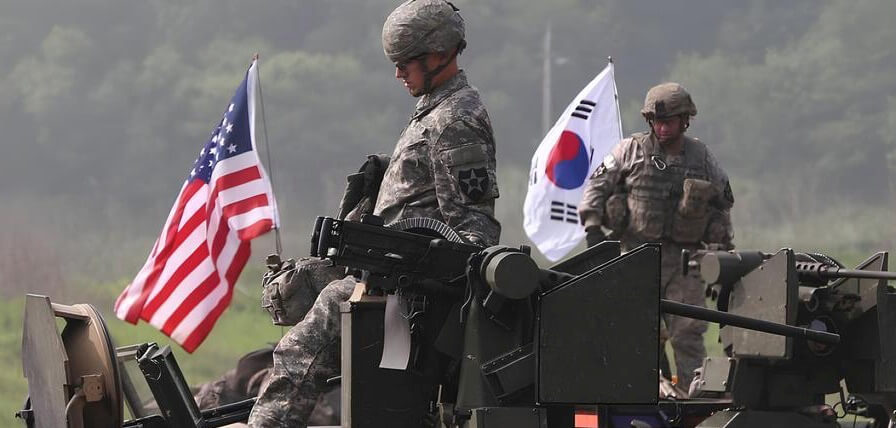
Since the Korean War of 1950-1953, the alliance between the United States and Korea has evolved into a mutual relationship toward global strategic balance throughout the 20th and 21st centuries. As a result, it has become the most important model of success in international society based on military, economic, and industrial cooperation. Korea is fully implementing the US security strategy in Northeast Asia, being a key ally not only in dealing with China and Russia, but also in countering North Korea.
Korea gained independence from Japan immediately after the US crushed Japanese imperialism with the nuclear bombings in 1945, also ending World War II.
However, the international community immediately plunged into the Cold War, and tension between the two superpowers engulfed the Korean Peninsula. Korea was divided against its will and occupied by Soviet and US forces. Five years later, North Korea invaded South Korea to reunify the country under communism, with strong support from the Soviet Union and China.
A grueling three-year war ended with the armistice agreement of July 27, 1953, on the condition that the US and South Korea sign a mutual defense treaty. This treaty ushered in a strong security alliance to prevent further invasions by North Korea, ensuring the US military presence in South Korea. The United States began to support Korea not only militarily but also economically as an important ally, easing regional tensions and overcoming the geopolitical fate of the Cold War.
Korea achieved the “Miracle on the Han River” in the 1970s and 1980s, entering the top 10 global economies at the beginning of the 21st century and ranking fifth among military powers in 2024. In particular, Korea ranks first in various military and industrial technology fields, so much so that the United States considers it one of the two leaders in the New Cold War. For example, since the United States signed a space cooperation agreement with Korea on April 27, 2016, the first such agreement between Asian countries, it has promoted an equivalent position for space exploration for peaceful purposes.
On April 2, 2025, President Trump declared a universal 10% tariff on a range of US imports, and a 25% tariff specifically on Korean products. Nevertheless, Korea’s semiconductor industry and highly advanced military technologies in the fields of fighter jets, tanks, warships, and missiles remained unbeatable on the world market as long as the US military continued to regard them as a priority. The Heritage Foundation’s Project 2025 has diagnosed that Korea’s military superiority ranks first in the world. If the US were to strengthen the alliance to counter China’s military expansion in Northeast Asia, Korea would surely be the most relevant ally to lead such an important mission.
The Security Context in Northeast Asia
Northeast Asia was a powder keg during the Cold War, and it remains so today in the New Cold War, surrounded by Russia, North Korea, and China. Korea is a strategic center in the current geopolitical context, between the autocratic bloc and democratic world.
Although the US won the Cold War outright, it has been struggling in the New Cold War since China surprisingly challenged the world economy with its bold ambition to surpass the US. A Chinese invasion of Taiwan could break out suddenly to dominate the South China Sea and drive the US out of territorial disputes. This is the fundamental reason why the United States has extended its strategy from the Asia-Pacific to the Indo-Pacific to completely encircle China.
Russia is attempting to regain leverage in Eastern Europe through the war in Ukraine, dreaming of its glorious communist past. Meanwhile, Russia is also strengthening its military strategy in Northeast Asia, having signed the Treaty on Comprehensive Strategic Partnership with North Korea on June 18, 2024, a security and defense treaty against the US and its allies.
Ironically, Russia is very suspicious of China’s strategy in the Indo-Pacific region, and willingly expands its national competitiveness in Northeast Asia through North Korea. If North Korea declares war not only on South Korea, but also on the United States, Russia would automatically support North Korea under the 2024 treaty.
Currently, Russia, China, and North Korea are assertive powers with nuclear weapons that can threaten regional security. If North Korea were to launch an intercontinental ballistic missile loaded with nuclear bombs, it could reach the mainland of the United States. In addition, North Korean cyberattacks would destroy key global systems for military and monetary purposes.
However, a plausible scenario is emerging in which Russia, exhausted by the war in Ukraine, will end up reducing its national competitiveness. The Soviet Union collapsed due to the economic crisis after spending all its national energy on the war in Afghanistan for 10 years around the 1980s. A similar outcome could be possible as long as the war in Ukraine continues, given that Russia is exhausting its military capability and is exposed to an economic crisis due to multiple sanctions.
In addition, China could also be shaken by an economic and political crisis, which could lead to the collapse of the country before a possible attack on Taiwan.
North Korea is also in a worse food emergency than in the 1990s, with symptoms of collapse when three million people died of starvation in three years.
The national crises in Russia, China, and North Korea are rapidly changing the security environment in Northeast Asia. Putin, Xi Jinping, and Kim Jong Un are all in political stalemates that could push them to extreme decisions. Nevertheless, they will not easily give up their political ambitions.
The US Indo-Pacific Strategy
South Korean President Lee Jae Myung has announced that South Korea will reduce its excessive dependence on the US by balancing its ties with China while strengthening its alliance with the US.
This means that Korea will play an intermediary role as a balance of power for regional security in Northeast Asia. Korea will prioritize multilateral relations with China, Russia, North Korea, and even Japan as a fundamental strategy, as “maintaining peace at the lowest cost is far more important than resorting to war or military conflict.” If President Lee Jae Myung succeeds in his multilateral policy, it will promote not only regional security but also economic prosperity within the US Indo-Pacific strategy.
As the most dynamic and fastest-growing region, the Indo-Pacific is an essential engine for US security and prosperity, home to the world’s busiest maritime trade routes. More than half of the world’s population lives in this region, which accounts for 60% of global GDP and two-thirds of global economic growth. US investment and trade in the Indo-Pacific region amounts to $2.28 trillion, benefiting from $956 billion in foreign direct investment. Four million jobs are linked to the United States, with five million jobs in the region in 2023, and more than two-thirds of international students in the United States come from the Indo-Pacific, prompting Trump to finally change his conservative strategy.
Since the publication of the Indo-Pacific Strategy in February 2022, the United States has promoted ambitious steps to strengthen the region’s prosperity and resilience to address the challenges and opportunities of the 21st century. The US Department of State is the central hub for building the architecture of diplomacy and global engagement through the Indo-Pacific Strategy. It is constantly reinvigorating its network of partnerships and alliances, building coalitions, and deepening its engagement in multilateral institutions. To maintain its strategic influence in the Indo-Pacific, the United States is rebalancing its approach to ensure a safer and more prosperous world both in the region and in the United States.
Although Trump is generally reducing foreign aid, he prefers practical options to restart dialogue with Indo-Pacific countries on development goals in order to prevent China from embarking on a strategic adventure in the region. In particular, Trump’s withdrawal of excessive foreign aid and the imposition of crippling tariffs undermine US economic, diplomatic, and strategic influence in the Indo-Pacific, creating space for China to expand its national advantages. The Trump administration and the US Congress have finally decided to reinvest in strategic partnerships in this crucial region.
First, Trump is strengthening bilateral alliances, demonstrating the US commitment to the region, and opening new avenues to promote economic diplomacy in the US interest. The US is focusing on extending economic partnerships in this region, as Korea’s economic growth is highly influential and critical as an important ally.
Second, the US Congress is expanding the mandate, scope, and capabilities of the US International Development Finance Corporation (DFC). With the downsizing of USAID, the DFC has become the main institution for assertive economic policy. Furthermore, as the most effective countermeasure to China’s Belt and Road Initiative (BRI), it also represents a transparent and sustainable alternative to Chinese development financing throughout the Indo-Pacific region. By strengthening the DFC, the United States is improving its economic and strategic expertise in the region.
Third, the US government has recently prioritized reducing the risk of private sector investment in Indo-Pacific markets, targeting China. To counter China’s development financing model, the US is expanding access to political risk insurance through agencies such as the World Bank’s Multilateral Investment Guarantee Agency (MIGA) and the DFC.
Fourth, the Trump administration is pursuing an economic strategy in the Indo-Pacific to strengthen US strategic objectives in the region. It has focused on strengthening supply chain resilience, enabling mutually beneficial economic growth and development with Indo-Pacific partners such as Korea, to maintain strategic influence in the region.
Korea’s Commitment to Regional Security
The Korea Defense Development Agency (ADD) has announced that Korea’s fifth scientific revolution stems from military technological innovation, demonstrating its unbeatable superiority among military superpowers. Crowning this process, on June 9, 2023, the Defense Acquisition Program Administration (DAPA) published the 2023-2037 Defense Technology Proposal, which includes an innovative weapon system with a medium- and long-term security plan.
The ten key strategic defense technologies proposed are: artificial intelligence, manned and unmanned autonomy, quantum, space, energy, advanced materials, cyber-networks, electronic warfare, propulsion, and WMD countermeasures. Korea’s innovative military technologies have made rapid progress at a relentless pace, enabling it to take the top spot in the military superiority rankings.
In particular, the three-axis system consisting of Kill-Chain, KAMD (Korea Air and Missile Defense) and KMRP (Korea Massive Punishment and Retaliation) embodies Korea’s offensive posture, characterized by preemptive strike and retaliation capabilities. It is capable of completely defeating any military challenge in Northeast Asia, such as China, Russia, North Korea, and Japan, without resorting to nuclear deterrence.
The three-axis system is totally dedicated to regional security, so much so that the United States relies on Korea’s military deterrence. If China hesitates to attack Taiwan, the fear would stem from the defense capabilities of Korea, a primary ally of the United States, which would destroy China’s audacious venture in an instant.
The precise content of the three-axis system aims to produce land, sea, and air weapon platforms for punitive retaliation. Thanks to an extraordinary process employing cutting-edge technologies, it has been possible to successfully develop ballistic missiles and cruise missiles, stealth aircraft and drones, as well as nuclear attack submarines. These innovative technologies will ensure regional security in Northeast Asia and strengthen the military alliance with the United States.
Despite strong military deterrence for regional security, President Lee Jae Myung has announced that the Korean government will restore peaceful relations with North Korea to prevent further military conflicts. Although the US and South Korea have pursued a CVID (Complete, Verifiable, Irreversible Dismantling) nuclear strategy for North Korea’s nuclear dismantlement, this may be impossible unless Kim Jung Un abandons his dictatorship or North Korea collapses.
Alternatively, President Lee Jae Myung is focusing on simultaneous multilateral relations with North Korea, China, and Russia to reduce military tensions. China is Korea’s largest trading partner with $250 billion, surpassing the United States’ $170 billion, while Russia is an important trading partner thanks to economic cooperation. If the war in Ukraine were to end, Korea, with its advanced technology, would become the priority country that Russia would need for national reconstruction in various sectors.
If South Korea were to resume economic exchanges with North Korea, regional tensions would ease and military provocations would be avoided, allowing North Korea to overcome its economic crisis and finally dismantle its nuclear weapons. Otherwise, if North Korea were to collapse suddenly, regional security would be seriously compromised by the involvement of China and Russia, which are linked by a military alliance. If, on the other hand, Kim Jung Un reforms the communist system and opens up economic markets following the example of Deng Xiaoping’s communist revolution in China, his successful model would belong to North Korea. Currently, China’s economic future is questionable due to the failure of the Belt and Road Initiative (BRI), and Russia is also facing an economic crisis due to the war in Ukraine.
However, if North Korea were to develop through economic exchanges with South Korea, its national competitiveness would increase, becoming an important power in Northeast Asia. North Korea’s economic prosperity would not only save the country from impoverishment, but also ensure regional security on the road to Korean reunification. At this point, relations between the United States, South Korea, and North Korea could evolve in such a way that South Korea would take on a mediating role, controlling direct military involvement on the Korean peninsula.
If Korea were reunified, nuclear weapons would automatically be dismantled and economic cooperation would be expanded through the connection of transcontinental railways and highways from the Korean peninsula to European countries. Gas pipelines would cross Korea from Russia and extend into the Indo-Pacific region with great benefits. This would boost economic prosperity from Eurasia to global markets, linking the world economy into a single system.
The US’s priority strategy in the Indo-Pacific region is not focused on military dominance, but on economic interests. Not only the US, but also most countries in the global society are aiming for the same goal: maximizing their economic interests rather than expanding their military power.
Therefore, through Korean reunification, if Korea becomes the main center of the world economy, playing a bridging role between the continent and the ocean, its commitment will be fully realized not only for regional security, but also for the economic prosperity of global society.
The US-Korea Alliance and the Global Power Structure
On June 6, 2025, President Trump delivered a speech to respond to the demands of the strategic environment and address new economic challenges: “The United States prioritizes deterrence toward China and ensures cooperation with Korea, as the bilateral partnership is strategically sustainable. Similarly, it is essential to modernize the alliance and calibrate the US military presence on the Korean Peninsula to reflect the realities of the regional security environment.”
Currently, the main concerns in Northeast Asia include North Korea’s continued military provocations and nuclear advances and geopolitical tensions with China. In addition, cybersecurity threats from state and non-state actors are reshaping the security landscape. In particular, North Korean threats significantly affect defense cooperation between the US and Korea, strengthening the alliance with a symmetrical role for regional stability and collective security.
The 1950-1953 Korean War ushered in the US-Korea alliance, changing the regional and global security landscape as the most successful model. Despite North Korea’s military threats, South Korea’s superior military capabilities and its strengthened role have led to a symmetrical partnership with the US. The Trump administration is reconfiguring the alliance so that its purpose, operational scope, and position are well aligned with the US geostrategic priority of countering sudden threats from an increasingly assertive China.
As long as the US views China as its main challenger, it will strengthen its alliance with South Korea. Meanwhile, President Lee Jae Myung is also accelerating efforts to transfer wartime operational control (OPCON) to Korea, marking a major change in the alliance structure. Korea’s independent military superiority with OPCON will strengthen the symmetrical leadership role of the combined forces.
Therefore, the Lee administration will pursue multilateral relations for regional security and economic prosperity in Northeast Asia in order to reduce tensions and military provocations. In the long term, the US-Korea alliance architecture will transform the global power structure, in which China, Russia, and North Korea will voluntarily participate in the regional peace and security process and their future will be guaranteed.
Author: Sunny Lee – Founder and President at CGPS (Center for Global Peace and Security), and Director at IKUPD (Institute for Korea – U.S. Political Development), Washington DC. Sunny Lee is the author of 115 academic books in politics (original English and in German, French, Russian, Polish, Dutch, Italian, Spanish, and Portuguese). She is a bestseller writer not only in politics but also in literature on Amazon. Her recent book is titled: “The Influence on Humankind’s Peace through Korean Reunification: Creating new paradigm in social science by interdisciplinary research.”
(The opinions expressed in this article are solely those of the author and do not necessarily reflect the views of World Geostrategic Insights).
Image Credit: Yonhap