



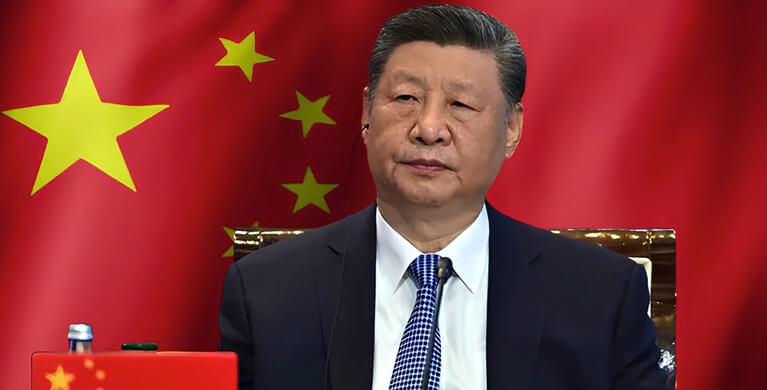
While strategic rivalry has shaped much of the contemporary international landscape, China’s rise as a global power is characterized not by war, territorial occupation, or imperial control, but by influence without invasion, including hegemony without territory or empire.

This evolving model disrupts the Western conception of international power projection, which has historically included military presence, territorial occupation, and ideological conversion.
From the weakening of the U.S.-dominated liberal international order, China proposes an alternative path of influence via economic statecraft, technological expansion, and selective norm setting as a means of governing and engaging with the rest of the world in ways not necessarily reliant on direct violence or physical conflict. This helps to raise Nagel’s fundamental questions about what international leadership looks like and should look like in the 21st century. Is it possible for a state to be hegemonic without being imperial? Is it possible for global governance to emerge without great power war? More pointedly, does China’s rise mark an end to Western dominance, or a change in what hegemony looks like?
Throughout history, hegemonic power has largely overlapped with the empire. The British Empire was a hegemonic force through naval superiority and colonial rule, while the United States, in the wake of 1945, became the rule-maker and rule-enforcer of a liberal international order based on military alliances (e.g., NATO, SEATO), economic institutions (IMF, World Bank), and narratives of democracy and human rights.
Hegemony relied upon and was enforced through persuasion as well as presence. China has forged a different path. It is expanding its geopolitical reach without military bases or ideological thinking, but rather through economic dependency, infrastructure diplomacy, and technology ecosystems. The Belt and Road Initiative (BRI) exemplifies this, having been signed with 151 countries to build reliance between China and Asia, Africa, and Europe through ports, rail and digital highways.
Unlike Western aid that is often bound by governance and transparency conditions, Chinese investment calls itself a project of mutual benefit and non-interference which is attractive to developing states fed up with Western paternalism. This is not just economic expansion; it is strategic envelopment. China – and its BRI partners – intends to place itself at the apex of global supply chains, energy corridors and digital infrastructure to share reliance and connectivity. While it is reminiscent of empire, it is not colonialism; it is hegemony – understood through interdependence.
China poses perhaps the most subtle yet profound challenge to the liberal order that the dominant modes of governance rest on normative rather than military challenge. The Western model rests on an assumption of universality or, at least, that it includes universality as one of its components. While China’s acceptance of this model remains and while China is a participating member of this order, it is not made of itself out of any intention to be homogenous to Western liberal norms.
China is not seeking to join a liberal order; it is developing an alternative model of governance alongside an economic model of exchange that offers an a palatable approach to centralized authority, technocracy, state-capitalist control over markets, and digital authoritarianism, and all of this is quietly and cheaply taking shape in a world under surveillance.
For regimes, who in fact value sovereignty more than liberalism and stability more than pluralism, China’s governance, economy, and technology are entirely palatable.From surveillance facial recognition to technical infrastructure for smart cities, technology from China is designed to plant social economic governance DNA in foreign systems. These tools are simply not ideological for the moment, but because they shape political possibilities differently, they also make certain control(s) more plausible and efficient.
Within at least some aspects of global institutions, China is playing a duplicitous game of support by merely obfuscating, bending the rules and skewing records of participation.
China is assuming a leadership role in United Nations peacekeeping operations and is gaining increasing influence in the World Health Organization and in standard-setting political bodies such as the ITU, even though it exploits rules that other states do not respect in order to regain its status as an indispensable nation on the international stage without having to openly challenge Western nations. It does not demand the destruction of the liberal order but to “recode” it from within in order to challenge Western hegemonic claims to legitimacy and headship.
Although many observers expect the imminent arrival of a “clash of civilizations,” or a new Cold War, the China-West conflict is not materializing as traditional clashes, proxy wars, or military standoffs, but as competing governance systems and spheres of influence. It is a competition of ecosystems—of finance, infrastructure, information, and values.
The American system, based on a network of alliances, open markets, and democratic ideals is fraying. The fragmentation is a consequence of increasing domestic polarization, economic inequality, and fatigue from intervention. The distinctly Western model of governance and accountability has weakened its moral authority and institutional coherence. At the same time, China is delivering predictable outcomes, efficiency, and growth—plus with no electoral politics or public dissent.
The gap is particularly stark in the Global South. Countries in Africa, Central Asia, and Southeast Asia are aligning themselves with China—not for ideological reasons, but for pragmatic ones. Beijing’s loans provide financial, technological, and infrastructure support clearly demarcated from overt and subtle steps to influence political agency. For many countries this is a better deal than imposed conditionality from the West. This should not be interpreted as these countries seek to mirror China’s system. Instead, there is an increasing multipolarity of models of governance and a plurality of governance systems, where liberal democracy is one model but not the only, or particularly the relevant one.
However, just because it does not involve violence, does not mean that it is not dangerous. China’s ascent – which is in many respects non-military – is not without coercion and cost. The critiques surrounding debt diplomacy regarding the BRI; fears surrounding digital surveillance, and the opacity of networks pertaining to Chinese political influence, suggest that soft power can also have quite sharp edges. There is a growing anxiety in democracies about Chinese influence over universities, media, and technology companies. Additionally, China’s actions in the South China Sea, border disputes with India, and military modernization should raise flags about its intentions.
Although Beijing is not interested in escalating to direct conflict, there are limits that are being tested; red lines are being blurred, and gray-zone behavior is being expanded. There is also the potential that a world influenced by China’s model might also contribute to the normalization of authoritarian behavior framed within efficiency and development. As more and more of China’s soft-power influence solidifies, it may also be more difficult to push back on behavior that threatens human rights, freedom of expression, or smaller states’ sovereignty.
The rise of China is a demonstration that hegemony does not have to mean empire anymore. A state can use economics, institutions, and technology to exert power beyond armies and territory alone. In short, China is not constructing colonies; it is constructing networks. China does not deploy troops; it deploys cables and ports.
China does not spread revolution; it spreads platforms and credit. The new power we’ve seen in China—distributed, data-driven, and deniably coercive—poses a strong challenge to the Western liberal order. It reorients our thinking about what global leadership looks like in a world where states do not necessarily avoid conflict as much as they embrace permanent competition. The West needs to think about renewing its influence in the world through reform, honesty, and clarity—not recreating an empire. If the liberal order is going to survive, it must adapt, not with a methodological emulation of China, but an alternative that is better. In this world of model wars, it will not be the loudest winner, but a resilient winner.
Author: Rana Danish Nisar – Independent international analyst of security, defense, military, contemporary warfare and digital-international relations.
(The views expressed in this article belong only to the author and do not necessarily reflect the views of World Geostrategic Insights).
Image Source: AFP