



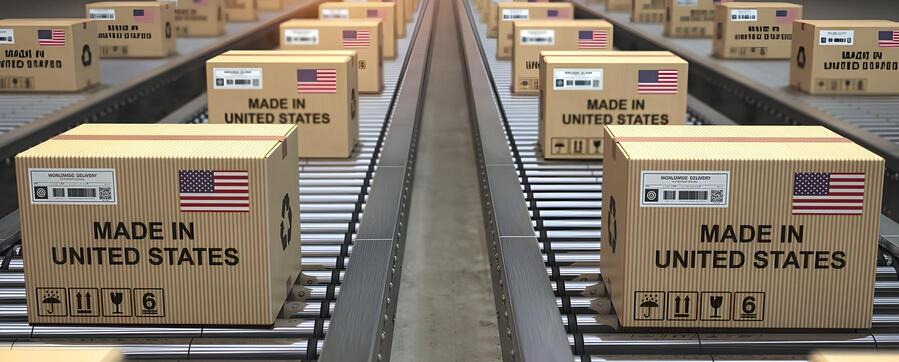
The logic behind the United States’ tariff-heavy approach to global trade was never solid, and now the economic risks are starting to surface.

While the political messaging may emphasize independence and domestic revival, economists are raising alarms that the long-term consequences of these policies could be more severe than anticipated. What may appear to be a resurgence of American manufacturing could end up diminishing the country’s economic competitiveness for years to come?
At this year’s Summer Davos in Tianjin, former WTO Chief Economist Robert Koopman voiced concerns that have been growing behind the scenes. The U.S. has yet to fully absorb the impact of the tariffs introduced over recent years. Front-loading by importers delayed the pain, but the underlying structural problems are far from resolved. American firms are facing rising costs and shifting supply chains, but the most serious issue is the erosion of investment, capital efficiency, and labor productivity.
The effort to bring companies back to U.S. soil has picked up political support. But that does not mean it makes economic sense. Even among those backing the reshoring push, there is skepticism about its ability to generate real gains. Importers are still footing the bill, with tariffs largely paid by domestic firms and consumers rather than the foreign exporters they were supposedly targeting. Koopman’s estimates suggest that only around 5 percent of tariff costs fell on exporters, while the bulk was absorbed domestically.
For households already stretched by inflation, the additional burden is evident. Harvard professor Graham Allison noted that the inflationary trend is becoming harder to control, and it is unlikely to fade soon. What compounds the issue is that new factories in the U.S. do not necessarily mean more jobs. Companies face persistent shortages of workers with the skills needed for modern manufacturing, and this is not a short-term mismatch. It is a systemic labor issue. American immigration policy has also limited the availability of unskilled labor, which remains critical in many industries.
Jeffry Frieden from Columbia University pointed out that a quarter of all manufacturing workers in the U.S. today are immigrants. Without expanding that workforce, expanding production is difficult. Firms relocating back to the U.S. may struggle to operate efficiently, especially as the economy lacks the labor pipeline needed to support a manufacturing revival. Even if some jobs return, the losses from shrinking export markets may cancel them out. Net employment gains are not guaranteed.
Another worry is the decline in foreign investment. Tariffs tend to pull capital into protected sectors that are less productive, like textiles or footwear, at the expense of high-growth areas. According to Koopman, this redirection of capital weakens the broader economic base and undermines innovation. Automation often fills the space where labor might have once been used, weakening the employment case further.
This retreat from openness does not just slow growth. It creates uncertainty. Frederic Neumann of HSBC explained that unpredictability in tariff policy has made it harder for firms to make long-term investment decisions. Whether it’s unclear durations, targeted goods, or shifting political goals, the instability reduces appetite for mergers, consumer spending, and even bond issuance. Data backs this up. The number of private-equity-backed IPOs in the U.S. and Europe dropped from 116 in early 2021 to just nine in early 2025, according to Dealogic.
Meanwhile, the rest of the world is adjusting. As Washington distances itself from established trade networks, others are strengthening their own links. China and the EU have deepened cooperation. Developing countries are moving more toward regional trade partnerships. The U.S. now accounts for a smaller share of global cargo imports, just around 13 percent. For many countries, the American market no longer holds the central position it once did. The shift is already happening.
The U.S. has traditionally benefited from its leadership in innovation, but that edge is now under pressure. Other regions are investing in critical technologies and academic collaborations. The calls in Washington to further restrict flows of people and capital for strategic purposes may end up weakening the very capabilities that powered past American growth. If the U.S. closes off too much, it may find itself isolated not just diplomatically but economically as well.
Gruenwald’s remarks in Tianjin made this point clear. The global trade structure is evolving without the U.S. at its center. Countries are forming new blocs, reshaping alliances, and expanding trade within Asia and beyond. This movement is not just tactical—it is becoming structural.
The bigger risk is reputational. Once trust is lost, it takes time to rebuild. Trade agreements are not patched up in a few weeks. When the U.S. unilaterally imposed restrictions, other countries took note. They begin to build systems that work around American influence, not with it. Europe is exploring deals with Asia-Pacific partners, and ASEAN states are expanding intra-regional trade. These moves reduce dependence on the U.S. and make its return to influence more difficult.
The early political advantages of tariffs may satisfy certain domestic audiences, but they carry hidden costs that accumulate slowly. These costs—missed investment, weak job creation, slower innovation—do not make headlines. But they shape the direction of an economy. As the U.S. continues to press forward with tariffs and reshoring, it risks building a future that is more constrained, less dynamic, and increasingly out of sync with the global economy. That reality will be harder to manage once it fully sets in.
Author: Muhammad Asif Noor – Founder Friends of BRI Forum, Advisor to Pakistan Research Center, Hebei Normal University.
(The opinions expressed in this article are solely those of the author and do not necessarily reflect the views of World Geostrategic Insights).