



By Farshad Adel
Israel’s attack on Iran began unexpectedly on the night of June 13, 2025, though warnings had been issued for months that an Israeli strike on Iran was inevitable.
This conflict, which peaked in a 12-day war, is an extension of a long struggle spanning over four decades. A confrontation rooted in geopolitics yet underpinned by ideology, it has, over the past forty years, become a foundational element of the Islamic Republic’s identity. For years, the promise of Israel’s destruction has been touted as one of the Islamic Republic’s foremost objectives.
This stance, seen by some as expanding Iran’s influence among Muslim nations, shaped Tehran’s regional policies and led to the formation of an axis of non-state actors known as the “Resistance Groups.” These groups, labeled by the Western axis as Iran’s proxy forces, prompted a long-term strategy to counter Iran’s regional influence.
Ultimately, through the narrative of the “Octopus Doctrine” in opposition to Iran, this strategy weakened Resistance Groups in Gaza, Lebanon, and Iraq, while pushing Iran’s sole state ally, Syria, toward collapse. The Western axis and Israel, by severing Iran’s regional arms and exhausting the Islamic Republic—already under severe sanctions—nullified Iran’s deterrence based on Resistance Groups and missile capabilities. Exploiting deep intelligence and security breaches, they launched a lightning operation in the early hours of the attack, targeting Iran’s top military commanders. With air superiority secured—facilitated by Iran’s lack of a robust air force—they struck the country’s most sensitive military and security sites.
This operation, which suppressed Iran’s air defenses, culminated in American bombers entering Iranian airspace and destroying nuclear facilities in Fordow, Natanz, and Isfahan. Thus, Israel’s primary objective—neutralizing the threat posed by the Islamic Republic—was achieved.
A New Middle East Order
Yet, what transpired was not merely an Israeli operation to neutralize Iran; the attack on Iran marks the final and most critical step in initiating a new security architecture for the Middle East and shaping a fresh political and economic order—one that could cement U.S. power as the world’s superpower for decades to come.
The Middle East is a region rich in cheap energy, governed by authoritarian rulers who can, with a single directive and bypass bureaucracy, allocate billions for R&D in high-tech industries. Merging Middle Eastern oil wealth with cutting-edge American technology and forging a strategic partnership with the U.S. in this domain would enable American industries to capitalize on this opportunity, shattering China’s dream of becoming the world’s high-tech superpower by 2049.
In an era where advancements in high-tech industries have surpassed economic growth as a priority for both the U.S. and China, America’s superpower status will only endure if it can stabilize the Middle East and optimally exploit the region’s opportunities. Most crucially, it must prevent China’s expanding influence and its potential exploitation of the Middle East’s advantages.
However, stability in West Asia hinges on Israel’s consolidation in the region and the normalization of ties between Middle Eastern states and Israel. In this context, the Islamic Republic of Iran—as the standard-bearer of anti-American resistance and a perceived anti-system element—stood as a major obstacle to realizing the “Abrahamic Order” and Arab-Israeli normalization. Weakening Iran and removing it from the regional power competition paves the way for a “New Order” in the region.
Geopolitical Shifts and Economic Integration
Amid the current transition of the Middle East from “crisis” to “development,” initiatives promoting regional economic integration are being pursued more vigorously. Projects like the “IMEC (India-Middle East-Europe Corridor)” and the “Middle Corridor” have been introduced as new brands facilitating this integration—with Israel positioned as a key node, anchored in the region through “economic stickiness.”
In this scenario, Iran must acknowledge that fundamental shifts in the region’s security, political, and economic order are underway. Accordingly, Iran should leverage its geographical and civilizational capacities to propose initiatives aligned with the new regional dynamics and unveil macro-strategies complementary to those of neighboring states.
The Path Forward
This flexibility—rooted in the “inherent tolerance of Iranian civilization”—will provide Iran with a significant opportunity to reassert itself as a prominent regional player.
Author: Farshad Adel – Secretary-General of The Iran-China Think Tank For Strategic Studies, Teheran, Iran.
(The views expressed in this article belong only to the author and do not necessarily reflect the editorial policy or views of World Geostrategic Insights).
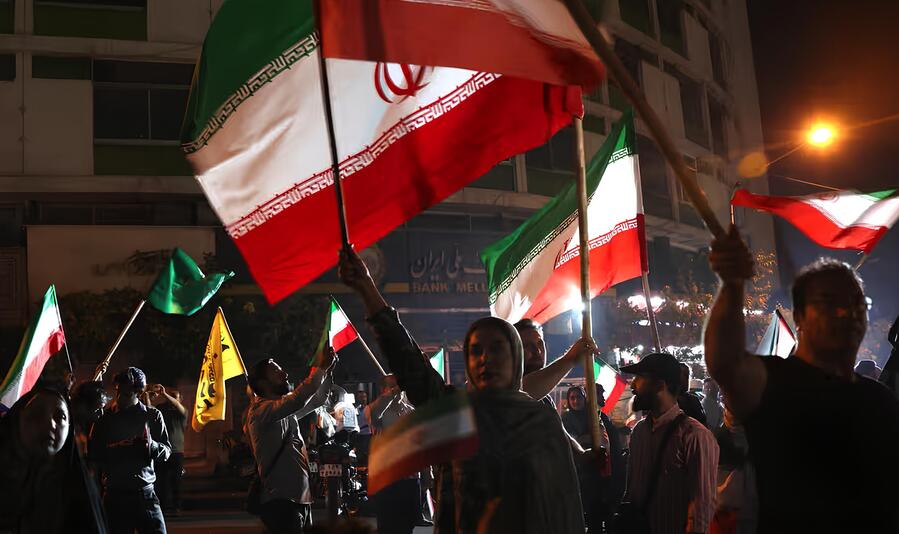
Image Credit: Majid Asgaripour/Reuters