



By Roxana Niknami
Europe often defines itself as a “normative power,” a concept denoting an international actor that legitimizes its foreign policy primarily through adherence to international law, promotion of universal norms, and respect for state sovereignty.

This normative identity positions Europe as a guardian of the international legal order, emphasizing the inviolability of territorial integrity and the prohibition on the use of force, as enshrined in the United Nations Charter. Article 2(4) of the Charter explicitly prohibits all UN member states from threatening or using force against the territorial integrity or political independence of any state.
The only recognized exceptions are actions authorized by the UN Security Council under Chapter VII of the inherent right of self-defense in accordance with Article 51. This principled framework is the cornerstone of Europe’s self-perception and its claim to international legitimacy.
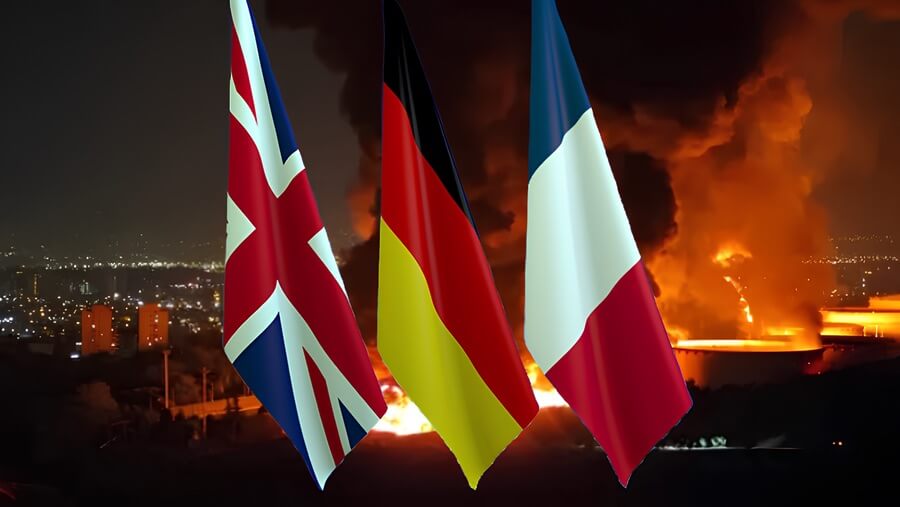
However, the recent Israeli military strike inside Iranian territory and the subsequent reaction of the European Troika—Germany, France, and the United Kingdom—cast serious doubts on Europe’s normative consistency and strategic autonomy.
While these European powers rhetorically affirm Israel’s “right to self-defense,” their failure to rigorously apply and demand compliance with international legal standards exposes a normative blindness that undermines their credibility as promoters of the rules-based international order.
Legal Framework and Violations
The United Nations Charter’s Article 2(4) establishes a clear and unambiguous prohibition on the threat or use of force. This foundational principle, a product of lessons drawn from the devastation of World War II, remains a bulwark against unilateral aggression.
Exceptions to this rule are narrowly circumscribed. First, the Security Council may authorize collective enforcement measures under Chapter VII in cases threatening international peace and security. Second, Article 51 preserves the inherent right of self-defense if an armed attack occurs. Israel’s recent attack on Iranian soil was neither authorized by the Security Council nor preceded by an armed attack against Israel that would justify immediate self-defense. The European Troika’s acceptance of Israel’s justification sidesteps these stringent criteria, instead offering political cover without substantiating claims through international legal instruments.
The doctrine of anticipatory or pre-emptive self-defense, often invoked in such contexts, derives from the 19th-century Caroline case. This customary law principle demands that the necessity for self-defense be “instant, overwhelming, leaving no choice of means, and no moment for deliberation.”
International jurisprudence, especially the International Court of Justice’s (ICJ) judgment in the Nicaragua case (1986), has further tightened these conditions, emphasizing that self-defense is triggered only by actual armed attacks, not speculative threats.
In the case at hand, evidence supporting an imminent and overwhelming threat posed by Iran to Israel remains unsubstantiated publicly. Moreover, the principle of proportionality, another cornerstone of lawful use of force, appears compromised given the scale of Israel’s military response.
Beyond jus ad bellum (the law governing the resort to force), the attack raises grave questions under jus in bello, or international humanitarian law. The targeting of nuclear or civilian infrastructure—even if justified under disputed claims of self-defense—is prohibited under the Geneva Conventions and their Additional Protocols.
The destruction or endangerment of civilian populations and non-military facilities violates core principles of distinction and proportionality. Mohamed ElBaradei, former Director-General of the International Atomic Energy Agency (IAEA), has explicitly stated that strikes on nuclear facilities constitute a violation of international norms and risk catastrophic consequences.
Moreover, the Rome Statute of the International Criminal Court identifies acts of aggression as prosecutable offenses. Many legal scholars classify Israel’s attack within this category, arguing it constitutes a breach of Articles 2(4) and 8bis of the Rome Statute.
Europe’s Normative Credibility at Stake
Europe’s diplomatic posture in the wake of this incident reveals a tension between political alliances and normative commitments. By tacitly endorsing or failing to condemn Israel’s breach of international law, European states compromise their claim as normative powers. The concept of normative power presupposes an ability and willingness to hold all actors accountable to the same standards, regardless of political convenience or strategic interests. This ambivalence erodes the trust other global actors place in Europe’s commitment to the rule of law and weakens its leverage in broader multilateral forums.
The European Union and its leading states risk being perceived not as impartial guardians of international norms but as selective enforcers, applying double standards based on geopolitical calculations. The strategic consequences of this erosion are far-reaching. Europe’s role as a mediator in regional conflicts, its capacity to promote peaceful resolution, and its influence in shaping global governance structures all depend heavily on its normative authority.
Political Dynamics and Strategic Implications
The European Troika’s reaction cannot be divorced from the complex geopolitical environment shaped by its close strategic ties to the United States and Israel. Within the transatlantic alliance, the expectation of unequivocal support for Israeli security often constrains Europe’s foreign policy autonomy.
The ongoing tensions surrounding Iran’s nuclear program, regional rivalries, and global security concerns further complicate Europe’s position. The European powers are challenged to balance their commitment to international law with pragmatic considerations regarding security and alliances.
Nonetheless, this balancing act comes at a cost. The selective application of norms risks deepening divisions within the EU regarding foreign policy coherence and strategic autonomy. Calls for a more independent European defense and diplomatic posture gain momentum in response to perceived over-reliance on the United States.
Restoring Europe’s Normative Role
For Europe to restore its normative standing, a reassertion of legal principles must be accompanied by concrete political actions. This entails a transparent and unequivocal reaffirmation of the UN Charter’s prohibitions on the use of force, including explicit condemnation of unauthorized military actions.
Supporting impartial investigations by international bodies, including the Security Council and the International Court of Justice, would demonstrate Europe’s commitment to accountability. Moreover, Europe should leverage diplomatic and economic instruments to encourage compliance with international law, rather than defaulting to political expediency.
A genuine reorientation towards normative consistency also requires internal cohesion among European states. Divergent national interests must be reconciled within a shared framework that prioritizes legal integrity and long-term stability over short-term strategic gains.
Conclusion
Europe stands at a crossroads regarding its self-ascribed identity as a normative power. The recent Israeli strike on Iran and the ambiguous or supportive response of the European Troika starkly illustrate the challenges inherent in reconciling legal obligations with geopolitical realities.
Failing to uphold international norms unequivocally risks relegating Europe to the role of a geopolitical actor constrained by power politics rather than a principled architect of the international legal order.
To avoid this fate, Europe must reaffirm its commitment to the UN Charter, uphold the rule of law impartially, and navigate its foreign policy with greater independence and integrity. Only through such a principled approach can Europe maintain its legitimacy and continue to shape a stable, rules-based international system.
Author: Roxana Niknami – Professor of Regional Studies, University of Tehran, Tehran. Iran.
(The views expressed in this article belong only to the author and do not necessarily reflect the views of World Geostrategic Insights).