



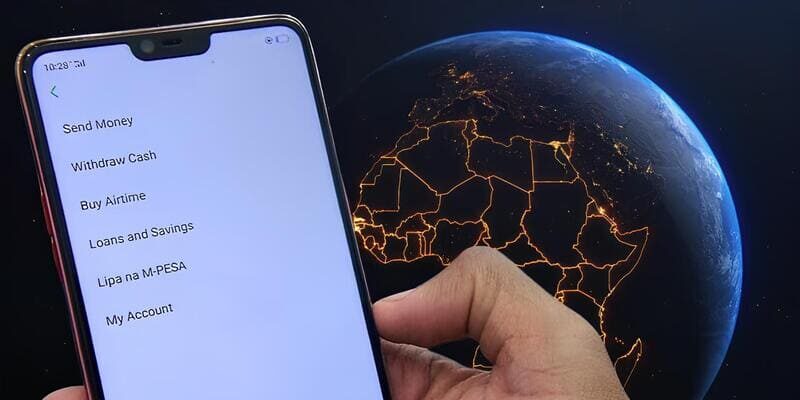
World Geostrategic Insights interview with David R. Whitehouse on the impact of fintech in Africa, its effects on traditional businesses, the risks inherent to microlending practices, and regulatory challenges.

David R. Whitehouse is a financial journalist with over thirty years of experience in the field. He spent 17 years in Paris as an editor for Bloomberg News, closely covering the most complex global economic developments. Today, he is the founder and author of The Dark Side of Development, a specialized newsletter on Substack that offers weekly analysis and critical insights on fintech and microcredit regulation in the Global South.
Q1 – In your work, you often point out that the actual impact of microfinance on poverty is close to zero. However, historic African mobile money platforms like M-Pesa are celebrated globally as miracles of financial inclusion. From your perspective, how does the narrative of success surrounding these tech giants mask a debt trap for the continent’s poorest populations?
A1 – The major problem with mobile money platforms is that they don’t, in themselves, do anything to expand the size of markets in which small-scale entrepreneurs operate. Some small businesses will gain an advantage from mobile-money adoption. The studies which focus on these advantages usually overlook the older incumbents in the same markets who find themselves displaced as a result of not being so quick to adopt. These older players may go out of business completely, so the narrative forgets about them.
Simple access to formal financial services – “financial inclusion” – doesn’t alter the business fundamentals for most small entrepreneurs. It simply makes further financial inputs available to all of them. An expanding pool of entrepreneurs finds itself competing for ever smaller sizes of the same pie, the only real difference being that they are more likely to be using digital debt as they do so.
Q2 – In Asia, tragic waves of suicides have occurred due to the inability to repay microloans. With the digitalization and spread of smartphones in Africa, are instant microloan apps (Fintech) replicating the exact same predatory schemes seen in Asia? What warning signs are you already seeing in key markets like Kenya or Nigeria?
A2 – The same patterns are emerging in some African countries as have already been seen in Asia. Kenya is perhaps the most alarming African example. Regulators in Kenya this year introduced a draft protection framework for borrowers which includes a requirement for assessment of ability to repay before a loan is made. That follows default rates of well over 50% on loans for $10, or $20 or $50 which are obviously too small to have a real business purpose.
There have also been abuses based on “harvest contacting” in Kenya – lenders were collecting the contacts on the phone when the loan is made and then notifying all the contacts if the borrower falls behind in repaying. This kind of “digital shaming” is faster and potentially even more dangerous than older forms of “social shaming” for non-repayment.
Q3 – Many African Fintech companies are funded by massive amounts of Western or Asian venture capital. Instead of generating local wealth, isn’t the African Fintech ecosystem at risk of turning into a giant extractive machine that transfers liquidity from rural African communities outward in the form of interest, fees, and dividends?
A3 – This is already true not just in Africa but across the developing world. Recent research by Isabelle Guérin and Arnaud Natal has estimated that around 33% of the world’s population regularly rely on unsecured or informal forms of borrowing.The only people who can deal with this are funders and regulators.
Q4 – Fintech startups facilitate access to instant cash, but often these digital loans do not finance micro-enterprises or productive investments, but rather consumer goods or emergency expenses. What is the macroeconomic impact on GDP and savings in African countries when private debt grows at breakneck speeds without generating real production?
A4 – In terms of impact on GDP, the impact of financial inclusion is unproven. The main studies which consider the relationship between financial inclusion and GDP growth do not look at the possibility of reverse causation. It may be the case that financial inclusion in fact does not have much effect on GDP, and that accelerating GDP has as a by-product an increase in financial inclusion.
At the same time, it’s clear that microcredit has a pro-cyclical impact on economies. The loan supply increases during periods of economic growth and contracts during recessions. In that sense, microcredit is no different from any other kind of bank lending.
Q5 – What are the primary obstacles to creating a unified, cross-border regulatory framework for digital lending across the African Continental Free Trade Area (AfCFTA)?
A5 – Progress by the European Union in financial regulation is often slow and contested. Africa has twice as many countries, and the EU is much older and better established than the AfCFTA. The harms of poorly regulated digital lending are far too urgent to wait for African regulatory harmonization, which could take another generation. National regulators have to step up, and co-operate where they can.
This, I would suggest, involves getting away from the idea that a laissez-faire regulatory approach is appropriate in the early stages of digital lending to enable scale to be achieved. In Asia, Africa and Latin America, regulators have repeatedly been chasing after the fact to seek to fix harms that should have been predictable. The harms that have already been incurred are irreversible, while the benefits of digital lending in poor countries are at best unproven.
Q6 – In 2022, the Central African Republic adopted Bitcoin as legal currency. You have pointed out that the only real winners of that move were financial criminals. Years later, and with huge markets like Nigeria and Kenya leading the way in crypto adoption, do you believe that cryptocurrencies in Africa are serving more as a shield for citizens against inflation or as a digital highway for money laundering and capital flight?
A6 – It’s arguably rational for people in countries with chronic inflation to hold crypto currencies as a hedge. Crypto currencies at the same time lend themselves to money laundering. The Financial Action Task Force (FATF), the global money laundering and terrorist financing watchdog, has standards on virtual assets and virtual asset service providers (VASPs) which can help, but global adoption has been slow.
There’s also a need for more countries to adopt and enforce the FATF’s “Travel Rule”, which requires financial services providers including VASPs to collect and transmit information on the identity of who is behind transactions.
Q7 – In your Substack blog, “The Dark Side of Development*, you’ve addressed the issue of crypto scams and criminal networks (such as the Chinese mafia in South Africa or cyber-scam syndicates in Southeast Asia) that use stablecoins to move proceeds from ransoms or human exploitation. Why are African regulators failing to enforce strict KYC (Know Your Customer) standards on local Crypto Asset Service Providers, allowing these ecosystems to be exploited by global mafias?
A7 – African regulators have financial and capacity constraints even when dealing with more domestic issues, and the rise of global cyber-crime often does not fit clearly into the responsibilities of existing functions. Even assuming capacity, the issues cannot be meaningfully addressed at a purely national level. Transactions may have originated outside Africa in places where it’s possible to obscure the identity of the originator. Crime syndicates will inevitably target the weakest links wherever they can be found. Global regulatory co-ordination is the only approach that has a realistic chance of success.
David R. Whitehouse – Financial journalist, founder and author of The Dark Side of Development.