



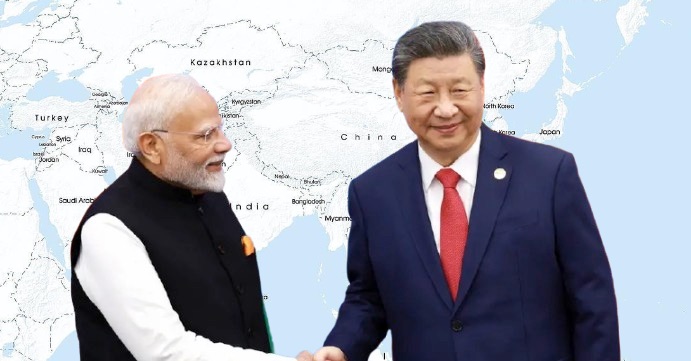
The 21st century is increasingly being framed as the “Asian Century” – a term that underscores the remarkable rise of Asian powers, particularly India and China, as dominant forces in global economics, politics, and technology.

Among analysts and observers, there is often a tendency to pit these two countries against each other in a binary narrative, suggesting that the rise of one must correspond with the decline of the other.
However, this approach fails to recognize the complexities of modern globalization in the age of economic nationalism, economic interdependence, and regional diplomacy. The truth is more nuanced: India’s economic rise is not China’s fall. Instead, it represents the diversification and deepening of Asia’s role in global leadership, potentially marking the beginning of a truly multipolar world.
India has emerged as one of the world’s fastest-growing major economies and the World Bank forecasts 6.7% growth in both FY26 and FY27. With a population of over 1.4 billion, a young demographic profile, and rapid digital adoption, India is well-positioned to become a pivotal force in the global economy. As of 2025, India’s Gross Domestic Product (GDP) has surged to $4.3 trillion, according to the International Monetary Fund (IMF), marking a 105% increase from $2.1 trillion in 2015.
India will become the 4th largest economy at the end of this year overtaking Japan; it will be 3rd largest by 2027. The transformation has been driven by several factors, including robust service and technology sectors, significant infrastructure development, and widespread reforms in digital governance. Government initiatives like “Digital India” and the “Unified Payments Interface (UPI)” have revolutionized digital transactions and financial inclusion, setting global benchmarks for fintech innovation.
India is also playing a proactive role in shaping regional and global geopolitics. As a member of strategic alliances like BRICS+, the Shanghai Cooperation Organization (SCO), and the recently launched India-Middle East-Europe Economic Corridor (IMEC), India has positioned itself as both a regional anchor and a global bridge.
IMEC aims to connect India to Europe through the Middle East via a network of rail, road, and ports, spanning the UAE, Saudi Arabia, Jordan, and Israel. This corridor not only strengthens India’s economic integration with West Asia and Europe but also represents an alternative model of infrastructure development – one that prioritizes transparency, sustainability, and multilateral cooperation and is expected to bolster transportation and communication links between Europe and Asia, facilitating trade and enhancing geopolitical cooperation among participating nations.
China, meanwhile, continues to be an economic juggernaut. Despite current challenges, it remains the world’s second-largest economy, commanding a leading role in global manufacturing, technology, and trade. Over the past two decades, China’s rise has been marked by massive industrialization, aggressive export-led growth, and strategic state-led investments.
The Belt and Road Initiative (BRI) is a testament to China’s ambition to reshape global trade routes and exert geopolitical influence through infrastructure diplomacy. The BRI’s span across 5 continents with more than 150 countries and almost 30 international organizations, involving an investment of more than $1 trillion, the BRI has constructed ports, railways, highways, and industrial parks across Asia, Africa, and Europe.
Yet, China is also facing headwinds. The nation’s manufacturing sector contracted in early 2025, with the Purchasing Managers’ Index (PMI), dropping to 49.0 in April – its lowest since December 2023. This downturn is largely attributed to escalating trade tensions with the United States, including tariffs exceeding 125% on Chinese goods. These pressures, coupled with a slowing property market and demographic challenges such as an aging population, have led economists to revise China’s growth forecast below its 2025 target of 5%, with some estimates placing it as low as 4.1%.
Internally, the property sector crisis and increasing levels of local government debt have triggered concerns about economic stability. Externally, growing tensions with the United States, coupled with accusations of “debt-trap diplomacy” in some BRI-partnered nations, have complicated China’s global standing. Nonetheless, China’s resilience and its ability to adapt through increased emphasis on domestic consumption, green technologies, and digital infrastructure suggest it is not on the verge of decline, but rather entering a new phase of recalibration.
The often-cited “India versus China” narrative is therefore misleading and unproductive. While the two countries share borders, compete for influence in Asia and beyond, and maintain tense relations over geopolitical disputes such as the Line of Actual Control (LAC), their economic paths are not mutually exclusive.
India and China are developing along distinct trajectories. China’s model remains state-centric and export-oriented, while India’s growth is driven by democratic governance, private enterprise, and a service-led economy. Both countries are vital to global value chains and, rather than replacing each other, they are likely to define different aspects of the global economic order.
Strategically, the emergence of IMEC presents a fascinating counterbalance to China’s BRI. IMEC is not only a connectivity project but a symbol of a broader vision – one that emphasizes multilateralism over unilateralism. By incorporating Europe, the Middle East, and South Asia into a cohesive trade corridor, IMEC has the potential to diversify energy routes, stimulate regional development, and foster new diplomatic alignments.
Its success could usher in a more inclusive model of global infrastructure, contrasting with China’s debt-heavy, state-to-state investment style. However, it is important to note that IMEC and BRI need not be antagonistic. Both corridors can coexist, offering nations diverse options and mitigating the risks of overdependence on a single power or route.
From a broader perspective, the Asian Century is not about a single hegemon replacing the West. Rather, it is about the rise of multiple centers of power within Asia – India, China, ASEAN nations, and others – each contributing to global growth, innovation, and governance. This shift is more horizontal than vertical.
It reflects the democratization of opportunity and the increasing relevance of non-Western voices in shaping the rules of the international system. Both India and China, through different means, are challenging the existing global order not to destroy it, but to rebalance it.
India’s rise also carries significant implications for the Global South. Its model of digital empowerment, bottom-up innovation, and low-cost infrastructure holds lessons for developing countries in Africa, Southeast Asia, and Latin America. Meanwhile, China’s experience in large-scale infrastructure and manufacturing continues to attract governments seeking rapid industrialization.
Together, these two giants offer distinct development templates, creating a more pluralistic global environment where countries can choose paths that align with their own values and contexts. Still, the journey ahead is not without risks. India must address its internal contradictions ranging from infrastructure gaps and policy bottlenecks to social polarization and Hindu extremism. Similarly, China must navigate economic slowdown, demographic decline, and global suspicion about its intentions.
The success of the Asian Century will depend not only on economic metrics but also on the ability of its leading powers to coexist, cooperate, and compete without confrontation. India’s economic rise is not a zero-sum scenario that spells doom for China. It is a sign of the times – an affirmation that Asia is no longer a passive recipient of globalization but a key architect of its future.
As both countries continue to evolve, the world must move beyond simplistic dichotomies and embrace a more nuanced understanding of power in the 21st century. The Asian Century belongs not to one, but to many. It is not about replacement, but about transformation – and in that transformation lies the hope of a more balanced, inclusive, and dynamic world order.
Author: Mirza Abdul Aleem Baig – President of Strategic Science Advisory Council (SSAC) – Pakistan. He is an independent observer of global dynamics, with a deep interest in the intricate working of techno-geopolitics, exploring how science & technology, international relations, foreign policy and strategic alliances shape the emerging world order.
(The views expressed in this article belong only to the author and do not necessarily reflect the views of World Geostrategic Insights).