



By Sumanta Khatiwara and Priyangshu Chakraborty
The international system is fast transforming into a multipolar, contested and institutionally fragmented world, where BRICS is stepping into its third decade. India’s BRICS presidency, with the theme “Building for Resilience, Innovation, Cooperation and Sustainability” in 2026, is at a critical moment.

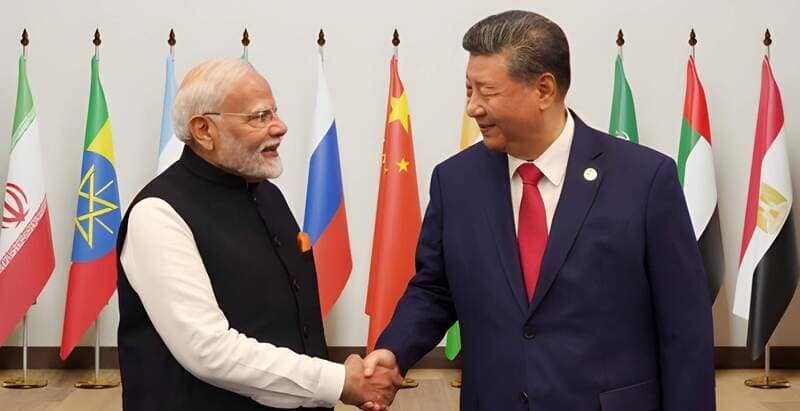
With the similar lens, the growth of BRICS has boosted its political and symbolic presence in the Global South with political diversity and divergent interests. The expansion of BRICS has considerably broadened the geopolitical reach of the grouping, with Indonesia’s joining as a full member last year in 2025, now BRICS comprises eleven full-time members, this expansion has increased political significance and made its internal strategic diversity more pronounced. At the core of this dilemma captures India-China dynamics: two great powers of Asia; cooperating in BRICS and competing to assert influence, strategic space and leadership in the South Asian game play. This visible paradox of amity and enmity between the two great powers raises a fundamental question. Is it even possible for BRICS to enhance multilateral cooperation as two of its key members are strategic rivals?

Significantly, the paradox of solution lies not in hoping for cooperation between New Delhi and Beijing but understanding BRICS as a platform for competitive cooperation and an abundance of opportunities. The interplay amid contestation within BRICS exemplifies the simultaneous processes of Conflict and Cooperation as India’s quest for strategic autonomy allows it to interact with China institutionally without conceding Chinese hegemony. In the early 2000s, the term competitive multilateralism began to gain traction and the Sino-India notion fits over the argument of competitive multilateralism. BRICS was never meant to become a traditional military or political formation. It has continued to serve as a dynamic coordination platform through which its members aim to gain a stronger voice for the Global South and to reform existing institutions of Global Governance.
Today, BRICS is a politically and ideologically diverse alliance that does not necessarily agree on a unipolar or bipolar world order. The flexibility in BRICS implies very thing that enables states with conflicting interests to work together. This functional aspect is reflected in the theme of India’s 2026 BRICS chairmanship, i.e. “Building for Resilience, Innovation, Cooperation and Sustainability.” Generally, Cooperation is advent to highlight the areas of energy security, disaster-risk reduction, health, science and technology urbanisation and other areas. These programs indicate the replication of lack of consensus between BRICS but tangible results are attainable. BRICS should be more correctly seen not as an anti-western coalition but as a negotiating forum in a new global balance of power. It aims at promotion of autonomy to its members from the current global governance mechanisms while maintaining their freedom to act in respective national interests.
India and China: Amity and Enmity in Parallel
The presence of contradiction and compulsion that is best exemplified by the India-China relationship. A theory of Regional Security Complex states that a pattern of amity and enmity forms the security perspective; gets visible between India and China. Moreover, there is a considerable amount of good-will at the international level of governance. Both the states want more developing countries to be represented and wishes to see reforms in international institutions and favour for multi-polar distribution of global power. BRICS do offer an ad-hoc body to further these common interests.
However, the relationship between New Delhi and Beijing gets more controversial at the regional level. India and China go head-to-head for control over Asia for connectivity, economic networks, technology and smaller states relations with contrasting interests. The unsettled border disputes and wider strategic rivalry exacerbate trust issues between two countries, considered as ever-lasting suspicious. To China, New Delhi is considered a potential threat to capture its market entitlement and emerging competitor in the region whereas, India treats China as an unavoidable partner but specs of lessons from historic distrust. Also, India’s interaction with Indo-Pacific allies and QUAD countries enhance equidistance, similarly the China-Russia engagement indicates India’s need for retaining capacity prior to national interests amid changing global politics.
Yet the persistence of the geopolitical rivalry has not eliminated economic interdependence. This is one of the most palpable empirical examples. Despite the ongoing strategic tensions, total India-China trade was approximately US$127.71 billion for FY 2024-25. India’s total imports from China were valued as US$113.46 billion while exports were valued as US$14.25 billion. This economic relationship is not so large as to imply a lack of competition; it is, however, a relationship where strategic competition and functional economic competition are not mutually exclusive.
The dynamic is not only an argument for the need to look at India-China relation beyond the dichotomous binary of cooperation versus confrontation, but also pours the relationship, an elevated sense of urgency. It is more aptly described as being limited to interaction and cooperation when interests overlap, perhaps competition when strategic interests are at odds. Therefore, relationships are marked by compartmentalised cooperation, that is, cooperation in areas where interests coincide and competition in areas where interests are divergent. Notably, it is not necessarily dysfunctional because of the presence of the India-China rivalry. Instead, it sets a limit on the extent to which institutional cooperation would go.
Strategic Autonomy and the Logic of Balance-of-Power
India’s transition from non-alignment to multi-alignment and strategic autonomy that goes beyond bloc politics; in freedom of action. The concept of strategic autonomy does not necessarily mean that it is an isolated position, but ‘one must remain in a position to make autonomous strategic decisions without becoming excessively dependent on any one power centre’. In a sense, India’s inclusion in the BRICS group is no evidence of drifting towards China at the expense of the West. Nor is India’s increasing involvement with the Western and Indo-Pacific partners a contradiction to its BRICS membership. Rather, these seemingly paradoxical connections are part of a larger plan of strategic space for manoeuvre.
This relies upon the dimension of Balance of Power. India is interested in averting a unipolar international system. With the rising economic and political influence of China, poses a specific challenge, as Beijing plays a major role in India’s multipolar aspirations and its key competition in the Asian region. This creates a strategic-autonomy paradox where India needs to cooperate and promote a more ‘plural global order’ and at the same time, to avoid this order being misaligned by China. Specifically, BRICS, then, is not only a tool of alignment, but rather an institutional balancing. India can engage itself in mechanisms which would reduce excess dependency upon Western powers and not been under the trap of Chinese influence.
Beyond India and China: Russia and the Expanded BRICS Matrix
The strategic environment in BRICS is not just a bilateral equation of India and China. Russia continues to be an important third player that determines India’s room for manoeuvre. Historically, Moscow was one of New Delhi’s most relevant strategic partners; later relation with Beijing has become a more significant aspect of Eurasian geopolitics. This presents a complicated triangular situation for India.
However, the addition of India to BRICS may offer Russia a further strategic space by not bringing India into the group as a force to balance upon China. India has a long-established diplomatic and strategic partnership with Russia that goes beyond rivalry with Beijing. Meanwhile, the strategic convergence between Russia-China entente suggests that India will not necessarily be able to rely on its traditional influence within the BRICS process as a whole. This strategic matrix becomes increasingly complex as BRICS expands.
Since Indonesia joined in 2025, BRICS members have raised the tally to eleven, namely Brazil, Russia, India, China, South Africa, Saudi Arabia, Egypt, the United Arab Emirates, Ethiopia, Iran and Indonesia while introducing the concept of a partner country. This expansion entails opportunities and constraints to India. On the other hand, more members can mean more inputs into the policy process, which may lead to the possibility of any single member dominating the policy process. India can be forming coalitions around certain issues with any other country where India’s interest is aligned with the other country on issues of development, technology, climate, connectivity or institutional reform.
However, such institutional expansion complicates the consensus-building process, particularly if the bloc struggles with a lack of internal cohesion.
Earlier, India had experienced with strong Russia, to balance China’s heft in the region; unlikely they went together to offset Western influence. A bigger BRICS is also a more diverse BRICS, and will include countries with differing regional agendas, security alliances and economic goals. India’s strategic freedom in this grouping will then rest mostly on not only its ability to control China, but on its capacity to operate in a far more complicated web of relationships and competing preferences. This makes the stakes of India’s balancing strategy considerably more significant. Notably, the involvement of more participants with BRICS is not just a relatively small coalition of emerging economies, it is now a much wider platform of 4P’s- ‘Populations, Prosperity, Power and Partnerships’
India’s 2026 Presidency: Managing Difference to Institutionalising Cooperation
The true meaning of India’s presidency of BRICS 2026 lies in whether it can turn this paradox into an institutional strength. New Delhi looks to aim the throne for Global South champion and pushing global governance reforms, economic resilience and innovative expansion within technocratic demands and sustainability. The New Development Bank (NDB) itself is an important affirmation of the fact that BRICS has already transcended rhetorical coordination. The NDB has been set up to draw in resources for infrastructure and sustainable development projects, and has disbursed projects in its member nations. To date, the Bank has approved financing for US$42.9 billion in 139 projects in its current portfolio of projects.
Recent projects include the Projects of Lucknow Metro Rail Phase 1B, financing affordable housing by the Bank in India, as well as infrastructure and development projects in other member countries. This is an NDB that is more relevant to the case of competitive cooperation, as it shows how each of the two countries, which have quite large-scale geopolitical differences, can engage in the same institutional channels when their developmental interests align. Institutional cooperation can indeed overcome the presence of political rivalry, as India and China are both members of the same development bank.
Nevertheless, there are certain pathways that are required to engage by the country while maintaining the status of sovereignty, national interest and understanding the gameplay with China. First, India needs to emphasise the need for functional cooperation in areas where geopolitical competition is less likely to hinder collective action. Just such opportunities exist in energy security, public health, disaster resilience, climate adaptation and digital public infrastructure and responsible AI governance. Second, India must secure the BRICS flexible, non-aligned nature.
Efforts to make the bloc BRICS a ‘hard’ clique may further deepen internal dissension. A flexible institution is one that gives members the freedom to work on common subjects and the autonomy to take action on subjects where they have opposing strategies. Third, India needs to make BRICS a reformist unlike revisionist institution. The goal should not be to reject the current international institutions in totality, but to share their voice, representation and decision-making power. Lastly, India should build coalitions on issues within the inclusion of BRICS+ initiative into greater height and broaden concerns for emerging contexts. It is more important to move forward by finding common grounds on all geopolitical issues as by identifying areas of mutual interest where cooperation can be achieved.
Conclusion
There is no argument over the fact that India and China’s competition will continue to be part of the greater Asian power struggle, but it will not pose any potential hindrance to the future of BRICS. The key question is whether the competition can be handled by building on an institutional basis. As a result, the Indian Presidency of the BRICS in 2026 will test India’s strategic autonomy with regard to competing centres of global power and its role as the multilateral platform amid internal power asymmetries.
Therefore, the core question for BRICS is not how to eradicate the odds by establishing some kind of faux consensus, but how to create sufficient room for amity amid odds. If India can do this, it is possible that BRICS would not become a harmonious geopolitical group, but something more valuable as a forum where competitors can work together without becoming foes in the first place. Whether the members of BRICS can institutionalise disagreement without letting rivalry undermine cooperation will determine the future of the bloc, rather than whether they agree or not.
Authors:
Sumanta Khatiwara – Integrated M.A. in Political Science, Pondicherry University His research interests include International Relations, Public Policy, Governance, Political Economy, Northeast India, and South Asian geopolitics, with a particular focus on India-Nepal relations, diaspora diplomacy, and digital governance.
Priyangshu Chakraborty – M.A Political Science, Assam (A central) University. His research interests include International Relations, Northeast India and Indian Foreign Policy in relation to Southeast and South Asian countries.
(The opinions expressed in this article belong only to the authors and do not necessarily reflect the views of World Geostrategic Insights).