



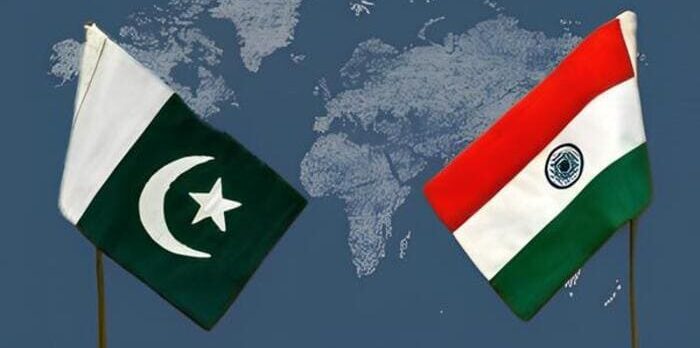
Every few years, whenever the international system begins to reorganize itself under the pressure of great-power competition, technological disruption, economic realignment, and strategic uncertainty, South Asia is compelled to revisit an old but unavoidable question! “Can Pakistan and India ever move beyond perpetual rivalry and enter an era of strategic coexistence?”

For decades, the answer appeared self-evident. Wars without closure, crises without resolution, unresolved territorial disputes, state-sponsored cross-border terrorism, disinformation war, competing national identities, military doctrines shaped by suspicion, and the political centrality of Kashmir collectively transformed hostility from a temporary condition into a permanent strategic structure.
Over time, the rivalry evolved beyond policy; it became embedded within the psychological, political, and security architecture of both states. Yet history rarely moves in straight lines. The geopolitical atmosphere emerging after the recent engagements between Donald Trump and Xi Jinping suggests that the international system may be entering another period of strategic transition.
Paradoxically, this transition does not imply the end of competition. Rather, it signals a broader strategic shift in which controlled coexistence is gradually becoming more valuable than unmanaged confrontation. This distinction is critical, as misinterpreting the shift could lead to costly overreach or devastating strategic miscalculations.
The earlier argument that Pakistan and India can become strategic partners was never rooted in emotional pessimism or historical fatalism. Methodologically, it was based on the documented logic of international systems, strategic behavior, and geopolitical incentives.
Tragically, states do not cooperate because peace sounds morally attractive. They cooperate when the structure of incentives changes, when the cost of confrontation rises, and when emerging realities begin to reward stability more than hostility. For years, South Asia remained trapped within what strategic theorists would describe as a rational rivalry equilibrium.
India pursued economic expansion and strategic ascent while simultaneously managing regional threats. Pakistan relied on deterrence, geopolitical balancing, and strategic positioning to preserve space within an asymmetrical regional order. The result was a cold but stable equilibrium where both sides viewed rivalry as costly yet strategically safer than uncertain reconciliation.
By its very nature, the asymmetry itself reinforced this condition. India’s economic and strategic rise fundamentally altered the balance of regional influence. Pakistan, facing recurring economic pressures and structural vulnerabilities, increasingly viewed unrestricted integration with India through the lens of strategic dependence rather than mutual prosperity.
Conversely, from New Delhi’s perspective, the incentive structure favored unilateral growth and global integration over complicated regional accommodation. This explains why repeated diplomatic openings repeatedly collapsed despite moments of optimism. South Asia never experienced the kind of decisive geopolitical reset that transformed Europe after the Second World War or normalized relations between former adversaries elsewhere.
History is often invoked to suggest that bitter rivals can reconcile. France and Germany did so after centuries of war; the United States and Vietnam normalized relations after catastrophic conflict. But such comparisons, popular as they are, obscure more than they reveal. Reconciliation in those cases followed decisive endings – clear defeat, exhaustion, external security guarantees, and, crucially, a reordering of incentives.
Pakistan and India instead experienced wars without finality, negotiations without permanence, and peace processes without strategic trust. Beyond a mere territorial dispute, Kashmir remained not merely a territorial dispute, but a deeply embedded symbol around which national narratives, strategic doctrines, and political legitimacy continued to evolve.
However, the strategic environment surrounding this rivalry is now undergoing subtle but important transformation. The emerging world order is no longer being shaped solely by conventional geopolitics. Geo-economics, technological supremacy, climate resilience, digital infrastructure, supply-chain security, artificial intelligence, energy transitions, and scientific innovation are increasingly becoming the new instruments of global power projection.
Great powers today are engaged not only in military competition, but in technological war-gaming, economic positioning, and strategic control over the architecture of future connectivity. Within this evolving framework, prolonged instability in South Asia is gradually becoming counterproductive not only for regional actors but also for major global powers.
This is where the post-Trump-Xi geopolitical atmosphere becomes important. Washington and Beijing increasingly appear aware that unmanaged instability across Asia threatens broader economic and technological objectives. Trade corridors, maritime connectivity, semiconductor ecosystems, energy routes, and emerging digital infrastructure all require a degree of regional predictability.
The logic of the emerging world order is therefore slowly shifting from permanent confrontation toward managed competition and controlled strategic coexistence. In this evolving strategic environment, even China’s regional role requires more nuanced interpretation than older confrontation-centric narratives allowed.
Beijing’s long-term strategic interests increasingly appear tied to connectivity security, economic continuity, infrastructure expansion, technological competitiveness, and regional stabilization, largely driven by the global rollout of the BRI and the integration of emerging economies through institutions like BRICS+ and SCO.
Thus, a stable South Asia better protects broader Asian economic architecture than perpetual escalation does. This does not eliminate strategic competition between regional actors, nor does it dissolve existing mistrust. But it does indicate that the larger geopolitical environment may increasingly reward equilibrium over destabilization.
Simultaneously, subtle yet significant signals are emerging from within India’s own strategic establishment. Statements associated with senior leadership circles linked to the Rashtriya Swayamsevak Sangh (RSS) alongside reflections made by former chiefs of the Indian Army suggest that sections of India’s security and strategic community are gradually reassessing the long-term costs of perpetual hostility with Pakistan.
These remarks are important not because they represent immediate policy transformation, but because they reflect a deeper intellectual transition within parts of India’s national security discourse. For decades, Pakistan was viewed almost exclusively through a threat-centric framework. Today, however, some Indian strategic thinkers increasingly recognize that India’s ambitions as a major global power cannot remain indefinitely tied to recurring subcontinental crises.
A nation seeking technological leadership, manufacturing dominance, Indo-Pacific influence, and global strategic relevance cannot permanently afford the diversion of political, military, and economic energies into repetitive regional instability. This emerging realization does not mean India and Pakistan are suddenly becoming allies. That would be an unrealistic conclusion.
But it does indicate that parts of the regional strategic community are beginning to ask a different question. Instead of asking whether historic friendship is possible, they are increasingly asking whether managed stability may serve national interests better than perpetual confrontation.
From a strategic standpoint, this shift in thinking is strategically profound. At the same time, the accelerating climate crisis is introducing another dimension that neither state can indefinitely ignore. Climate Diplomacy may soon become as strategically important in South Asia as conventional military diplomacy once was.
Water scarcity, glacial melt, heat emergencies, agricultural disruption, floods, environmental migration, and energy insecurity are gradually emerging as shared civilizational challenges transcending traditional borders. No missile system can stop climate collapse. No military doctrine alone can manage ecological destabilization.
This reality may eventually force South Asia toward new frameworks of engagement rooted not merely in political necessity but in collective survival. Similarly, Science Diplomacy may emerge as one of the few viable bridges capable of operating even amid political distrust.
Scientific cooperation in areas such as climate adaptation, public health, water management, artificial intelligence governance, renewable energy systems, agricultural innovation, and disaster resilience can create limited but meaningful spaces for engagement without immediately challenging core political disputes.
Historically, science has often succeeded in opening channels where traditional diplomacy failed. The twenty-first century may require South Asia to rediscover that lesson. Strategically, for Pakistan and India, this moment represents not weakness, but strategic opportunity.
Such a transformation would not require abandoning deterrence or compromising sovereignty. Rather, it would involve redefining strategic success itself. In the coming decades, the strongest states may not necessarily be those capable of sustaining permanent hostility, but those capable of balancing competition with selective cooperation.
The tragedy of South Asia was never that peace was impossible. The tragedy was that the regional and global structure consistently made rivalry appear more rational than cooperation. Today, however, the strategic architecture of the emerging multipolar order is gradually altering those calculations.
Pakistan and India may still remain strategic competitors, but for the first time in many years, the changing international environment is beginning to create incentives where calibrated engagement, managed stability, Science Diplomacy, Climate Diplomacy, and geo-economic pragmatism may slowly become more rational than perpetual hostility.
To get down to brass tacks, if history is any guide, strategic partnerships are never born from sentiment alone. They emerge when changing realities compel nations to redefine the meaning of national interest itself. After decades of missed opportunities and mounting geopolitical friction, South Asia is now approaching precisely such a historical moment.
Author: Mirza Abdul Aleem Baig – President of Strategic Science Advisory Council (SSAC) – Pakistan. He is an independent observer of global dynamics, with a deep interest in the intricate working of techno-geopolitics, exploring how science & technology, international relations, foreign policy and strategic alliances shape the emerging world order.
(The opinions expressed in this article are solely those of the author and do not necessarily reflect the views of World Geostrategic Insights).