



Tensions in the Gulf region continue to grow. Fully aware that, in the event of another round of large-scale hostilities, the Islamic Republic would require significant external backing – including from China – the country’s leadership is seeking to secure stronger strategic assurances. But can Tehran really count on Beijing’s full support?

When in late April Iranian Foreign Minister Seyed Abbas Araghchi announced his plans to visit Pakistan, Oman, Russia, and China, it was apparent that Tehran was preparing a broader diplomatic initiative aimed at consolidating regional support and coordinating its actions with key partners. The choice of countries he visited was unlikely a pure coincidence.
Oman is the only Gulf state that, during the active phase of the war, maintained somewhat friendly relations with Iran. Pakistan, on the other hand, managed to position itself as a key mediator, while Russia is traditionally seen as Iran’s key “ally”. In reality, however, the Kremlin has a history of using Iran as a tool for leverage, or a counterweight, to balance its relations with Western powers.
Still, under the current circumstances, Iran has little choice but to attempt to strengthen its 2025 comprehensive strategic partnership with Moscow. But given Russia’s preoccupation with the conflict in Ukraine, the Kremlin does not seem to be in a position to provide large-scale military assistance to Tehran, even if it wanted to. Weapons are undoubtedly what Iran needs most.
On April 4, US Black Hawk helicopters and C-130 transport aircraft were observed operating over a remote mountainous area of Iran during a rescue operation to extract the pilot of a downed F-15E Strike Eagle. This incident has clearly shown that Iran did not effectively contest the airspace at low altitudes, suggesting a lack of even basic man-portable air-defense systems.
Despite rumors that China may be preparing to supply Iran with such weapons, there is no concrete evidence that the Islamic Republic has actually received any from Beijing. Chinese officials have also repeatedly rejected these allegations.
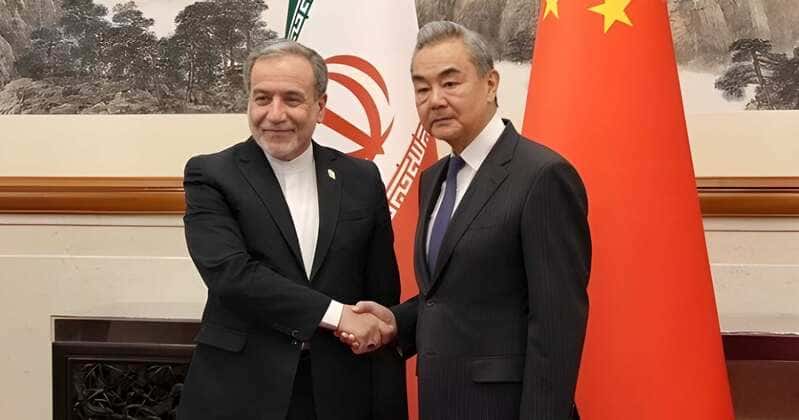
The People’s Republic, however, continues to provide political support to Iran. On May 6, during Araghchi’s meeting with Chinese Foreign Minister Wang Yi, the Chinese top diplomat stressed that “China supports Iran in safeguarding its national sovereignty and security and appreciates Iran’s willingness to seek a political solution through diplomatic channels.”
For Beijing, the continuation of the war is the least desirable outcome. The Chinese economy has already faced some consequences from the Iran war, although not nearly to the extent portrayed in some Western media. But if the conflict escalates, and the Strait of Hormuz remains closed for a long time, global energy markets are expected to be disrupted and China will likely face rising economic pressure as a major oil importer. All this raises the question of how long the People’s Republic can continue its “do nothing and win” policy.
Mindful of potential challenges, Yi has emphasized that China “considers that a complete cessation of fighting must be achieved without delay, that it is even more unacceptable to restart hostilities, and that continuing to negotiate remains essential.” His rhetoric suggests that Beijing is unhappy about the US naval blockade of Iranian ports, but is also frustrated with Iran’s continued closure of the Strait of Hormuz.
The problem, however, is that the United States does not seem to share the same view as China’s leadership. If the Strait of Hormuz remains blocked, China, Southeast Asian countries, and to a significant degree Europe would face far greater risk and disruption than the United States. As a major oil and gas producer, Washington could even potentially benefit from the situation. What seems to worry US President Donald Trump is that renewed hostilities, or even a continued state of limbo, could have negative political repercussions for the United States, especially by further straining its ties with Europe, as well as with the Gulf states – America’s traditional allies in the Middle East.
In spite of that, reports suggest that the US military is building up forces in the Middle East, possibly preparing for another round of fighting. During Operation Epic Fury, Washington has not achieved any of its strategic objectives. As a result, Trump will not be in a position to negotiate US–China relations with Chinese President Xi Jinping in Beijing on May 14–15 from a position of strength.
Thus, if he fails to secure a face-saving diplomatic solution to tensions with Iran – which is something he repeatedly insists on – a “hot phase” of the conflict may become inevitable. Meanwhile, the Iranian leadership will likely continue seeking to secure, if not military, then at least strong economic and diplomatic support from nations it perceives as friendly – with China remaining the key partner.
The ball is now in Beijing’s court.
Author: Nikola Mikovic – Journalist, researcher and analyst based in Serbia.
(The views expressed in this article belong only to the author and do not necessarily reflect the editorial policy or views of World Geostrategic Insights).