



By Varuna Shankar
In recent times, the India-Japan partnership has gained traction through its novel idea of agricultural sector collaboration. By 2036, it is expected that India’s urban population will surge toward 600 million. This will create a critical sustainability imperative for feeding megacities like Delhi, Mumbai, and Bengaluru.

The innovative partnership between Japan’s advanced vertical farming technology and India’s expanding smart city initiatives is creating a new concept of vertical villages.
Japan, with 92 percent urbanization and only 38 percent food self-sufficiency, has pioneered solutions that India can adapt and scale. This article explores cooperation focused on integrated urban agricultural ecosystems, which aim to revolutionize food security, reduce environmental impact, and transform the relationship between cities and agriculture.
Japanese Innovative Style of Farming
Japan has been an early pioneer in vertical farming. It holds the largest share in the global vertical farming market. Its Vertical Farming Market was valued at approximately USD 120 million in 2024 and is projected to reach around USD 950 million by 2032. It exhibits a robust Compound Annual Growth Rate (CAGR) of over 29.5% from 2025 to 2032. This significant growth trajectory reflects technological advancements and increasing investments.
Vertical farming in Japan is rooted in the necessity of its geography and social fabric. In this type of farming, crops are grown indoors under artificial lighting and temperature control. It uses soil-less methods such as aquaponics, hydroponics, and aeroponics. It uses significantly less water and pesticides than traditional agricultural methods, aiming at higher productivity in smaller spaces. The system offers several benefits, including monsoon resilience against flooding, continuous production, heat management through advanced cooling systems, and higher nutritional density due to optimal growing conditions. Traditional farming is significantly losing relevance due to an ageing population and rural migration.
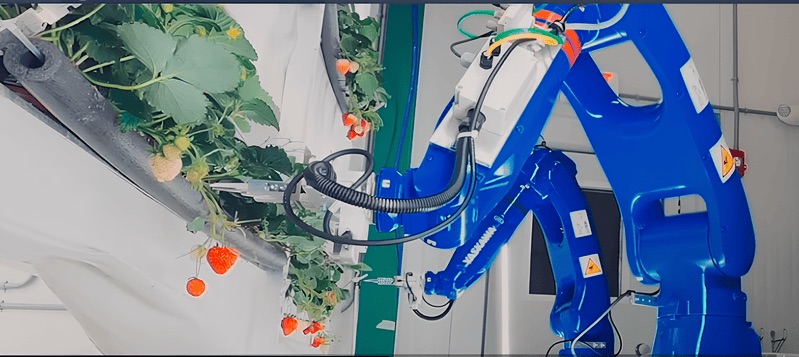
Japanese vertical farming characterises integrated technological systems that combine AI-powered growth optimization, precision environmental control, and robotic automation. This includes LED lighting systems with customized spectral outputs optimized for specific crops, consuming 40 percent less energy, robotic automation of seeding, transplanting, and harvesting systems, climate control integration through underground facilities utilizing geothermal energy and solar panels to create closed-loop systems, AI-powered growth management through machine learning algorithms that monitor plant health through adjusting nutrients, humidity, computer vision, and lighting in real-time to optimize growth rates and nutritional content
As a result, Japanese vertical farming technology has achieved remarkable efficiency gains with year-round production cycles independent of climate variability, 95 percent water savings, and 30-fold higher yields per square meter. Companies like Mirai Group, Spread Co., and PlantX have developed fully automated systems that produce leafy greens at costs competitive with traditional farming.
India as a Beneficiary
It is estimated that India’s megacities will face an unprecedented food security crisis. As per statistics, over 590 million Indians will live in cities by 2030. They will require an estimated 50 percent increase in food production. Traditional farming methods cannot scale to meet this demand within sustainable resource constraints, while agricultural land continues to shrink due to urbanization. Furthermore, India’s per-capita arable land has been declining, from 0.15 hectares in 2010 to 0.12 hectares by 2030. For example, Mumbai alone consumes over 3 million tonnes of food annually. Out of this, 90 percent is transported from rural areas, which are usually located 500-1,000 kilometers away. This distance results in 30-40 percent post-harvest losses, inflated food prices, and massive carbon emissions from transportation. This situation disproportionately impacts urban poor populations.
In this context, India’s vertical farming market is experiencing explosive growth. It is valued at USD 62.21 million in 2024 and is expected to reach USD 200.14 million by 2030, with a compound annual growth rate of 21.50% over the forecast period. New urban farming initiatives have gained traction but are concentrated in major metropolitan areas. This includes hydroponic farms in Hyderabad operated by UrbanKisaan. It serves over 10,000 households through subscription services, demonstrating the commercial viability of local production. Similarly, in Bangalore, Agricool India has established container-based vertical farms. They produce fresh produce within 5 kilometers of major IT corridors, reducing transportation costs and ensuring same-day freshness. Another example is vertical farms in Mumbai by Nature’s Miracle. It operates from repurposed warehouses, producing exotic greens and herbs for high-end restaurants and health-conscious consumers.
In August, 2025, the Prime Ministers of India and Japan decided to promote food security and agriculture-based entrepreneurship between the two countries. The partnership aims to strengthen agricultural ties, share innovations, and advance food security initiatives. Recently, in the 18th Indo-Japanese Strategic Dialogue, S Jaishankar, India’s Minister of External Affairs, and Toshimitsu Motegi, Japan’s Minister of Foreign Affairs, reaffirmed their commitment to strengthen their Special Strategic and Global Partnership, including issues such as maritime cooperation, enhanced global fertilizer supplies, and sustainable economic development. The discussions included collaboration on sustainability, technology, and the optimization of food supply chains for mutual benefit. Various Japanese companies, including Omatec Company Limited, Miyachi Corporation, Mebius Inc, Escorts Kubota Limited, Nichino India Private Limited, presented their technologies. Previously, the Indian government’s Smart Cities Mission allocated ₹48,000 crore for urban infrastructure development, with specific provisions to integrate sustainable agriculture.
At the regional level, state governments are providing additional incentives. While Karnataka has designated urban agriculture zones within city master plans, Maharashtra offers 50 percent subsidies for rooftop farming installations. The Uttar Pradesh government held the third joint working group meeting with Japan, establishing large-scale demonstration units under the Japan-India Model Farm Project. This is essential for the successful adoption of Japanese technology and the development of various agri-processing zones in the state. Similarly, collaboration with JICA has led to the integration of cutting-edge technologies such as AI and drones in agriculture, with ongoing projects in Haryana, Uttarakhand, and Himachal Pradesh serving as models for urban applications.
The Northeast Region presents a bright opportunity for collaboration in this sector. Cultural and dietary similarities can be envisaged in agricultural cooperation, where they share similar food patterns such as the consumption of fermented soybeans, bamboo shoots, and sticky rice. The agro-business sector is a sunrise sector aligned to the region’s rich biodiversity. Best practices to improve the quality and productivity of agro-based products, as well as the processing and packaging of products, could be shared, assisting the region in advancing science- and technology-based agricultural processes. Agro-products like jackfruit, buckwheat, mushrooms, and various spices, as well as horticulture and forestry, are promising areas for Japanese collaboration.
However, the stumbling block remains the high initial investment where setting Vertical farm costs range from ₹15-50 lakh for medium-scale operations, requiring innovative financing mechanisms; technical adaptations would require significant R&D investment; skill development training programs and technical manuals in local languages is essential and the challenge of energy consumption where climate control and LED lighting account for 70% of operational costs.
Vertical Farming as a Bright Spot
India and Japan, through their collaboration in the agriculture sector, are pioneering a model for 21st-century urban agriculture. Beyond addressing immediate food security challenges, this model can be replicated across the developing world, making cities partners in global food production. It will reduce dependencies on the increasingly strained rural agricultural systems. The Vertical Villages initiative represents an agricultural innovation in this context, creating sustainable urbanization in which cities become self-reliant, productive, and environmentally responsible. By combining India’s entrepreneurial energy and market scale with Japan’s four decades of vertical farming expertise, this partnership creates a new paradigm for urban food systems.
As Indian megacities continue to grow, the concept of vertical villages will enable urban centers to move from mere consumers to net contributors to food security and environmental sustainability. India and Japan are natural partners who share common values and strategic interests, and the fusion of traditional agricultural wisdom with cutting-edge technology, supported by private-sector innovation and robust government frameworks, offers a roadmap for feeding the world’s urban future sustainably.
Author: Dr. Varuna Shankar – Associate Fellow, India’s World Magazine, New Delhi. She is also a Non-Resident Vasey Fellow, at Pacific Forum, Honolulu, Hawaii.
(The opinions expressed in this article belong only to the author and do not necessarily reflect the views of World Geostrategic Insights).
Image Source: Oishii Farm