



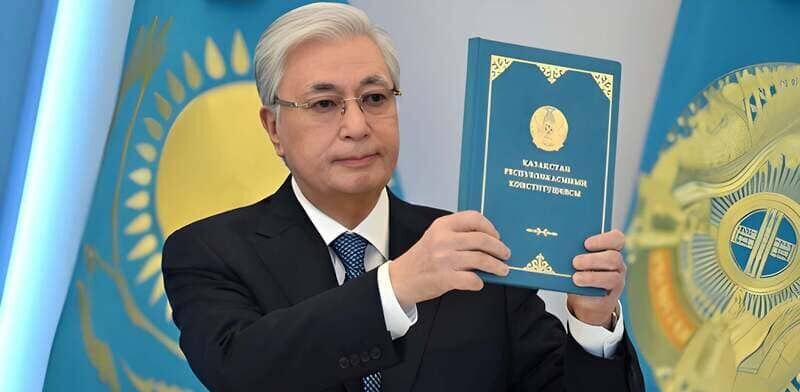
On 15 March 2026, Kazakhstan voted in a landmark national referendum to adopt a new constitution, marking a pivotal moment in the country’s political evolution. The constitution, approved by 87 percent of voters on a turnout of 73 percent, will enter into force on 1 July 2026, and 15 March has been declared a national holiday, Constitution Day, underscoring the symbolic importance of this reform.

According to the Central Election Committee, more than nine million citizens voted across some 10,000 polling stations in Kazakhstan and abroad. Survey data from 2025 by the Kazakhstan Institute of Strategic Studies suggest that 79.1 percent of respondents aged 18–29 were acquainted with, had read, or at least understood the Constitution, indicating a relatively high level of constitutional awareness among youth. President Kassym-Jomart Tokayev has repeatedly described the new Basic Law as youth-oriented and argued that it will bring tangible benefits to the younger generation.
The new constitution is framed not as an incremental amendment package but as a fundamental recalibration of Kazakhstan’s political architecture. Although the country has amended its constitution several times since independence, many analysts have characterised the 2026 document as a “Big Bang” reform because it revises roughly 84 percent of the existing text—around 77 of 101 articles. The changes are intended to modernise the state, strengthen institutional stability over personal rule and improve succession management in a volatile regional and global environment.
Crucially, the constitution is presented as the first in Kazakhstan’s history to place human rights and freedoms explicitly at the core of the document’s meaning, introducing a discourse of human-centred governance even as several provisions tighten political control.
Key Features of the New Constitution
The core aim of the new Basic Law is to anchor stability in institutions rather than charismatic individuals, while simultaneously allowing the executive to remain the primary driver of policy. Several features stand out:
- Transition to a unicameral parliament (Kurultai):
The former bicameral system (Senate and Mazhilis) will be replaced by a single chamber, the Kurultai, with 145 members elected for five-year terms through proportional representation. On paper, this is meant to streamline decision-making and enhance accountability, but the constitution also grants priority to presidential bills, which must be adopted within a short timeframe, preserving strong agenda-setting power for the executive. - Creation of the Halyk Kenesi (People’s Council):
A new representative body, the Halyk Kenesi, will have the right of legislative initiative and can submit draft laws to the Kurultai, but all 164 of its members are to be appointed personally by the president. This arrangement formally widens public representation while substantively reinforcing presidential influence over policy initiation. - Redistribution of powers between president and parliament:
The president will retain extensive authority, including the right to nominate all candidates for the Supreme Court, as well as members of the Constitutional Court, the Supreme Audit Chamber and the Central Election Commission, subject to Kurultai approval. On paper this creates a system of checks and balances; in practice, it embeds a presidential veto-point in the appointment of all key oversight institutions. - Tightening controls on foreign funding and civil society:
The new constitution strengthens pre-existing bans on foreign financing of political parties and extends restrictions to include foreign states, international organisations, foreign companies and enterprises with foreign participation, plus stateless persons. Non-governmental organisations are required to disclose foreign funding, entrenching state oversight over civil society and limiting external political influence. - Human-rights language alongside conservative social clauses:
While human rights and freedoms are proclaimed as the main priority of the document, the constitution also entrenches conservative social norms, for example defining marriage strictly as a union between a man and a woman, thereby constitutionally excluding LGBTIQ+ partnerships. This duality highlights the tension between the rhetoric of human-centred governance and substantive rights protection.
In sum, Kazakhstan’s new constitutional model is designed to speed up decision-making, clarify authority and manage succession, but it simultaneously narrows the space for external political financing and preserves a highly centralised presidency behind the language of institutional reform and human-rights-oriented governance.
Reactions from External Players
The 2026 constitution will be watched closely by Kazakhstan’s neighbours as well as by major powers such as Russia, China, the United States and key European actors. President Tokayev has, since assuming office, recalibrated Kazakhstan’s foreign policy toward a greater emphasis on national sovereignty, economic pragmatism and diversified multilateral alignments beyond the traditional Russia–China axis. This strategic reorientation is visible in his restrained rhetoric on Eurasianism, expanded outreach to Western and Asia-Pacific partners, and carefully managed participation in regional organisations to avoid overdependence on any single power centre.
President Tokayev has effectively layered geopolitical hedging onto Kazakhstan’s long-standing integrationist ambitions, moving from symbolic Eurasianism toward a more technocratic, pragmatic and adaptive foreign policy designed to navigate an increasingly volatile regional and global landscape. The current approach seeks to safeguard Kazakhstan’s strategic space by maintaining equidistance among major powers while maximising economic and connectivity gains. In Indian parlance, this trajectory resembles strategic autonomy, where Astana resists formal alignment with any bloc and instead manages a portfolio of relationships across Russia, China, the West and emerging partners.
Against this backdrop, the new constitution becomes not only a domestic governance blueprint but also a signal to external players—especially Russia, China, the US and Europe—of how Kazakhstan intends to structure its sovereignty, manage external influence and sustain its multi-vector positioning in the years ahead.
Sovereignty, Language Politics and Implications for Russia
The 2026 constitution places notable emphasis on sovereignty and territorial integrity, themes that have gained greater resonance across Eurasia since Russia’s interventions in Georgia (2008) and Ukraine (2014 & 2022). This has implications not only for Kazakhstan’s domestic nation-building but also for its sensitive relationship with Russia, a key security partner and former imperial centre.
Sovereignty and nation-building
The new Basic Law devotes considerable attention to affirming Kazakhstan’s sovereignty, signalling that Astana seeks firmer constitutional insulation from external pressure, also an indication to Moscow. The adoption of a framework that allows special legal regimes in certain regions and cities further underscores a desire for flexible internal governance that does not rely on external security guarantees.
One of the most politically sensitive innovations is the rebalancing of language status. Article 9 of the new text elevates Kazakh as the dominant language, while Russian is designated as an official language used by the government “alongside” Kazakh. At first glance this appears a modest adjustment, but it signals a long-term shift in educational policy, identity formation and the symbolic hierarchy of languages in the state.
Russian reactions and cultural distance
For Russia, these developments are double-edged. On the one hand, President Tokayev is seen in Moscow as a relatively reliable partner and a buffer against a surge of anti-Russian sentiment, as evidenced by Kazakhstan’s 2022 request for CSTO assistance during nationwide protests. On the other hand, the emphasis on sovereignty and Kazakh-first language policy is liable to be interpreted as a gradual erosion of the ‘joint space’ of culture and memory that Russia claims with many post-Soviet states.
Some Russian and pro-Russian media have already framed Kazakhstan’s language provisions as a downgrading of Russian and a symbol of distancing from Moscow, despite the continued predominance of Russian in business, urban administration and everyday communication in cities such as Astana and Almaty. The fact that Russian remains deeply embedded in Kazakhstan’s economy and bureaucracy may temporarily assuage Kremlin concerns, but the constitutional privileging of Kazakh can be read alongside Russia’s own invocation of language rights in Ukraine as a casus belli, making this a potentially sensitive fault line.
At the societal level, the relationship is already more complex. Some Kazakh school textbooks and public narratives have been accused in Russian commentary of fostering Russophobia and portraying Kazakhs as historically subordinate within the Russian–Kazakh alliance. Reports that Russia’s Ministry of Foreign Affairs has privately pressed Astana to adjust textbook language on colonialism, repression and Soviet-era history illustrate Moscow’s sensitivity to symbolic and narrative shifts in the post-Soviet space.
Two-level impact on Russia–Kazakhstan ties
The long-term impact of the new constitution on Russia–Kazakhstan relations is likely to be two-level:
- Government-to-government:
At the official level, continuity is likely despite President Tokayev’s closer leaning towards China. Kazakhstan remains a member of the Eurasian Economic Union and CSTO, and Tokayev continues many aspects of former president Nursultan Nazarbayev’s integrationist policy framed under a broader Eurasian identity, which still suits the Kremlin. The 2022 CSTO deployment to quell protests strained public perceptions but did not rupture elite-level ties. - Society-to-society:
At the societal and cultural level, however, the combination of stronger Kazakh-language prioritisation, greater emphasis on sovereignty and residual resentments over the Soviet past is likely to widen the gap between Kazakh and Russian identities. Moscow’s track record in Georgia and Ukraine reinforces anxieties in Kazakhstan about overdependence on Russia and feeds domestic support for a more autonomous foreign policy.
Overall, the constitution formalises Kazakhstan’s sovereign identity and subtly reorders the hierarchy of languages and narratives, which may remain manageable for Moscow in the short term but could translate into deeper political distance if Russian elites perceive these trends as a challenge to their regional influence.
Tokayev’s Multi-Vector Foreign Policy: China, the West and Geopolitical Hedging
Since assuming office, President Tokayev has refined Kazakhstan’s traditional “multi-vector” foreign policy into a more technocratic, pragmatic and hedging-oriented approach designed to preserve national sovereignty in a multipolar environment. The new constitution should be read as a domestic anchor for this external strategy—by tightening control over foreign political financing and centralising decision-making, Astana seeks room to manoeuvre between Russia, China, the United States, Europe and other actors.
China: Deepening strategic partnership
For China, the new constitution does not currently pose a source of concern, due to the depth and trajectory of bilateral ties. Kazakhstan has positioned itself as a pivotal transport and logistics hub linking China’s Belt and Road Initiative (BRI) to Europe through the Trans-Caspian International Transport Route (TITR), or Middle Corridor, which bypasses Russian territory. Under Tokayev, this corridor has been elevated into a central pillar of Kazakhstan’s economic and foreign strategy, reflecting his emphasis on infrastructure-led diplomacy and practical cooperation.
The National Development Plan to 2029, which prioritises transport corridors, investment attraction, industrial modernisation, energy development and innovation, dovetails closely with what China can offer. During President Xi Jinping’s state visit to Astana in June 2025, both sides signed 24 intergovernmental and interdepartmental agreements spanning energy, aerospace, digitalisation, customs, agriculture, e-commerce, tourism, intellectual property and science, consolidating China’s status as Kazakhstan’s largest trading and investment partner. Tokayev publicly characterised China as a time-tested, reliable strategic partner and stressed that Chinese–Kazakh relations are free of historical grievances, in implicit contrast to Kazakhstan’s more complicated legacy with Russia.
Given this context, the new constitution is unlikely to disrupt China–Kazakhstan ties in the short term. The ban on foreign financing of parties and stricter NGO oversight may apply equally to Western and Chinese sources in legal terms, but in practice Beijing’s engagement is routed primarily through state-to-state projects and large-scale investments rather than political funding, insulating it from the immediate impact of these provisions.
United States: Strategic partnership, but wary of constraints
Kazakhstan’s relationship with the United States has expanded in recent years, with both sides stressing the potential of their Enhanced Strategic Partnership Dialogue. In November 2025, Presidents Tokayev and Donald J. Trump welcomed major commercial deals in critical minerals, transport, artificial intelligence and information technology, framing cooperation in terms of economic modernisation and next-generation opportunities. Astana has further signalled its openness to US-backed regional initiatives by joining the Abraham Accords framework and President Trump’s so-called “Board of Peace,” illustrating its willingness to diversify partnerships beyond the traditional Eurasian sphere.
Yet there are clear boundaries. In February 2026, a US diplomat publicly commented that Washington’s goal was for Kazakhstan to have full freedom in using its critical mineral wealth for the benefit of its citizens, and also described the constitutional reform as an ambitious package whose core objective should be to protect citizens’ natural rights. While such statements appear constructive, for a leadership alert to the risks of perceived interference, they also underline why Astana has constitutionally entrenched a ban on foreign financing of political parties and trade unions and tightened controls on foreign-funded NGOs.
Given the history of Western-backed regime change, civil conflicts and unintended consequences in places such as Libya, Syria and Afghanistan, Central Asian governments with systems akin to Russia and China remain cautious about excessive proximity to the West. The new constitutional provisions therefore serve as a legal firewall—they allow Kazakhstan to welcome US investment and strategic dialogue while signalling that political engineering or democracy promotion through funding channels will be firmly constrained.
Europe: Connectivity, energy and vulnerability
Kazakhstan’s ties with Europe have grown steadily since the establishment of diplomatic relations 33 years ago. The Enhanced Partnership and Cooperation Agreement (EPCA), signed in 2015 and in force since 2020, provides a comprehensive framework across 29 areas, including trade, investment, aviation, education, research, civil society and human rights. Current talks on a Visa Facilitation Agreement aim to boost people-to-people contacts and further embed Kazakhstan in European networks.
The EU–Central Asia Strategy (2019) and the EU Global Gateway Strategy have elevated Kazakhstan’s role as a partner in four priority areas—transport connectivity, critical raw materials, digitalisation and water–energy–climate cooperation. Projects such as the Middle Corridor and investments in critical raw materials, including ventures like the Sarytogan graphite project, have become central to Europe’s efforts to reduce dependencies exposed by recent geopolitical shocks.
In 2024, Kazakhstan, Uzbekistan and Azerbaijan signed a memorandum of understanding with the EU to export green electricity produced from solar and wind power across the Caspian Sea, however this route stands to be jeopardised by the Iran–US war and related missile risks. For Europe, the conflict has underscored its structural vulnerability in energy and trade routes, making stable partnerships with Kazakhstan more important but also more complicated. The absence of West, including the US bases in Central Asia and the continuing influence of Russia and China mean that EU engagement must navigate not only security constraints but also local sensitivities about external political interference.
Within this context, Kazakhstan’s new constitution sends a dual message to Europe. On one side, the human-rights-centric language and institutional reforms allow Brussels to welcome the referendum’s outcome; on the other, the ban on foreign funding for parties and tighter NGO oversight are a clear reminder that any European support must respect red lines of sovereignty and non-interference, especially in an era marked by regime-change fatigue and heightened great-power rivalry.
India–Kazakhstan Relations in the New Constitutional Context
India occupies a distinct place in Kazakhstan’s external relations as a democratic partner that does not pursue regime-change agendas and consistently upholds a policy of non-interference in internal affairs. This gives India an advantage in engaging Astana at a time when the new constitution formalises barriers to foreign political influence yet leaves ample room for strategic, economic and technological cooperation.
Kazakhstan is India’s largest trading partner in Central Asia, and their strategic partnership is anchored in energy cooperation, trade, connectivity and regional security. The relationship is buttressed by deep civilisational links and cultural affinities that predate modern statehood, which help stabilise ties beyond transactional diplomacy. For Astana, New Delhi contributes to its multi-vector policy by offering a major Asian partner that is neither part of the Russia–China axis nor a traditional Western power, while for India, Kazakhstan advances strategic autonomy by providing energy resources, connectivity options and a platform in Central Asia.
In March 2026, Kazakh Ambassador to India Azamat Yeskarayev met External Affairs Minister Subrahmanyam Jaishankar and reaffirmed that India is a time-tested key strategic partner for Kazakhstan in South Asia and an influential global actor. Both sides emphasised strengthening cooperation in trade, investment and business linkages, including outreach to leading Indian conglomerates such as Tata Group and Reliance Industries.
Looking ahead, the constitutional consolidation in Kazakhstan coincides with emerging domains of cooperation:
- Digital and technological collaboration:
Kazakhstan’s interest in digital corridors, AI and emerging technologies dovetails with India’s strengths in IT services, digital public infrastructure and start-up ecosystems, creating scope for co-development and capacity building without the political baggage associated with Western aid. - Green and renewable energy:
Both countries seek to expand low-carbon energy portfolios. Joint projects in solar, wind and grid modernisation, including potential participation in Kazakh green-energy exports, can reinforce energy security and climate goals. - Water security and climate resilience:
Water security is a less explored but critical area, where both mid-riparian countries face challenges from climate variability and glacial melt. Cooperation in water-infrastructure technology, public–private partnerships in irrigation, hydrological data-sharing, climate and glacier research, and capacity building through SCO, CICA and UN platforms can strengthen resilience while remaining strictly non-intrusive in domestic politics.
Because India does not sponsor political parties, fund regime-change efforts or use civil society as a tool of pressure, the new constitutional restrictions on foreign political financing are unlikely to impede the partnership. Instead, they may make India comparatively more attractive as a partner that can support Kazakhstan’s development priorities without triggering anxieties about sovereignty.
New Delhi is therefore well placed to welcome Kazakhstan’s constitutional reform as an assertion of sovereign choice and to deepen cooperation in sectors that the new constitution implicitly favours—stability-oriented governance, state-led modernisation and pragmatic, multi-directional external engagement.
Conclusion
Kazakhstan’s 2026 constitution is being hailed domestically and internationally as a turning point that promises institutional modernisation, youth-oriented governance and a clearer focus on human rights and freedoms. At the same time, key provisions—especially the shift to a unicameral parliament dominated by presidential priority, extensive appointment powers for the head of state, bans on foreign political financing and conservative social clauses—suggest continuity with a strong-presidency model and a guarded approach to liberal political pluralism.
For Russia, the constitution formalises Kazakhstan’s sovereign identity and recalibrates language politics in ways that may gradually widen cultural distance, even as official cooperation in security and regional integration continues. For China, it consolidates a stable partner at the core of continental connectivity, where deep economic interdependence outweighs concerns over political reform. For the United States and Europe, the new Basic Law offers both an opening—via its human-rights rhetoric and institutional reform—and a constraint, via strict limits on political funding and wariness of external interference, particularly in light of past Western interventions elsewhere.
In this complex environment, Tokayev’s refined multi-vector foreign policy, underpinned by constitutional safeguards, is likely to continue hedging between great powers while seeking maximum room for manoeuvre. India, with its large democratic profile and consistent non-interference stance, is well positioned to deepen a trust-based strategic partnership that spans energy, connectivity, technology and water security without cutting across Kazakhstan’s new constitutional red lines.
On the new Constitution, whether the promise of human-centred governance and youth-oriented reform is fulfilled will depend less on the letter of the new Basic Law than on how its provisions are implemented when future crises test the balance between stability, rights and political openness.
Author: Dr. Indrani Talukdar – Fellow at the Chintan Research Foundation, New Delhi.
(The opinions expressed in this article belong only to the author and do not necessarily reflect the views of World Geostrategic Insights).
Image Source: ANP / EPA / Kazakhstan President Press Service (Kazakhstan’s President Kassym-Jomart Tokayev attending the ceremony marking the adoption of the new Constitution of Kazakhstan in Astana, Kazakhstan, on March 17, 2026.).