



Everyone believes that security, upheld in ontological parlance of freedom from fear and want, is fundamentally a serious business. However, strategic humor is a deliberate use of comedy and irony to advance foreign policy narratives, deflect criticism, and engage global audiences through participatory public diplomacy.

Breaking through security fatigue, Ronald Reagan once mastered self-depreciating humor to appear warm and used his jokes as a pivot to end a debate and move to a new topic. While Winston Churchill enjoyed humor as a tool of resilience, with his wit serving as a weapon against fascism during World War II. Even in ancient times, lores of court jesters in China, Egypt, and Greece channeled anti-war comedies to mock military conflict and the absurdity of judicial systems.
Today, provocative world leaders grasped effective strategic humor for authenticity over performative politics to feel natural by either gaining trust for respectful levity or misunderstood by opponents. From a casual banter to a deliberate state tool for managing global narratives, caricatures and memes are now useful visual arts pieces for diplomatic icebreakers in situational summits.
Modern memeplomacy, or strategic humor in a digital era, tries to normalize post-truth diplomacy by utilizing memes and digital trolling by framing events to advance state narratives while maintaining plausible mentality. Diplomats use the method of mediating estrangement to navigate cultural and linguistic differences in various circumstances. Generals use the game for strategic thinking and bickering. Politicians enjoy the luxurious idea of building community or sanitizing conflict and polarization.
For instance, comedian-turned-wartime leader Volodymyr Zelenskyy’s defiant one-liner, “I need ammunition, not a ride,” during the early days of Russia’s full-scale invasion in Ukraine, after refusing the US offer to evacuate him but instead chose to lead his country, had integrated strategic humor in his inscrutable leadership to maintain domestic morale and engage international audiences. This relatability tool demonstrates his total control of volatile situations and poignantly criticizes powerful allies as his forum for strategic criticism to galvanize global support.
Conversely, Donald Trump’s bombastic humor paves a way for aesthetic branding and anti-political rhetorical strategy in favor of simple yet emotionally charged adjectives like “beautiful” and “great” that signals a mass-based pathos to sound more desirable to his audience while disarming humor at large. The power of comedic populism as the means of populist weapons to ridicule and rouse absurdity can discredit institutional opponents and grab global headlines at the same time.
Even Emmanuel Macron used his French strategic deflection while facing domestic and international pressure in March 2025. He employed humor to reframe Russia as a permanent threat to Europe. By shifting the blame of geopolitical instability caused by irrational external hostility, his sense of humor was able to mobilize European unity through a shared identity of resistance amid the increasing presence of deepfake satire.
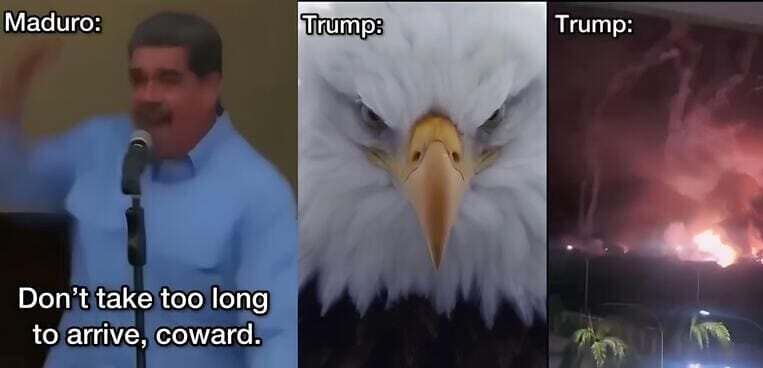
The parody in South America’s Venezuela to the South China Sea has simplified legal jargons to comic books and viral skits that are more relatable to younger netizens subscribing to social media and elderly locals loyal to traditional media. For example, the Trump administration’s use of memes against Nicolas Maduro to project strength and Washington’s power in the American hemisphere were divisive devices in putting the fallen Venezuelan dictator under their custody. In the Indo-Pacific, the Philippines launched a 40-page comic book drawn in sarcastic visuals and simple dialogues to frame China’s direct maritime bullying and distorted narratives.
In contrast, the Chinese state-affiliated media gathered parodic framing of footage to present Manila’s resupply missions as a rehearsed performance. Touted as a staged show filmed for Western media as Beijing used satirical social media videos to depict Filipino fishermen as actors who play the thief while crying victim. Consequently, satire films provide a layer of deniability by framing aggression as jokes or theatrics while dismissing global outcries as overreactions or based on an emotionally charged state of being.
The laughter buffer is real because it deflects security fears in a fragmenting world. The comic framing of security anxiety seen in memes and heard in deepfakes are propagated in various platforms of ontological security to amass psychological stability and derived from coherent narratives are totally frightening. Truth’s existentialism asserts subjectivity that strategic ridicule is used to mock adversaries and turning laughable performance into a serious threat. Therefore, security is truly a feeling more than a want, or it can be both.
The deliberate use of humor for instrumental national goals becomes a comedy of chaos to a point when a satire defense can pave the way for an international security dilemma. In the age of global chaos, people see warrior jokers to the right and political clowns to the left. Everything is left unclear that we all aspire to acquire critical thinking and critical feeling. In the end, the question lies if strategic humor can become a shield in managing the security paradox of the world order or can global leaders use satire to stabilize a chaotic system.
In sum, tactical wits are perceived as a backdoor strategy for a diplomatic withdrawal plan if a provocative statement results in a backlash. One can just utter, “Yes, it’s a joke!” Or it can serve as a safety net for de-escalating tense diplomatic negotiations or starting another war. But it can also create a stable narrative and temporary unity that helps citizens cope with fear and anger.
For many politicians, comic framing and national laughter is a recognized asset for nation branding and hybrid warfare where humor creates shareable content that bypasses traditional media gatekeepers allowing digital agility of AI-content creators and consumers who are the major stakeholders of truth sharing like the global Gen-Z and Alpha generation, potentially hooked in memes and the irony of a transborder virtual system.
Author: Dr. Chester Cabalza – Founding President of the Manila-based think tank International Development and Security Cooperation (IDSC).
(The views expressed in this article belong to the author and do not necessarily reflect the views of World Geostrategic Insights).
Image: Screenshot from a video posted by US President Donald Trump on his social network Truth, in which he mocks Nicolas Maduro, who had challenged him to capture him.