



As tensions in the Indo-Pacific simmer, much of the public debate in Washington and allied capitals centers on the fate of Taiwan and the U.S. ability to project power across the Western Pacific.

Yet, often overlooked in this conversation is the crucial role Micronesia, those small islands scattered across the blue expanse of the Pacific, has played throughout history in great power competition. As China expands its reach and studies past conflicts like the Falklands War for strategic lessons, the United States must not neglect Micronesia or assume that its current posture and alliances will suffice in the event of war over Taiwan.
A Region Forged by Empire
Micronesia’s geopolitical significance is not new. From the late 15th century onwards, these islands have been the object of imperial rivalry. Spain’s early claims, driven by the Treaty of Tordesillas, marked the first era of European interest. Spanish missionaries and administrators established outposts, particularly in the Marianas, and integrated the islands into trans-Pacific trade routes connecting the Far East with Europe through Mexico. Yet, as Spain’s empire waned following Mexico’s independence in 1821, Micronesia became vulnerable to encroachment by other powers.
Germany’s brief period of colonial rule started in the mid-1800s after they acquired the Marshall Islands. After the Spanish American war in 1899, they expanded their Micronesian colonies to eventually include Palau, the modern-day Federated States of Micronesia (FSM), and the Northern Marianas Islands. This period saw efforts to develop local economies and integrate the islands into a broader imperial system, but the archipelago soon changed hands again with the onset of World War I. Japan seized the islands and, under the League of Nations mandate, rapidly built infrastructure and established military bases, transforming Micronesia into a strategic springboard for its imperial ambitions in World War II.
The current period, dominated by the USA, began with the defeat of Japan and the islands’ administration under the United Nations Trust Territory system and continues today through a patchwork of U.S. territories and sovereign states in free association with the U.S. (like the FSM, Marshall Islands, and Palau). Throughout the Cold War and into the 21st century, Micronesia has remained a linchpin for U.S. military strategy, enabling force projection, intelligence operations, and logistical support in a region increasingly contested by China.
China’s Lessons from the Falklands and Implications for Micronesia
The People’s Republic of China has not only invested heavily across Micronesia in recent years through infrastructure, economic development, and diplomatic outreach. This investment is supported by careful consideration for past conflicts such as the 1982 Falklands War. In that conflict, the United Kingdom’s success hinged on controlling critical mid-ocean staging points, especially Ascension Island. The ability to secure, resupply, and project force across vast ocean distances with forward located infrastructure was decisive.
China’s military planners have internalized these lessons. In a Taiwan contingency, Beijing will seek to prevent external intervention by targeting U.S. and allied forces’ ability to reinforce or resupply from the central Pacific. Micronesia’s islands acting as logistics hubs, airfields, or surveillance outposts could become targets. We should anticipate influence campaigns, sabotage, or even military action, precisely because they enable or deny the flow of U.S. power west across the Pacific.
The Counterargument: Guam and Direct Force Flow
Some argue that Micronesia’s importance is overstated. The U.S. possesses formidable bases on Guam, and with advanced air and naval assets, can flow forces directly from the U.S. to Guam, then onward to hotspots like Taiwan or the South China Sea. According to this logic, so long as Guam remains secure, the smaller islands of Micronesia can be bypassed in the event of a great power contest. This view is complacent.
A Contested Sea: Lessons from Micronesia’s imperial periods
History teaches that the ocean is naturally contested and must be actively held to ensure security. During both World Wars, German raiders and Japanese submarines preyed on Allied shipping, forcing the U.S. and its partners to fight diligently for control of the sea lanes. Often at staggering cost. Micronesia’s islands served as both forward operating bases and defensive outposts. In World War I, German possessions in Micronesia had to be captured deliberately with some warships successfully evading destruction well into 1917. The U.S. “island-hopping” campaign in World War II was predicated on seizing Micronesian islands as steppingstones to enable sustained operations across the Pacific.
In the modern era, the threat is not just from submarines or commerce raiders, but also from long-range missiles, cyber-attacks, space-based surveillance, and political subversion. If the U.S. does not maintain positive control and trusted partnerships across the islands between the U.S. and Guam, its logistical and reinforcement routes could be disrupted or interdicted by Chinese action, long before a shot is fired at Guam itself.
Micronesia as a Strategic Crossroads
Today, the Compact of Free Association countries (FSM, Palau, and the Marshall Islands) remain vital U.S. partners, granting military access and supporting the American presence. But Chinese influence campaigns are making inroads, seeking to offer economic incentives, infrastructure investment, and educational exchanges as alternatives to U.S.-led development. Should these nations drift from Washington’s orbit, the U.S. could risk losing access to key airfields, ports, and surveillance sites.
Moreover, the local populations of these islands, often overlooked in grand strategy documents. are not disposable pawns. Their perceptions of American commitment, respect for sovereignty, and willingness to invest in their well-being will determine whether U.S. access is assured in peacetime and crisis alike.
Next Steps for US Policy
First, the US must treat engagement in Micronesia as a strategic priority. This means enhancement of the Compacts of Free Association, robust economic and development assistance, and regular high-level diplomatic visits. It also means transparency and partnership, ensuring that local populations see tangible benefits from their association with the U.S.
Second, the US military must invest in distributed logistics, resilient supply chains, and prepositioned assets across Micronesia, not just in Guam. This will complicate the Chinese strategy of isolating forward bases and ensure that the U.S. can sustain high-tempo operations deep into the western Pacific.
Third, the US needs to counter Chinese influence operations. Not just reactively, but proactively, by strengthening Micronesian civil institutions, supporting independent media, and building local capacity to counter Chinese operations.
Finally, military planners must study Micronesia as more than a hypothetical. If war comes to Taiwan, the contest for sea control, logistics, and regional influence will extend far beyond the first island chain. Micronesia will once again become the crossroads where the fate of the Pacific is decided.
Conclusion
Micronesia’s history is a story of great power rivalry, shifting alliances, and local resilience. As the U.S. confronts the challenge of China’s rise and the real possibility of conflict over Taiwan, it cannot afford to neglect the islands that have so often shaped the outcome of Pacific wars. Renewed government interest and engagement in Micronesia is not just prudent, it is essential for peace, deterrence, and victory.
Author: Francisco Garza – He was an active duty U.S. Marine Corps officer. Commissioned as a Second Lieutenant in 2010, he served on active duty from 2011 to 2018, deploying three times in support of global operations. His assignments included platoon command in both infantry and reconnaissance units, and advanced professional military education.
A native of Houston, Texas, Francisco earned his bachelor’s degree in political science with a minor in history and a postgraduate certificate in international affairs from Texas A&M University, where he was a member of the Corps of Cadets. He also earned an MBA from the University of Houston.
(The views expressed in this article belong only to the author and do not necessarily reflect the views of World Geostrategic Insights).
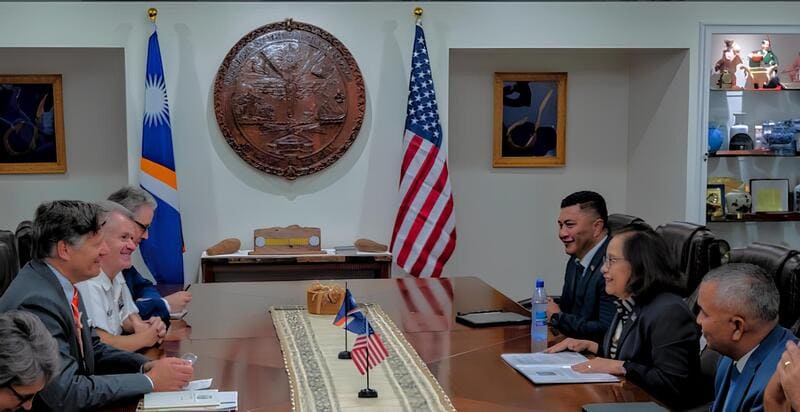
Image Source: U.S. Indo-Pacific Command website (Adm. Samuel J. Paparo, commander of U.S. Indo-Pacific Command, and Deputy Secretary of State Christopher Landau visiting the Republic of the Marshall Islands, on Sept. 18, 2025, to deepen partnerships and advancing shared priorities in the Pacific).