



Japan confronts its gravest leadership crisis since the 1860s. The working-age population shrinks by approximately 500,000 annually, threatening economic foundations. Japan ranks 116th out of 146 countries in the World Economic Forum’s 2023 Global Gender Gap Report, with women holding approximately 15% of management positions overall and less than 10% of senior executive roles in major corporations.

An aging political establishment maintains power through seniority-based systems that stifle innovation. Meanwhile, China, Russia, and North Korea coordinate challenges to the international order, while America’s return to more transactional diplomacy under Trump creates strategic uncertainty.
This moment demands transformational leadership comparable to the Meiji Restoration architects who modernized Japan within a generation. Yet surveying today’s political landscape raises a critical question for Japanese citizens, where are Japan’s modern Meiji reformers?
Lessons from the Meiji Architects
The Meiji Restoration succeeded because three leaders combined pragmatic realism with revolutionary vision, offering blueprints for contemporary challenges.
Ito Hirobumi served four terms as Prime Minister and led the drafting of Japan’s 1889 Constitution. His methodology was systematic. He studied Western institutions through the Iwakura Mission (1871-1873), adapted successful models to Japanese conditions, and built implementation capacity before announcing reforms. When Western powers imposed unequal treaties, Ito avoided confrontation, instead methodically building Japan’s legal and institutional framework until renegotiation became possible.
Facing today’s demographic crisis, Ito would pursue comprehensive immigration reform while ensuring social integration. He would recognize that economic vitality requires workforce expansion and craft policies attracting skilled migrants with robust cultural assimilation programs but at levels that would be accepted by Japanese citizens. His constitutional expertise would prove valuable in restructuring Japan’s rigid educational and employment systems.
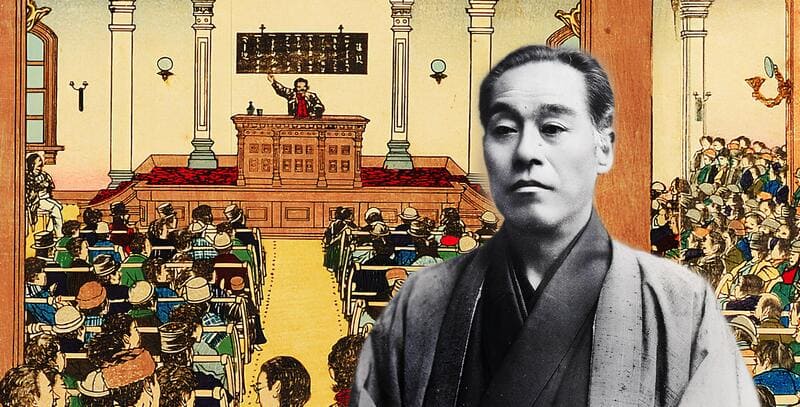
Fukuzawa Yukichi revolutionized Japanese education and social consciousness. He founded Keio University in 1858, and he introduced merit-based advancement over hereditary privilege. His translations of Western texts and advocacy for “independence and self-respect” challenged Confucian hierarchy while promoting individual initiative. Fukuzawa understood that institutional transformation required cultural change.
Confronting today’s educational stagnation, Fukuzawa would dismantle the university ranking system perpetuating social stratification, replace memorization-based learning with critical thinking curricula, and create pathways for lifelong learning. His emphasis on practical knowledge would align with contemporary needs for technological innovation and international competitiveness.
Sakamoto Ryoma orchestrated the Satsuma-Choshu Alliance that enabled the Restoration despite centuries of regional rivalry. His “Eight-Point Program” outlined parliamentary government, international trade, and military modernization. These were radical proposals that became Meiji policy. Though assassinated in 1867, Sakamoto’s coalition-building enabled comprehensive reform.
Facing current geopolitical challenges, Sakamoto would forge new partnerships transcending traditional boundaries. He would strengthen democratic alliances while managing great power competition strategically, building domestic coalitions between reformist politicians, business leaders, and civil society to overcome entrenched resistance.
Evaluating Current Leadership
Measuring today’s candidates against Meiji standards reveals significant limitations.
Sanae Takaichi demonstrates policy expertise in economic security but lacks the Meiji leaders’ adaptability. Her opposition to same-sex marriage and separate surnames for married couples represents backward-looking politics when Japan needs forward-thinking solutions. While her economic nationalism addresses legitimate concerns, her social conservatism contradicts the demographic realities requiring comprehensive societal transformation. Meiji leaders preserved tradition through strategic change; Takaichi confuses preservation with stagnation.
Shinjiro Koizumi offers generational change and environmental leadership, echoing Fukuzawa’s innovation. His climate advocacy and disaster relief work demonstrate public service commitment. However, his policy depth remains questionable. Meiji leaders combined vision with detailed expertise. Ito mastered constitutional law, Fukuzawa translated complex texts, and Sakamoto crafted specific reforms. Koizumi’s reliance on inherited political capital and limited legislative achievements suggest insufficient preparation for transformational leadership.
The fundamental challenge is that current candidates appear better suited to managing existing systems than transforming them. The Meiji leaders understood that preserving Japan’s essence required revolutionary change in its institutions. Today’s politicians seem to believe that preserving institutions will somehow preserve Japan’s vitality. This is a dangerous reversal of priorities.
Alternative Pathways to Reform
Given the absence of obvious transformational leaders, Japan might achieve necessary changes through alternative scenarios.
Crisis-Driven Coalition Government
Severe external shocks such as Taiwan Strait conflict or demographic collapse could shatter LDP dominance and force a coalition government. The 1993-1994 Hosokawa coalition, despite lasting only eight months, introduced significant electoral reforms including the shift from multi-member to single-member districts. A crisis-driven coalition including reformist LDP members, Constitutional Democratic Party progressives, and business-backed centrists could push through migration reform, gender equality legislation, and educational modernization impossible under single-party rule.
Generational Succession Within the LDP
Demographics will eventually force change as the party’s aging base shrinks. Younger politicians like Koizumi could develop into effective reformers given experience and institutional support. This requires patient cultivation of reformist networks, similar to how Meiji leaders built support before 1868. Success depends on developing policy expertise, building international relationships, and demonstrating crisis management competence.
Business-Led Reform Pressure
Corporate Japan increasingly recognizes that demographic decline threatens economic survival. Major companies could drive reform by demanding policy changes as conditions for continued domestic investment. This echoes how business pressure forced financial sector reforms following the 1990s crisis. Corporate leaders advocating migration reform, women’s advancement, and educational modernization could create irresistible momentum for political change.
Technocratic Leadership from Outside Politics
Japan’s bureaucratic tradition offers another pathway. Respected figures from academia, business, or international organizations could emerge as crisis managers, similar to how Mario Draghi led Italy’s technocratic government. This would require constitutional innovation but could bypass political gridlock that prevents necessary reforms.
The Imperative for Transformation
Japan’s challenges demand Meiji-scale transformation, but current leadership appears inadequate. The Meiji reformers succeeded through combining long-term vision with tactical flexibility, international awareness with domestic sensitivity, and idealistic goals with pragmatic implementation. Today’s candidates possess some qualities but none demonstrate the complete package.
The demographic mathematics are unforgiving. Every year of delay increases adjustment costs and narrows policy options. Japan’s postwar development model of lifetime employment, age-based promotion, and export-led growth cannot survive population decline and technological disruption. Without transformational leadership soon, Japan risks joining the ranks of former great powers unable to adapt to changed circumstances. In the worst case, one could imagine not Galapagos Japan but the Aztec-itization of Japan.
More troubling is the possibility that Japan’s very success in creating stable institutions now prevents the kind of creative destruction necessary for renewal. The Meiji leaders had the advantage of clear system failure, the Tokugawa order’s inability to handle Western pressure was undeniable. Today’s gradual decline may be too slow to generate the crisis mentality needed for radical reform.
The Search Continues
The Meiji generation proved rapid, comprehensive reform possible when national survival was at stake. Contemporary Japan faces similarly existential challenges but lacks leaders of comparable vision and capability. The question is whether such leadership can emerge organically through existing political processes or whether external crisis will be required to catalyze transformation.
Japan’s continued relevance as a major power and its viability as a modern society depends on finding leaders equal to this historical moment. The Meiji Restoration happened because extraordinary individuals rose to extraordinary challenges. Japan desperately needs their modern equivalents to emerge before demographic and geopolitical pressures overwhelm the nation’s adaptive capacity.
The search for Japan’s modern Meiji moment continues, but time is running short. Without transformational leadership soon, Japan’s remarkable journey from feudal isolation to global prominence may end not with dramatic collapse but with slow, inexorable decline, a fate perhaps worse than the crises that originally forged the nation’s strength.
Author: Stephen R. Nagy – Professor of politics and international studies at the International Christian University in Tokyo and concurrently a visiting fellow for the Hungarian Institute for International Affairs (HIIA) and a Distinguished Fellow at the Corvinus Institute for Advanced Studies (CIAS). He holds strategic appointments as Senior Fellow at the MacDonald Laurier Institute, Research Fellow at the Canadian Global Affairs Institute, and Visiting Fellow at the Japan Institute for International Affairs. His expertise is further recognized through affiliations with the Institute for Security and Development Policy, the East Asia Security Centre, and the Research Institute for Peace and Security. From 2017-2020, he served as Distinguished Fellow at the Asia Pacific Foundation. His forthcoming monograph is entitled: “Navigating U.S. China Strategic Competition: Japan as an International Adaptor Middle Power.” (Link to Dr. Stephen R. Nagy website: https://nagystephen.com/).
(The views expressed in this article belong only to the author and do not necessarily reflect the views of World Geostrategic Insights).
Image: Yukichi Fukuzawa. Source: fl-keio.info