



World Geostrategic Insights interview with Naser al-Tamimi on the vulnerability of the Gulf monarchies to the current regional turmoils, the implications of the disruption of maritime traffic in the Strait of Hormuz, the significance of the United Arab Emirates’ withdrawal from OPEC, the influence of major powers, with particular reference to the role of China, and the ‘black swan’ risks that policymakers in Europe and the Gulf are currently underestimating the most.

Dr. Naser al-Tamimi is the founder of MidEast Strategia, an independent consulting firm specializing in geostrategy, political economy, energy policy, and the complex relations between China and the Gulf countries (MENA). He is a Senior Research Associate at ISPI (Institute for International Political Studies) in Milan and a Senior Fellow at the Global Institute for Strategic Research (GISR) in Doha, Qatar. He is also the founder of the China-Arab Forum (CAF) on Platform X, a space dedicated to in-depth analysis and ongoing updates on Sino-Arab relations. A regular columnist for major international publications, he is the author of the book “China-Saudi Arabia Relations, 1990-2012: Marriage of Convenience or Strategic Alliance?” and academic paper “The relations between China and Saudi Arabia: continuity amid new challenges”.
Q1 – In a recent analysis, you spoke of the “end of immunity for the Gulf Cooperation Council.” What are the main factors that, in 2026, are making the Gulf monarchies more vulnerable to regional turmoil than in the past?
A1 – The Gulf’s “immunity” has diminished because of geography, energy dependence, and economic openness, which now channel conflict directly into domestic stability. Threats from missiles, drones, Hormuz disruptions, vulnerable energy infrastructure, cyber threats, and investor concerns heighten the Gulf monarchies’ exposure. The previous belief that wealth, US protection, and neutrality could safeguard them from regional conflicts is no longer valid.
Q2 – On May 1, 2026, the UAE officially withdrew from OPEC. The “divorce” between the United Arab Emirates (UAE) and Saudi Arabia is manifesting itself primarily as an oil and geopolitical split, marking a deep rift in the Persian Gulf. What are the repercussions for energy markets and the political balance within the GCC?
A2 – The UAE’s decision to leave OPEC deepens the divide between Saudi Arabia and the United Arab Emirates: Abu Dhabi emphasises maintaining flexibility in oil production, whereas Riyadh focuses on fixing prices and enforcing organisational discipline. While the immediate market impact may be limited as long as the Strait of Hormuz remains unstable, this move could, over time, erode OPEC+ unity, heighten competition for supply, and affect Saudi Arabia’s influence within the GCC. Politically, this development signals a shift from a relatively unified Gulf stance towards more competitive, state-interest-driven strategies.
Q3 – You firmly maintain that “Hormuz has no substitute” and describe alternative land routes as an “illusion.” Why, despite massive infrastructure investments, does the Gulf remain inextricably linked to this critical passage?
A3 – Hormuz has no viable substitute. Alternatives can reduce exposure but cannot match its scale, geography, or flexibility. Pipelines only partially bypass Gulf exports, remain vulnerable to missile and drone attacks, and cannot handle the full volume of oil and LNG flows. Qatar’s LNG, much Iraqi and Kuwaiti oil, and key shipping routes remain tied to Hormuz. The strait is not only an energy chokepoint but also a global trade artery, carrying roughly a quarter of seaborne crude, one-fifth of LNG, one-third of fertiliser, half of sulphur, and a third of helium. Disruption would also raise freight, insurance, and food costs, with the heaviest impact on vulnerable developing economies. Infrastructure can mitigate risk; it cannot erase the chokepoint.
Q4 – In the current conflict between the United States, Israel, and Iran, China has positioned itself as a strategic mediator and an economic lifeline for Iran, while carefully avoiding direct military involvement. What is your opinion on the role Beijing is playing?
A4 – Beijing adopts a cautious yet effective approach: economically critical to Iran and diplomatically valuable to Gulf states, without resorting to military intervention. This strategy grants China influence without taking ownership of the crisis. Its goal is not to supplant the US security role but to leverage American overstretch while maintaining access to energy, mediation authority, and strategic options.
Q5 – President Xi has proposed a ‘sustainable security architecture’ for the Gulf. How does this model differ from traditional Western-led security frameworks in the region?
A5 – Xi’s “sustainable security architecture” fundamentally contrasts with Western approaches by prioritising sovereignty, non-interference, economic growth, dialogue, and inclusive regional agreements over military alliances, forward bases, and deterrence blocs. It treats security as a political and developmental framework rather than primarily a military one. However, its weakness lies in enforcement: China can propose principles, but it lacks strong coercive tools to ensure adherence.
Q6 – Is it realistic to expect China to assume in the future the role of guarantor of regional security, replacing or complementing the United States?
A6 – In the near future, China is unlikely to become the Gulf’s primary security guarantor. While China may work alongside the US through diplomacy, reconstruction finance, technology, and crisis mediation, it avoids establishing bases, escalating risks, making defence commitments, or assuming political burdens. China seeks influence without entanglement, leaving the US as the region’s main military power.
Q7 – In a book you published several years ago, you described the China-Saudi Arabia relationship as a “marriage of convenience.” Now that cooperation extends to technology, defence, and civil nuclear energy, do you believe we have moved toward a true strategic alliance, or does economic pragmatism still prevail?
A7 – The relationship has progressed beyond a basic oil-for-markets partnership but has not yet evolved into a full alliance. Cooperation in areas such as technology, defence, nuclear energy, and investment signals a deeper strategic alignment, yet both parties retain their autonomy. Riyadh remains heavily reliant on US security, while Beijing refrains from making formal commitments. Economic pragmatism continues to underpin the relationship, which has become more strategically nuanced.
Q8 – Could the growing cooperation between the Gulf and China in artificial intelligence and civil nuclear energy compromise Gulf countries’ security agreements with Washington?
A8 – Yes, potentially. Cooperation with China in the AI, cloud infrastructure, telecommunications, surveillance, and civil nuclear sectors could raise US concerns about data security, dual-use technology, sanctions risks, and compatibility with US defence systems. Gulf states are likely to compartmentalise China’s involvement in infrastructure and technology, while the US manages advanced security. However, Washington may increasingly compel these countries to choose sides in sensitive areas, at least in the near future.
Q9 – You recently noted that Chinese companies operate with a different “risk calculation” than Western companies in the Middle East. Can you elaborate on that?
A9 – Chinese companies typically assess risk differently, reflecting stronger state support, longer-term perspectives, less emphasis on reputation, and greater tolerance for politically complex environments. They may accept sanctions, payment delays, or instability if the projects align with strategic objectives. Conversely, Western firms often face stricter compliance requirements, shareholder expectations, insurance constraints, and reputational risks, prompting them to exit projects more swiftly.
Q10 – India is becoming an increasingly assertive trading partner in the Gulf, challenging China’s dominance. How do you view this competition between New Delhi and Beijing for influence in the GCC?
A10 – India is not replacing China but is emerging as a significant alternative. Its strengths include geography, labour connections, food security, digital services, and political trust with Gulf states. While China still dominates in trade, infrastructure, technology, and industrial capacity, Gulf states are likely to welcome the competition, which enhances their bargaining power and promotes a more aligned foreign policy.
Q11 – What would be the immediate economic consequences for Asian economies if the Strait of Hormuz were to experience prolonged disruptions?
A11 – A sustained disruption at Hormuz would harm Asian economies by driving up oil and LNG prices, freight and bunker fuel costs, and insurance premiums, and by causing supply-chain delays. Such a shock would also raise fertiliser and food costs, worsen inflation, and put pressure on households. Countries such as China, India, Japan, South Korea, and those in Southeast Asia would see weaker trade balances and industrial disruptions. While strategic reserves could mitigate the initial impact, they would not be sufficient to prevent the effects of a prolonged maritime crisis.
Q12 – What is the ‘black swan’ risk that policymakers in Europe and the Gulf are currently underestimating the most?
A12 – The least recognised black swan event is not a single military attack but a cascade of infrastructure failures: simultaneous disruptions to shipping through the Strait of Hormuz, Gulf energy facilities, undersea cables, ports, and cyber systems. Policymakers tend to analyse these risks in isolation. However, the true threat lies in their interaction, with failures across energy, finance, logistics, and digital connectivity occurring simultaneously and triggering a systemic shock.
Q13 – Is it possible to envision genuine economic integration between Iran and the GCC countries?
A13 – Genuine Iran-GCC economic integration can occur only with a stable political agreement, not amid current security issues. Opportunities such as trade, energy links, ports, reconstruction, and tourism could provide strong incentives. However, sanctions, mistrust, militia networks, ideological clashes, and ongoing maritime and security disputes continue to pose significant challenges. In the short term, a gradual and selective approach to engagement is more realistic than full integration.
Dr. Naser al-Tamimi – Founder of MidEast Strategia, Senior Research Fellow, and Author.
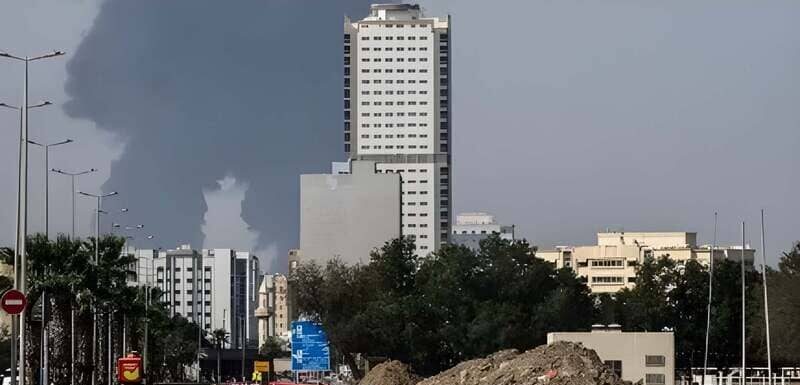
Image source: AFP (Smoke rises following attacks on a power plant in the emirate of Fujairah, United Arab Emirates, on March, 2026).