



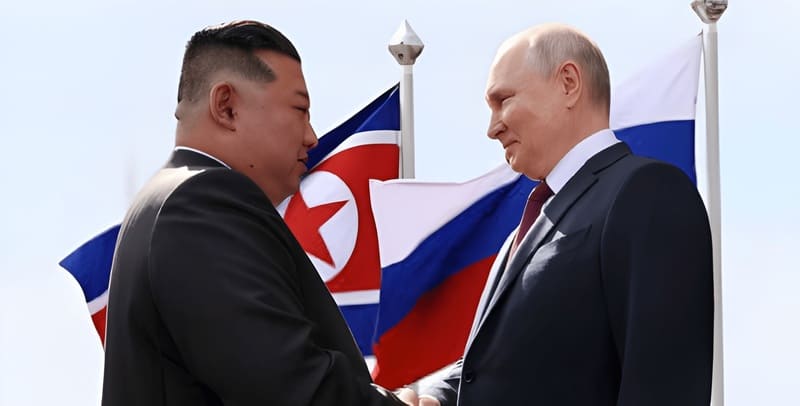
World Geostrategic Insights interview with Terence Roehrig on Pyongyang’s growing significance as a military partner for Russia, and its implications for the interests of the United States and its allies in the Yellow Sea, as well as for regional stability.

Terence Roehrig is a Political Science Lecturer at the University of Wisconsin-Madison and a Professor Emeritus of National Security Affairs at the U.S. Naval War College in Newport, Rhode Island. Previously, he was a Research Fellow at the Kennedy School at Harvard University and President of the Association of Korean Political Studies. Roehrig has written numerous books, articles, and book chapters on Korean and East Asian security issues, North Korea’s nuclear weapons program, the South Korean Navy, deterrence theory, and the U.S.-South Korea alliance. His books include Japan, South Korea, and the U.S. Nuclear Umbrella: Deterrence After the Cold War (Columbia University Press) and The Evolution of the South Korea-United States Alliance (Cambridge University Press), co-authored with Uk Heo.
Q1 – Relations between Kim Jong-un and the Kremlin have been further formalized with a five-year military cooperation plan (2027–2031) announced in late April. The parade of North Korean troops on Red Square for Victory Day (May 9, 2026) is an unprecedented symbolic signal. Is Pyongyang becoming an indispensable partner for the projection of Russian power, beyond the conflict in Ukraine?
A1 – Russia’s invasion of Ukraine has been a catalyst for a growing partnership with North Korea. When Putin did not achieve his anticipated quick victory and the war dragged on into a bloody stalemate, he turned to an unexpected partner, North Korea, for help. A lingering question is how deep is this partnership and how long will it last. After signing a formal defense treaty in 2024, Russian Defense Minister Andrei Belousov traveled to Pyongyang in April where he indicated a willingness to sign a 5-year military cooperation plan that would “place our military cooperation on a stable, long-term footing.” Details of what this plan might entail are unknown. These actions are a sign that the relationship remains important for Russia and a recognition that Moscow sees this war continuing for a while. However, it is not clear how deep and how long this relationship will last in the years ahead. Time will tell.
Q2 – It is speculated that Russia is supplying advanced satellite and missile technologies to North Korea. What is your opinion? If so, could this ‘transfer of know-how’ render obsolete the forecasts regarding the timing and extent of the development of Kim Jong-un’s nuclear program?
A2 – Though it is unclear exactly what Russia has provided North Korea by way of assistance, it is likely that there has been substantial technology transfer and financial assistance that has had an important impact on North Korea’s missile and satellite programs. Moscow has provided technical guidance and weapons technology to help Pyongyang improve its ballistic missile capabilities along with cruise missiles and hypersonic glide vehicles. North Korea has also sent its KN-23 short-range ballistic missile (SRBM) to Russia for use against Ukraine, a missile that is based off the Russian Iskander SRBM. As a result, North Korea has been able to field test the weapon in combat and receive upgrades from Russia to improve its capabilities. Russian financial assistance has also given North Korea more resources to direct toward improving its missile and satellite capabilities helping Pyongyang to sidestep UN sanctions. In the end, Russian assistance will help to improve North Korea’s ability to counter U.S. and South Korean air and missile defenses while improving missile guidance systems and targeting capabilities.
Q3 – Are current allied missile defenses (such as the Patriot system or THAAD) still effective, given the progress of technological innovations applied to North Korea’s military?
A3 – North Korea has a large arsenal of ballistic missiles of all ranges and continues work on more advanced cruise missiles and hypersonic glide vehicles with some capable of carrying nuclear as well as conventional warheads. Pyongyang also continues a robust testing program to increase the number and capabilities of all these systems. As a result, U.S. and South Korean ballistic missile defense will be increasingly hard-pressed to counter North Korea’s missiles. Indeed, part of Pyongyang’s motivation for growing its missile arsenal has been to counter ROK/US missile defense.
Q4 – If reports of a possible transfer of Patriot batteries from South Korea to other theaters, particularly the Middle East, were confirmed, what impact would this have on South Korea’s perception of the United States’ ‘Extended Deterrence’?
A4 – In discussions with South Korea and other US allies in the Asia-Pacific, the term “extended deterrence” typically refers to extended nuclear deterrence and the U.S. nuclear umbrella where Washington pledges to use nuclear weapons to deter and defend against a nuclear attack. However, it is important to think of extended deterrence more broadly in ways that encompass the entire relationship and the overall U.S. commitment to defend South Korea with whatever assets are effective and appropriate. Moreover, the relationship is no longer a one-way defense commitment but a broad economic, political, and security partnership. While there is strong support in South Korea for the alliance, there are several issues of concern including U.S. credibility given that North Korea can now reach the U.S. with a nuclear weapon, U.S. tariffs, expectations for ROK assistance in a Taiwan contingency, and alignment with the Trump administration on North Korea policy. The withdrawal of Patriot batteries to the Mideast adds another item to this list, but Seoul may have little choice in the matter unless Tehran and Washington can reach a peace agreement soon.
Q5 – During his visit to China in early January 2026, South Korean President Lee Jae-myung asked Xi Jinping to promote dialogue and push for a freeze on North Korea’s nuclear program. It is likely that this request will not be followed up on in a significant way. However, is President Lee Jae-myung’s policy of rapprochement with China compatible with Seoul’s commitment to trilateral coordination with the U.S. and Japan established at Camp David?
A5 – While many expected Lee Jae Myung to make a drastic shift to the left after succeeding the conservative Yoon Suk Yeol administration, he has steered a more middle-ground path that is often labelled “pragmatic diplomacy”. Lee has sought to improve ties with China after tension during the Yoon years, China’s economic punishment in response to the deployment of U.S. THAAD missile defense batteries to South Korea, and Beijing’s concerning activities in the Yellow Sea. In addition, Lee has continued efforts to improve relations with Japan through continued trilateral cooperation with Japan and the U.S. along “shuttle diplomacy” of regular bilateral summit meetings between Seoul and Tokyo. Though the difficult history issues remain between South Korea and Japan, Lee and his counterpart, Japanese Prime Minister Takaichi Sanae have opted to set these matters aside to address common security and economic concerns. So far, these efforts have been successful but remain fragile and vulnerable to domestic politics.
Q6 – The joint U.S.-South Korea “Freedom Shield” military exercises last March were conducted on a reduced scale in an attempt to ease tensions. Is this an effective de-escalation strategy, or does it risk being interpreted as a sign of weakness by Pyongyang?
A6 – South Korean and U.S. militaries must conduct regular training exercises to remain effective and send messages of alliance unity to strengthen deterrence. During the summit years of 2018-19, exercises were adjusted to promote dialogue and the possibility of reducing tensions on the Korean Peninsula, a worthwhile effort at the time. Then or today, I doubt North Korea views this current effort as a weakness but it is also likely to be ineffective in restarting dialogue. Kim Jong Un has shown no interest in talks with South Korea though he has left the door open to meeting with President Trump but with an important condition: Washington must recognize the North as a nuclear weapons state.
Q7 – North Korea has announced the imminent deployment (scheduled for mid-June) of the Choe Hyon, the first of a new class of modern destroyers. The 120-nautical-mile sea trial conducted by the Choe Hyon in May marks North Korea’s transition from a coastal navy to a blue-water force. What are the implications for the protection of U.S. and allied maritime lines of communication in the Yellow Sea?
A7 – In recent years, Kim Jong Un has indicated his determination to build a stronger navy. The North Korean fleet consists largely of small, coastal patrol vessels with outdated weapons and targeting systems. The deployment of the Choe Hyon and a few new other ships has improved the North Korean navy, and Kim has indicated his intention to continue prioritizing improvement of the fleet. Moreover, it is likely there has been some Russian help in the modernization effort. However, while concerning, it will take many more ships with improved capabilities along with operator experience to build a force that changes the naval balance of power and is able to challenge the ROK and U.S. navies. The more serious and immediate concern is Pyongyang’s intent to use these new vessels for nuclear launch platforms.
Terence Roehrig – Political Science Lecturer at the University of Wisconsin-Madison and a Professor Emeritus of National Security Affairs at the U.S. Naval War College in Newport, Rhode Island.