



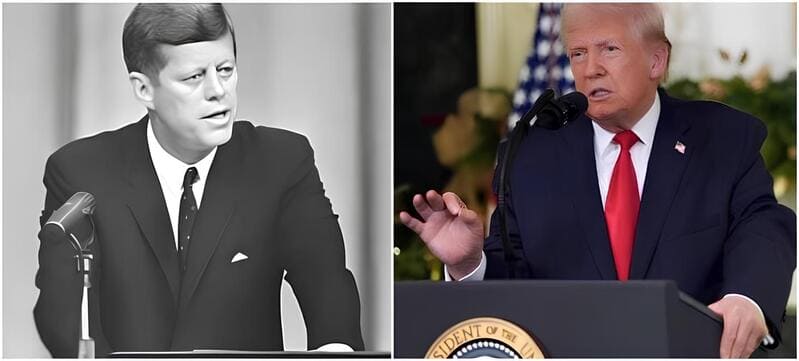
Witnessing USSR’s deployment of medium-range (MRBM) (nuclear-capable) missiles at Cuba, via U.S. aerial reconnaissance and satellite imagery taken on October 14, 1962, United States Intelligence alerted the National Security Advisor and President John F. Kennedy immediately.

Consequently, President Kennedy directed the National Security Council to begin formulating immediate policy responses. However, any immediate military options could fairly rapidly lead to the cataclysm of Soviet retaliation, increased likelihood of nuclear war, or a third world war.
Apart from conventional and military direct action, US President Kennedy took wise diplomatic steps. The U.S. ultimately imposed an ‘embargo’ (also referred to as a “quarantine”) on Cuba using naúical or maritime blockade tactics. While the goal of the blockade was to stifle further shipments of Soviet military supplies to Cuba, it also afforded the U.S. an opportunity to pursue diplomatic resolutions. The strategic reasoning regarding the missiles, at the same time, was embedded in an effortless grasp of how quickly U.S. cities would be subject to attack in light of the proximity of Cuba to U.S. mainland; as such, it would jeopardize the ability to respond in a timely manner, completely obliterating any potential options and resulting in catastrophic consequences.
On October 22, 1962, President John Fitzgerald Kennedy made a speech to the American public and international community informing them that there were Soviet missiles located in Cuba. Shortly thereafter, Soviet ships proceeded toward the blockade line and the entire world was placed on edge, as it seemed likely that nuclear war was imminent. Soviet forces were on high alert in Cuba while the U.S. raised their military readiness to DEFCON 2, which was the highest level of military alert short of declaring a full-scale nuclear war. The urgency of this crisis stressed the seriousness of the situation. Fidel Castro’s close cooperation with the Soviet Union had already strained relations between Cuba and Washington, and the creation of a military base in the Western Hemisphere by the Soviet Union would also be perceived by the United States to be an unacceptable threat to their national security.
In reaction to this crisis, intensive diplomatic negotiations between Moscow and Washington took place behind the scenes. Nikita Khrushchev, the leader of the Soviet Union, sent President Kennedy a number of letters alternating between conciliatory offers and confrontational threats. The most dangerous period of the crisis occurred when the Soviet Union shot down a U.S. U-2 spy plane over Cuba, killing the pilot and greatly increasing the risk of accidental escalation. Ultimately, despite mounting pressure to go to war, both Moscow and Washington realized the catastrophic losses that would accompany a nuclear war and instead settled on a peaceful resolution to the crisis. The Cuban Missile Crisis was resolved through a secret diplomatic compromise between the Soviet Union and the United States. The Soviet Union agreed to remove nuclear missiles from Cuba with monitoring by the United Nations. In exchange for Soviet withdrawal from Cuba, the United States made a public pledge to not invade Cuba and a private promise to withdraw U.S. intermediate range Jupiter missiles from Turkey. On October 28, 1962, Prime Minister Khrushchev officially stated that Soviet missiles were gone from Cuba, thus ending this incredible incident in history.
Through the realist perspective, this event represents many underlying principles of state interaction in international relations. First, it illustrates the anarchic nature of the international system; states operate on the basis of self-help as there is no higher power in the system to protect them from each other. The actions of both the U.S. and Soviet Union were not taken for moral reasons but were done for strategic necessity. The Cuban Missile Crisis, therefore, illustrates the significance of power and deterrence in International Relations; power being the pre-condition for any activity that uses military force, whether through conflict or dialogue, and how power also provides limitations as to what types of activities a country may participate in.
Furthermore, MAD formed the basis for what constitutes a “zero-sum” game between the United States and the Soviet Union where neither nation could declare victory unless it was able to destroy all of the other’s nuclear weapons resulting in massive casualties on both sides. The final point from the Cuban Missile Crisis shows how geography and proximity shape perception of threat. The U.S. perceived the presence of Soviet missiles in Cuba as a threat to national security, while at the same time, the Soviet Union viewed U.S. missiles in Turkey as an equally threatening situation to its security and, therefore, acted accordingly. This likeness in perceptions of threats reinforces the Realist argument that all actors react to the same types of threats in similar fashions; specifically, all states respond to their unique security dilemmas using the tools at their disposal.
The Cuban Missile Crisis had worldwide repercussions for a long time. After it was over, leaders in Washington and Moscow created a way to communicate directly with one another, which helped decrease the severity and number of errors that were likely to occur as a result of miscalculations when faced with similar crises. Additionally, the actions taken during and post-crisis promoted future arms control efforts, most notably shown through the 1963 Partial Test Ban Treaty. More importantly, the lessons learned during the Cuban Missile Crisis demonstrated that even ideologically opposed actors can rationally act in a manner that is beneficial to maintaining national survival.
With the difference of a more complex contemporary strategic environment than during the Cuban Missile Crisis due to advances in military technology, the evolution of more sophisticated nuclear weapons, and the acceleration of information flows, the geopolitical landscape surrounding Greenland will present a similar strategic situation between the U.S. and its allied military partners to the one faced during the Cuban Missile Crisis. The possibility of misperceptions or unintended consequences caused by the spread of misinformation, disinformation, and deep-fakes will continue increasing.
As previously mentioned, even small events or false information can lead to major problems. Russian and Chinese interest in Greenland has created a major psychological, strategic, political, and financial challenge for the United States. Since Greenland is located in a strategic area (the Arctic and North Atlantic), Washington will not allow other great powers to expand their influence into Greenland. The reason Denmark’s limited amount of military power and Europe’s broader military capabilities do not change the fact that the U.S. military power continues to be the single most important factor influencing the balance of military power in the Arctic. While occasional conflicts can arise between the United States and NATO allies, these conflicts have little strategic impact, as the U.S. is the primary military supporter of NATO.
Consequently, the U.S. is likely to pursue policies to limit Russian and Chinese influence across Europe and into the Arctic. European countries understand that they do not currently have the military capability to operate independently on the global stage. The projected U.S. defense spending is projected to exceed $1.7 trillion by 2026. Contemporary evidence supports this positioning; For both the first and second world wars, Europe could not defeat its enemies in either conflict without the help of the United States. Currently, the United States possesses significantly more power than it did during either of these conflicts due to its military bases, which are spread throughout the world.
Realists also argue that, although the intentions of states are uncertain, some European nations could ally themselves with alternative global powers, such as China and Russia, under certain conditions.
From Washington’s perspective, increasing its strategic military presence in Greenland would create additional means to influence rival global powers and maintain its superpower status; however, any military conflict between the United States and one of the other great powers poses a danger of escalating into a third world war, which could have devastating consequences worldwide.
Therefore, it is necessary for European Nations (specifically Denmark) to prioritise diplomatic relations with the United States. History has witnessed that while a battle may be fought over egotism or narcissism, it can often be barred using discretion, arbitration, and cooperation. Ultimately, if escalation or prolonged hostility occurs between nations, it could easily involve all nations in a sustained conflict. The future of Greenland will be determined by how the major world powers decide to deal with the problems that exist on the Greenlandic mainland. If they follow their selfish agendas, the instability and worldwide conflict will rise.
Author: Rana Danish Nisar – Independent international analyst of security, defense, military, contemporary warfare and digital-international relations.
(The views expressed in this article belong only to the author and do not necessarily reflect the views of World Geostrategic Insights).
Image: President John Fitzgerald Kennedy and President Donald Trump.