



By Yasir Masood
Global diplomacy is in transition, with Beijing increasingly appearing as a diplomatic hub. In the last six months alone, it hosted several state leaders, including four from the UN Security Council’s permanent members. More importantly, Putin’s visit came days after Trump’s visit to Beijing, which carries significant weight for Washington, especially as the joint declaration on May 20, 2026, explicitly highlighted the need for a “multipolar world” amid a fragmented world order.

The growing traction of regional and global powers toward Beijing isn’t only about the convergence of new alliances, nor is it about considering Beijing as a diplomatic center of gravity. Rather, these developments reflect a broader reconfiguration in which great powers engage through alternative channels within the existing state structure. This also produced a new strategic triangle of the United States, China and Russia, but this three-way bond is not the foundational reason for an emerging world order. Instead, the logic is that of a “multi-vector” diplomatic approach based on a “marriage of convenience,” beyond rigid loyalty to state blocs. The visibility of a “multipolar world” at the Xi-Putin meeting reinforces the idea that multiple states are now aligning themselves beyond unipolar influence, without making the strategic triangle the organizing logic of the emerging order.
Whether these engagements are hedging strategies or will converge into long-term cooperation is uncertain. But what’s certain is that multiple states are now testing alternative methods of state interaction as a way to reform the current state structure from within, and not to replace it entirely.
In fact, the ongoing global situation drives the need for alternative methods of state interaction. Has the war in Ukraine not entered its fourth year with no immediate solution in sight? Has the unabated mayhem in Gaza and South Lebanon already morphed into peace? Has the Persian Gulf crisis, which is affecting almost every household globally, reached a sustainable conclusion? Has protectionism, economic stress, environmental issues, mushrooming global crimes, terrorism and uncertainty found any relief? Is the world in its true sense united against these ills, or just marching in place? Have starvation and more than 50 armed conflicts in Africa ended? And to what extent has the Global South achieved equity in resource distribution and governance structures? The questions are too many and too painful, and can go on endlessly without finding answers.
In order to address these disparities, Beijing has long advocated reform of the international system since Hu Jintao’s 2005 “Harmonious World” speech at the United Nations. The same vision was later institutionalized in Xi’s Global Development Initiative (2021), the Global Security Initiative (2022), the Global Civilization Initiative (2023) and the Global Governance Initiative (2025). But so far, Washington has responded with criticism toward Beijing-led initiatives, including the Belt and Road Initiative (BRI). Western alternatives, such as the G7’s Partnership for Global Infrastructure and Investment (PGII) and the European Union’s Global Gateway, have also expanded, though their global reach has remained more limited than Beijing’s outreach.
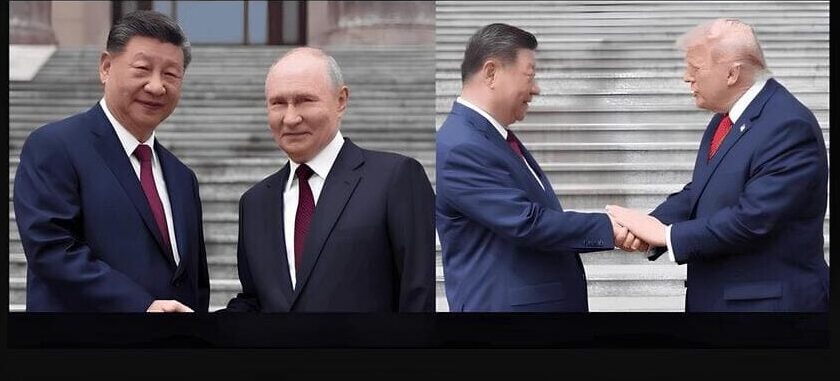
This reform narrative now finds practical expression in recent summit diplomacy. The recent Xi-Trump-Putin Summit exemplified how these broader dynamics are shifting in state interaction. The difference between these engagements was visible right from the outset in reception, gestures, handshakes, joint declarations and cooperation agreements. According to the BBC, Xi and Putin signed more than 20 agreements on trade and tech, including a declaration on a multipolar world order. China’s Ministry of Commerce reported that bilateral trade reached $227.9 billion in 2025, surpassing the $200 billion mark for the third consecutive year. In the first quarter of this year, bilateral trade totaled $61.2 billion, up 14.7% year on year. However, differences still persist on the stalled multi-billion-dollar Power of Siberia 2 natural gas pipeline, reaching “a general understanding” only. Reuters reported that Trump, in contrast, left Beijing with no joint declaration and no support on the Strait of Hormuz. CNN described the outcomes as “short on specifics” and “fell short of a major breakthrough.” Beijing called them “preliminary” but agreed to buy $17 billion worth of farm goods and 200 Boeing planes, as confirmed in reporting from CNN.
That said, even as Beijing deepens its ties with Russia alongside Washington, the strategic limitations between Beijing and Moscow reveal the real story. For instance, China and Russia have economic convergence, strong cultural bonds, trade and security cooperation, and educational exchanges. Despite deep ties, their nuclear doctrines differ, their geopolitical objectives contrast at times, and both diverge on economic systems. Brookings notes that their relationship is more about mitigating the perceived threat from the West and less about pursuing long-term strategic cooperation. The concept of “indivisible security,” often discussed in their bilateral discourse, justifies this logic. But questions arise about whether this principle applies uniformly in the Ukraine war or in the realm of dual-use technology flows, particularly given Western concerns over Chinese exports supporting Russia’s defense-industrial base in Ukraine, as documented by CSIS and Reuters.
The same limitations are evident in the economic and strategic interdependence between Beijing and Washington, illustrating a clear picture of why complete decoupling isn’t possible but manageable, as outlined during the Xi-Trump Summit under the framework of “constructive strategic stability.”
Overall, the trend in state partnerships is moving away from alliance blocs toward a multi-vector diplomatic approach that allows states to engage and leverage their strategic flexibility selectively. This pattern is evident in the diplomatic maneuvers of major powers like China and Russia toward the West and its institutions despite strategic competition. This very fragility, which results from a marriage of convenience rather than ideological identities, makes the engagement harder, not easier. But cooperation can still continue even if it struggles in some sectors, and this is what makes managed competition a viable option.
For the time being, the strategic relations between Russia, China and the U.S. don’t represent a zero-sum departure from the current international system but a need-based structure of competition, cooperation, and containment. In this equation, especially for Washington, several strategically viable options exist for managing relations with the other two actors. First, a two-track strategy could help avoid costly two-front competition while keeping “selective engagement” with China alive – as outlined in its 2025 National Security Strategy – and managing Russian threats diplomatically. Second, “managed competition” allows a long-term strategy to engage China in the Global South, since “China containment” has proved somewhat ineffective. And finally, revisiting the “modus vivendi” framework used by Richard Nixon and Henry Kissinger in the 1970s and revived by Joshua Eisenman in 2013 could manage competition and prevent escalation.
Thus, the Trump-Xi-Putin Summit reflects a glaring shift in the international system, shaped by the interaction of multiple major powers responding to shifting constraints and opportunities. This change is not organized around a new strategic triangle or rigid loyalty to state blocs, but rather a multi-vector, marriage-of-convenience logic within the existing state structure. The growing role of Beijing is therefore not merely the result of strategic necessity but also of incremental development. For Washington, the best bet would be to embrace managed competition beyond zero-sum logic, or risk being left behind in an emerging global order it no longer controls.
Author: Dr. Yasir Masood – Pakistani political and security analyst, academic, and broadcast journalist specializing in strategic communication. He holds a PhD in International Relations with a focus on conflict transformation in Balochistan and an MSc from Kingston University, London. His research covers South Asian geopolitics, Pakistan’s foreign policy, U.S.–Pakistan relations, and the China–Pakistan Economic Corridor (CPEC). His commentary and analysis have appeared in South Asian Voices (Stimson Center), TRT World, South China Morning Post, Dawn, The Express Tribune, and The Diplomat. He has taught at the National Defense University and Quaid-i-Azam University in Islamabad and has served as Director of Media and Publications at the Center of Excellence for CPEC, as well as Consultant for Communication and Media at UNESCO (Islamabad). His study, Media Warfare: Comparative Perspectives on U.S.–China Relations, has been accepted for a visiting affiliation at the University at Albany, SUNY (2025–2026).
(The opinions expressed in this article are solely those of the author and do not necessarily reflect the views of World Geostrategic Insights).