



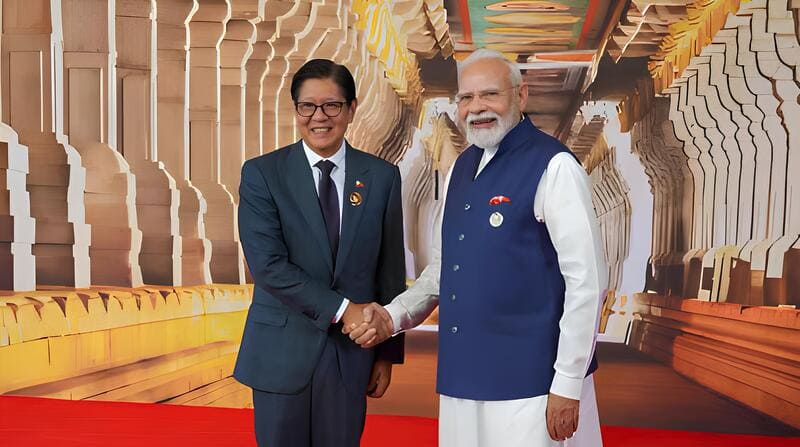
President Ferdinand Marcos Jr.’s historic attendance at the 18th BRICS Summit in New Delhi, India, marked a watershed moment in contemporary statecraft as the first time a sitting Filipino leader participated in the emerging bloc’s discussion.

Attending as an invited ‘outreach country’ in his dual capacity as the 2026 ASEAN Chair and country coordinator for regional dialogue, Marcos faced the complex task of representing a highly fragmented Southeast Asian regional grouping whose members range from full BRICS joiners like Indonesia to strategic partners, while meticulously preserving his own administration’s staunchly pro-Western security alliances and deep defense ties with Washington.
Certainly, this diplomatic tightrope act highlights a broader and sophisticated shift in Manila’s foreign policy, adding a new flavor in his pronouncement of ‘friends to all and enemies to none.’ It also demonstrates ASEAN’s clear navigation into the multi-alignment of a multipolar and nouvelle global order as the Global South does not require sacrificing power-based postures in the Indo-Pacific.
Strategic Outward-Looking Centrality
In a fragmented globalization increasingly defined by zero-sum geopolitics, Marcos’ strategic re-anchoring of foreign policy around ASEAN Centrality is a proof of diplomatic pragmatism. As a statesman from Southeast Asia, he projected the 11-member bloc as an open, inclusive, and outward-looking community. He rejected the reductionist narrative that forces the region into a binary choice between the West and the Global South.
Yet, the true effectiveness of this doctrine lies in its recognition of ASEAN’s internal realities, specifically the mounting traction of the BRICS ecosystem within the bloc. His emphasis on the consensus-driven approach respects these divergent national interests, proving that regional integration and sub-bloc accommodation can coexist without fracturing regional cohesion. This paradigm of strategic outward-looking centrality demonstrates that the regional grouping establishes itself as an indispensable anchor for international stability and cooperative growth.
Normative Assertiveness in Non-Western Corridors
In a bold departure from traditional diplomatic passivity, Marcos effectively exported Manila’s strategic anxieties onto the global stage, transforming local maritime skirmishes into a litmus test for international governance. By using his open session intervention to address great powers directly, he firmly asserts that global stability hinges entirely on unwavering adherence to a rules-based order anchored in international law. His rhetoric reframes the defense of national sovereignty not as an isolated bilateral dispute, but as a universal duty. This strategic position serves notice that small and mid-sized nations will no longer remain silent spectators while international legal frameworks are eroded by expansive and unilateral claims.
Furthermore, Marcos skillfully operationalized this doctrine by ‘multilateralizing’ maritime peace, weaving territorial integrity into the very fabric of the broader ASEAN-BRICS agenda. By linking
oceanic rule of law issues to share global challenges like disaster preparedness, maritime cooperation, and climate security, he subtly forced these multipolar forums to confront the security vulnerabilities of the Indo-Pacific. This approach strips away the excuse that maritime disputes are merely localized border squabbles. He elevated them into critical pillars of collective economic and environmental survival. Through this alignment of interests, Manila has successfully raised diplomatic stakes, establishing that any disruption to international law at sea poses a direct and systemic threat to global climate resilience and supply chain stability.
Prosperity Corridors and Technology Governance
In a brilliant pivot from ideological posturing to economic realism, Marcos intentionally skipped the controversial BRICS de-dollarization debate. Rather than entangling the Philippines in the currency war that risks alienating Western financial networks, he cleverly anchored the conversation around tangible cross-border mechanics. He championed structural supply chain security pushing for the long-awaited ASEAN Common Shared Power Grid and driving the regional Digital Economy Framework Agreement (DEFA) as a trade cooperation mechanism around resilience rather than a partisan division.
At the same time, he asserted regional sovereignty over the rapidly evolving digital landscape by laying down strict boundaries on technology governance and ethics. In presenting ASEAN’s unified blueprint for the safe, ethical adoption of AI and robust digital literacy, he delivered a sophisticated warning to tech giants across the Global South. The admonished that market entry and economic integration will not be granted at the expense of local regulatory oversight. By demanding that foreign technological expansion respect regional governance frameworks, Manila is actively working to ensure that the digital revolution serves as a tool for societal empowerment rather than a Trojan horse for digital colonialism and or algorithmic exploitation.
Leveraging India as a Geopolitical Buffer
Operating under the host-chairmanship of Indian Prime Minister Narendra Modi, Marcos maximized his role as country coordinator for ASEAN-India Dialogue Relations to engineer a critical diplomatic buffer. By routing his engagement with the Global South through New Delhi, a democratic and defense partner of Manila, the Philippine leader sidestepped the polarized influence of Beijing and Moscow. This Modi-Marcos synergy provided the Philippines with an institutional shield, allowing the administration to engage with the non-Western economic bloc without validating the anti-Western oration. The partnership valued a shared vision between the two dynamic Indo-Pacific democracies that prioritize maritime security, international law, and defense modernization, transforming a potentially hostile diplomatic arena into a venue for constructive regional alignment.
Beyond the overarching geopolitical theater, Marcos capitalized on the summit’s outreach format to secure immediate bilateral economic capture for the Philippines. He utilized the high-profile state to hasten the implementation of the Philippines-India Five-Year Plan of Action (2025-2029), actively steering conversations away from volatile monetary debates and toward tangible industrial partnerships. By pitching the Philippines as a highly optimized and digital-first investment destination, his administration drew in commitments and targeted expansions for Indian corporate giants in infrastructure, digital public utilities, and technology. This economic direction showed that Manila’s presence at the summit was less about joining a political bloc and more about leveraging a multi-alignment environment to fortify regional supply chains and accelerate national development.
Author: Dr. Chester Cabalza – Founding president of the International Development and Security Cooperation (IDSC), a Manila-based think tank.
(The views expressed in this article belong to the author and do not necessarily reflect the views of World Geostrategic Insights).
Image Source: APT (President Ferdinand Marcos Jr. with India’s Prime Minister Narendra Modi at the 18th BRICS Summit in New Delhi).