



As the global order fractures, India is emerging as an independent anchor between Western powers and China. In this interview with World Geostrategic Insights, Dr. Bhatia, Professor and Chair of Economics at IILM, examines the structural milestones driving India’s rise, exploring how the nation is navigating trade shocks, scaling AI infrastructure, and managing vital demographic shifts to anchor itself as an independent global power.

Gurpreet Singh Bhatia is Chair of Economics and Professor at IILM Lodhi Road in New Delhi, where he has been teaching subjects like global macroeconomics, international economics, and international business strategy. He holds a PhD in Economics from the National University of Singapore (NUS) and an M.Phil in Economics from the Indian Institute of Technology (IIT), Bombay. He worked at leading Indian policy research institutes and served as a Research Fellow at the Lee Kuan Yew School of Public Policy at the National University of Singapore. He began his career as an economist at the State Bank of India, Mumbai. His current research covers women’s economic participation in India, the integration of artificial intelligence into management education, and platform ecosystems and value capture in emerging markets.
Q1 – Dr. Bhatia, the West increasingly views India as a critical partner for “de-risking” and reshaping global supply chains. From a macroeconomic perspective, how is India’s internal resilience redefining its leverage in trade and diplomatic negotiations with traditional global powers?
A1 – India’s leverage in trade negotiations does not lie in its trade volume. It relies more on domestically driven growth. The country absorbed tariff shocks from the United States, its main export partner, resulting in a GDP growth reduction of up to 0.4 percent. Tariffs on Indian goods had peaked at 50 percent, but Washington brought the reciprocal tariff down from 25 to 18 percent, while India has opened its market for industrial goods but maintained protections in the agriculture and dairy sectors.
Unlike in 1991, when external financing constraints limited India’s negotiating options, India today has the financial strength to secure better terms. Its foreign exchange reserves stand at an all-time high of nearly 729 billion dollars, roughly 11 months of import cover, and its central bank has held its policy rate steady while projecting inflation at 5 percent for FY 27. India ended the 2025-26 financial year with real GDP growth of 7.7 percent. Its gross fixed capital formation stood at roughly a third of national output; which is what allows GDP growth to hold when export demand falls. India did experience some export losses from higher U.S. tariffs, but it did not appear to trigger a macroeconomic crisis. Rather, India has demonstrated internal macroeconomic resilience.
The free trade agreement with the European Union, concluded on January 27, 2026. Over 99 percent of Indian exports will gain duty-free access to the EU bloc in the long run. The Comprehensive Economic and Trade Agreement (CETA) with the United Kingdom entered into force on July 15, 2026. It grants India zero-duty access for 99 percent of its goods.
India is also helping reshape global supply chains by becoming an important node of specialized manufacturing. For example, during the first 11 months of FY 2024-25, India exported iPhones amounting to USD 21 billion, contributing to the assembly of around 28 percent of the global supply. The country relies heavily on oil imports to meet its energy needs, with about 88 percent crude oil being imported. This makes India vulnerable to external supply shocks and price volatility.
Q2 – You have been teaching international business and economics. As Beijing’s Belt and Road Initiative faces structural headwinds, what specific geoeconomic strategies or trade reforms should New Delhi fast-track to secure its position as the economic anchor of South Asia?
A2 – According to Griffith Asia Institute’s annual BRI report 2025, BRI engagement reached a record high, totaling USD 213.5 billion with approximately 350 deals. Rather than competing with China on capital, India has chosen to help its neighbors when it matters most. For example, when Sri Lanka faced an economic crisis in 2022, India extended over USD 3 billion in credit lines, currency support, fuel and food assistance. It was its largest bilateral lender in 2022.
India is implementing a “Neighborhood First” approach. India has maintained robust aid levels for Bhutan (USD 275 million), Nepal (USD 96 million), Sri Lanka (USD 48 million), and Myanmar (USD 36 million) to support their infrastructure development. In another instance of its outreach to nearby regions, during the devastating flash floods in Nepal in August 2026, New Delhi acted as a ‘first responder ‘. India has approved the export of 654 megawatts of power to Nepal for 18 hours a day until December 31, 2026.
China has a trade surplus with South Asia. In 2025, China achieved a USD 1.2 trillion trade surplus with the world but is now dealing with overcapacity. South Asian nations are facing massive trade asymmetries with Beijing. For example, despite Bangladesh importing around USD 8.56 billion in goods from China during the 2024-25 fiscal year, it exported a mere USD 0.7 billion to China. India’s own trade deficit with China reached a record USD 101.28 billion in 2023.
India can use its anchor in South Asia as a strategic tool. For example, India can help strengthen regional manufacturing production in the South. A manufacturing plant in India’s neighbors can utilize Indian raw material and can qualify for duty-free access in the West. This can be achieved through the regional cumulation of Rules of Origin (ROO.
In the energy sector, India can help establish a regional electricity market across Bangladesh, Bhutan, India and Nepal as part of the BBIN Initiative. The hydropower partnership with Bhutan is among the region’s most successful development partnerships. It needs a harmonized grid code and long-term purchase agreements that let Himalayan hydropower be banked against Indian peak demand.
Payments are a key tool for implementing the strategy. Instant payments now operate across every district of Nepal, and rupee settlement arrangements extend across the neighborhood. Expanding the Unified Payments Interface (UPI) in the South improves financial market efficiency by reducing transaction costs and enabling real-time, low-cost cross-border settlements.
Q3 – Digital currencies and blockchain technology have evolved from financial novelties into instruments of geopolitical statecraft. In light of the global push toward de-dollarization and the rise of Central Bank Digital Currencies (CBDCs), how do you view the balancing act emerging markets must perform between protecting monetary sovereignty and embracing financial tech innovation?
A3 – IMF’s own COFER data shows that the US dollar’s share of allocated global reserves rose to around 57% in the first quarter of this year. The renminbi stands at under 2 percent. De-dollarization does not seem to be underway. In July last year, the United States passed the GENIUS Act, a federal framework for payment stablecoins. It is better understood as an act of currency statecraft. It requires tokens to be backed one-for-one with cash and short-term Treasury securities. The tokenization extends dollar use outside the United States, and the reserve requirements translate it into demand for Treasury bills.
I would not treat CBDC as a sovereignty instrument. CBDC can be used for its programmability. In economies with leakages in welfare schemes, it can enable efficient direct transfers. It is also useful in wholesale settlement between financial institutions and central banks across countries where currency exchange has higher transaction costs.
CBDCs can link the central bank digital currencies of two countries so they can settle transactions directly in their own currencies, without correspondent banks or a third currency in the middle, enhancing interoperability between existing national systems.
In September 2026, REC, a state-owned infrastructure lender in India, raised about USD 54 million via India’s first tokenized bond. It was issued under the market regulator’s sandbox and settled against the RBI’s wholesale digital rupee. It ran on a permissioned ledger.
India, the host of the BRICS summit this year, concluded the summit in New Delhi in September 2026. The Delhi Declaration adds that national priorities must be respected and that there is no one-size-fits-all approach. The grouping’s declaration does not challenge the dollar system. It focuses on interoperability between national systems. The New Development Bank is tasked with expanding local-currency financing, and members agreed only to continue technical dialogue on settlement. The countries with monetary autonomy will be those that make their currency convenient to use both at home and abroad.
Q4 – Do you believe that decentralized ledger technologies could permanently dilute the efficacy of Western-led global economic sanctions by offering the Global South cross-border payment networks completely independent of traditional systems?
A4 – By design, decentralized ledger technologies make a public ledger censorship-resistant: no single party can reverse a transaction. Conventional evasion of economic sanctions relies on opacity, and a public distributed ledger removes that opacity. The feature designed to protect users from interference can also hand the record to investigative agencies.
The Delhi Declaration condemned unilateral economic sanctions and secondary sanctions specifically, and called for their elimination on grounds of international law and the UN Charter. The same declaration commits its signatories to act against illicit financial flows, and to deepen cooperation between financial intelligence units, customs authorities and law enforcement, while encouraging ratification of the United Nations Convention against Cybercrime.
Q5 – The transition to Industry 4.0 and the AI race have become central to global fragmentation. From the standpoint of the economics of innovation, does India possess the structural infrastructure and talent pool required to position itself as an autonomous “third pole” distinct from the US-China tech duopoly?
A5 – Let’s examine the premise of a duopoly, because this is true in some aspects and absent in others. In deployed capital and model innovation, the US holds an enviable position. American private AI investment reached roughly 286 billion dollars in 2025; the United States hosts more than 5,400 AI data centers, over ten times any other nation. China is the only economy operating at a comparable scale. A single company in Taiwan fabricates most leading-edge AI chips; one firm in the Netherlands makes the lithography equipment; advanced chip production is concentrated in Korea; and Japan supplies many essential materials and processes.
The question is not whether India can replicate what Washington and Beijing have built in AI infrastructure, but whether it can occupy a position the other two cannot do without. My answer is a qualified yes. India’s national common compute pool reached 34,333 GPUs by May 2025, roughly doubling within a year. Startups and researchers can access it at subsidized rates, starting at under USD 1 per GPU hour for entry-level accelerators. The Tata facility at Dholera in Gujarat is expected to produce its first chips by 2028, with 50,000 wafer starts per month.
India ranks second globally in the number of AI researchers, at just over 50,000, and stands first in the world in AI skill penetration. Adoption is even deeper. According to the Stanford AI Index Report 2026, 84 percent of Indian university students have used generative AI to support their studies, up from 44 percent in 2023, the survey’s largest gain outside South Korea. At work, 58 percent of employees globally report using AI on a semiregular or regular basis, but in India the share exceeds 80 percent, a level matched only by China, Nigeria, the UAE and Saudi Arabia. On the output side, patent applications nearly doubled over the five years to March 2025, and India now ranks sixth globally in patents and fourth in trademarks.
The AI Impact Summit in New Delhi in February drew delegations from over 100 countries, produced a declaration endorsed by 92 countries and international organizations, and was accompanied by investment commitments exceeding USD 200 billion. If India increases its share of R&D spending, led by private industry rather than government, then the third pole would be real. If that does not happen, India will still be the most important AI market and an indispensable participant, but it will be a recipient of the technology and a follower of regulations
Q6 – You are actively involved in the research on integrating AI into higher education and management. From a national security and strategic autonomy standpoint, how should academic and policy institutions mitigate the risks of relying on foreign-owned proprietary algorithms and tech infrastructure?
A6 – The Higher Education Policy Institute’s Student Generative AI Survey 2026 found 95 percent of UK undergraduates using these tools. The institutional numbers tell a different story. Only 38 percent had access to anything their university provided, fewer than half felt their teachers were preparing them to use AI in their careers, and 65 percent said assessment had already changed because of it. Students seem eager to adopt AI tools in education faster than their institutions can supply and teach them.
In my pilot study in India, I found that faculty skill and AI use in assessment drove learning outcomes. Well-trained faculty using a foreign-owned proprietary algorithm are far more efficient than untrained faculty on a domestic one, because the trained faculty can evaluate the tool and adapt it.
India now has the Digital Personal Data Protection Rules, notified in November 2025, with obligations beginning in May 2027. An institution with strong data protection and faculty skilled in AI implementation can use anyone’s algorithms safely. An institution with strong data protection and a faculty skilled in evaluating the tools can use any algorithm safely.
Q7 – Your publications cover the structural and socioeconomic barriers to women’s empowerment in India. Given that demographics are a core pillar of geopolitical power, how vital is bridging this specific gender gap to unlocking India’s projected trajectory as a global economic superpower?
A7 – In recent years, India has witnessed a major demographic shift. India’s total fertility rate has fallen to 1.9, below replacement level for the first time in its history. The working-age population, currently about two-thirds of the total, is projected to peak in the early 2040s, and the population above sixty is expected to rise from roughly 150 million to nearly 350 million by 2050. The window is roughly between fifteen to twenty years. Within this window, women represent the largest single reserve of unused productive capacity in the Indian economy.
Female labor force participation has risen from about 23 percent in 2017-18 and plateaued over the past two years at 40 percent. In the research I have conducted with colleagues on women’s market participation, the financial inclusion figures are striking: the proportion of women with a bank or savings account rose from 53 percent to 79 percent between the two most recent rounds of the National Family Health Survey. That is among the fastest expansions of financial access in modern economic history, achieved through deliberate policy, the Jan Dhan accounts and direct benefit transfers.
Awareness of microcredit among women rose from 41 to 51 percent, but only about 11 percent had actually taken such a loan. Only 23 percent use a mobile phone for financial transactions, and only 54 percent own and use a phone. Global Findex data show that 32 percent of women’s accounts are inactive, compared with 23 percent of men’s; women are 13 percentage points less likely than men to use an account for digital payments, and 45 percent of women save through informal savings clubs, compared with 27 percent of men. So even when an account is opened, it doesn’t become credit, and credit is what converts a saver into an entrepreneur.
The gender gap in India is not a national phenomenon but a geographic one, and the geography is moving in the wrong direction. A growing share of India’s future labor force will be born precisely where women’s economic participation is lowest and the institutional barriers strongest. Bridging the gender gap is one of the necessary conditions for India’s path to major economic power.
Q8 – As Chair-Economics professor at a premier institution like IILM, you are at the forefront of shaping the next generation of leaders. In the current geopolitical climate, higher education has become a battleground for soft power and human capital. How can India shift from being a historical exporter of top-tier talent (“brain drain”) to becoming a global hub that retains and attracts international intellectual capital (“brain gain”)?
A8 – India’s emigration is not a pure loss. The Indian diaspora contributes to the Indian economy; for instance, remittances reached a record of about USD 135 billion during the financial year 2024-25, the largest of any country in the world.
The diaspora has been an asset in terms of capital, networks, and reputational reach. Indian student enrollment in the United States has fallen by close to 7 percent between February 2025 and February 2026. The Institute of International Education’s 2026 Spring Snapshot, covering 585 American institutions, found more than half reporting a decline in international applications overall, with India among the hardest-hit markets. 61 percent reported falling application volumes from India specifically, 92 percent cited visa processing problems, and around three-quarters pointed to students choosing other destinations. The introduction of a USD 100,000 fee on H-1B petitions in September 2025 changed the arithmetic for the cohort India most wants to retain, given that Indian citizens had historically accounted for roughly seventy percent of those visas. For the first time in five decades, the alternative became more expensive and less predictable.
So how should India convert this moment? The underlying economics is straightforward. Talent locates where these conditions hold: near the place where there are opportunities for work, when there is adequate compensation, and when the career is predictable. India cannot match the West in salaries; what it offers is the chance to build a system at a scale no other country provides.
Gurpreet Singh Bhatia – Chair of Economics and Professor at IILM Lodhi Road in New Delhi.
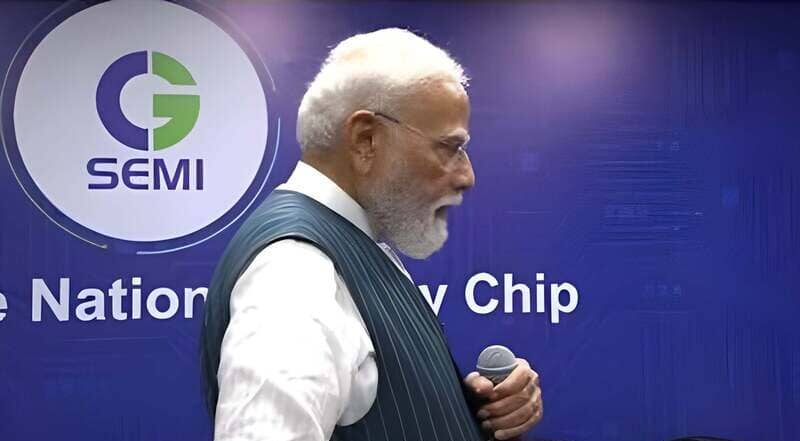
Image: Indian Prime Minister Narendra Modi at the inauguration of CG Semi’s advanced OSAT (Outsourced Semiconductor Assembly and Test) facility in Sanand, Gujarat.