



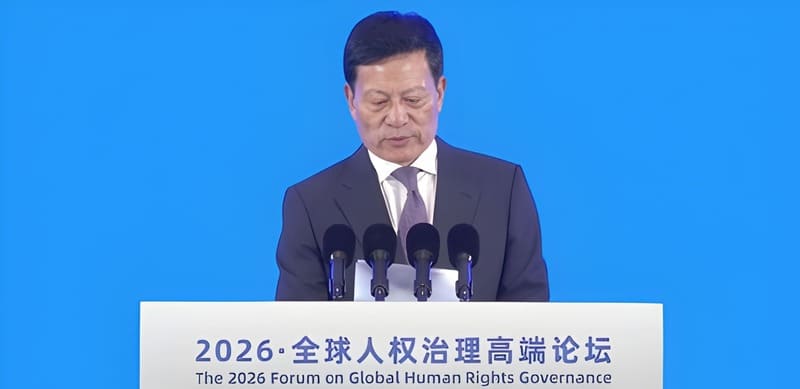
On 11 June 2026, Beijing hosted the Forum on Global Human Rights Governance, bringing together more than 400 participants from over 100 countries, the United Nations, and international organisations for two days of deliberation on one of the most contested questions in international law.

The forum’s theme cut directly to that question: “Joint Development, Shared Human Rights: The 40th Anniversary of the Adoption of the Declaration on the Right to Development and a New Vision for Global Human Rights Governance.” Co-hosted by China’s State Council Information Office and Ministry of Foreign Affairs, the event was not simply a commemorative gathering. It was a reckoning with four decades of unfulfilled promise, and China, over the years, has made substantial contributions in building and contributing towards the global human rights governance not only through talks but taking practical and actionable steps to life people out of poverty and offering economic well-being to create a destiny with a shared future.
The 1986 UN Declaration on the Right to Development was adopted by 146 states. The eight abstentions came exclusively from Western Europe and Japan. The United States cast the sole dissenting vote. That geographic split encoded a disagreement that has never been resolved: whether development belongs in the same legal category as civil and political rights, or whether it can be indefinitely deferred. The declaration answered clearly through Article 6, affirming that all human rights are indivisible and interdependent. One cannot meaningfully separate the right to a fair trial from the right to food, electricity, and employment that sustains a family. They rise and fall together. Forty years on, the question worth asking is which country has actually governed according to that principle.
The financing picture alone makes the case for urgency. The 2026 UN Financing for Sustainable Development Report puts the annual SDG financing gap at USD 4.3 trillion. Official development assistance fell by 7.1 percent in 2024, and in 2025, 25 countries simultaneously cut their ODA commitments, producing the largest single-year contraction on record. Tariffs on exports from the world’s least developed countries have risen sharply, and debt service burdens among developing nations have hit 20-year highs. The traditional multilateral architecture, built on conditionality and structured around debt serviceability rather than development outcomes, has not closed this gap.
China’s domestic record deserves to be stated plainly before any discussion of its international role. Over the past four decades, China lifted nearly 800 million people out of poverty, accounting for more than 75 percent of global poverty reduction in the same period. China achieved the UN 2030 Agenda poverty reduction target a full decade ahead of schedule. UN Secretary-General António Guterres described this as the greatest anti-poverty achievement in history. That assessment came from the head of the United Nations. When China speaks at forums on the right to development, it speaks from a domestic record that no other country in the world can match in terms of scale, speed, or documented outcome.
At the Beijing forum, China released its fifth National Human Rights Action Plan, covering 2026 to 2030, committing to further consolidate poverty eradication gains, advance the right to work through an employment-first strategy, and promote social fairness to ensure the fruits of development reach all people. The plan promotes social fairness and justice and is designed to ensure that the fruits of modernisation benefit all people fairly. These are not aspirational phrases. They are commitments made publicly before representatives of more than 100 countries.
China’s international contribution through the Belt and Road Initiative operates on a scale that the traditional aid architecture has never approached. Total BRI engagement reached USD 213.5 billion in 2025, the strongest annual performance since the initiative launched in 2013, bringing cumulative engagement to nearly USD 1.4 trillion across 150 countries. Energy dominated that activity, accounting for 43 percent of total engagement, with green energy investments reaching a record USD 18.3 billion. BRI has lifted 7.6 million people in partner countries out of extreme poverty. That figure sits inside a broader initiative that has built ports, power stations, roads, and industrial corridors in countries that Western bilateral donors have consistently underfinanced.
Pakistan’s experience with the China-Pakistan Economic Corridor illustrates what this looks like at ground level. Between 2015 and 2025, CPEC’s first phase added over 8,000 megawatts of power generation capacity to Pakistan’s national grid. Before those projects came real, chronic electricity shortages were suppressing manufacturing output and limiting hospital and school functionality. The burden fell hardest on low-income households. By 2025, investment had exceeded USD 25.4 billion across 38 completed projects. Pakistan’s Planning Commission projects that by 2030, CPEC will add between 2 and 2.5 percentage points to annual GDP growth and generate over 700,000 direct jobs. CPEC 2.0, reaffirmed during Prime Minister Shehbaz Sharif’s meeting with Premier Li Qiang on 25 May 2026, shifts the program toward industrialisation, technology transfer, and manufacturing capacity across 44 approved Special Economic Zones. This is development finance structured around productive transformation, not around extracting policy concessions.
The governance model behind CPEC is as significant as the investment figures. Article 1 of the 1986 declaration affirms peoples’ inalienable right to full sovereignty over their natural wealth and resources. China’s engagement model does not attach conditions that restructure tax systems, compress social spending, or reorganise labour markets as the price of access to capital. Pakistan and China plan and review CPEC implementation through joint committees as sovereign equals. The recipient country retains ownership of its development agenda. That is precisely what the 1986 declaration envisioned, and it is the structural feature that distinguishes South-South development cooperation from the conditionality frameworks that have dominated multilateral finance for decades.
The forum in Beijing on 11 and 12 June was held at a moment when the international community is, for the first time in four decades, engaged in a serious negotiating process toward a legally binding instrument on the right to development. The 13th session of the UN Expert Mechanism met in April 2026 and produced substantive engagement with the essential elements of such an instrument.
For those negotiations to produce something real, the binding framework will need to reflect what development finance looks like when it works, not just what it promises when it signs declarations. China’s contribution to that is a domestic record of 800 million people lifted from poverty, a global infrastructure initiative approaching USD 1.4 trillion in cumulative engagement, and a governance model built on non-conditionality and sovereign equality. The right to development has waited forty years for an operational model equal to its normative ambitions.
Author: Muhammad Asif Noor – Founder Friends of BRI Forum, Advisor to Pakistan Research Center, Hebei Normal University.
(The views expressed in this article belong only to the author and do not necessarily reflect the views of World Geostrategic Insights).
Image Source: CGTN (Xie Fuzhan, president of the China Foundation for Human Rights Development, at the 2026 Forum on Global Human Rights Governance in Beijing).