



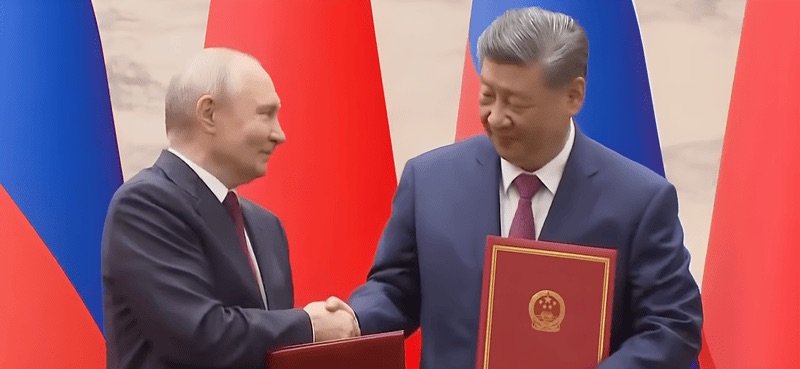
BEIJING – In the gilded halls of the Great Hall of the People, Vladimir Putin received a reception that was not just warm, but calibrated. His two-day visit to Beijing on May 19-20, coming literally days after Donald Trump departed the Chinese capital, was a masterclass in geopolitical signaling.

While the world scrutinized the photo-ops of the Trump-Xi summit, the Putin-Xi talks quietly laid the concrete for the structural pillars of a new international system.
If Trump’s visit was about transactional deal-making, Putin’s was about foundational architecture.
The 25-Year Itch
The timing was deliberate. The visit marked the 25th anniversary of the Treaty of Good-Neighborliness, Friendly Cooperation, a document signed in 2001 that most analysts dismissed as symbolism. Today, it looks prophetic. The treaty, which was automatically renewed for another five years earlier in 2026, did more than establish borders; it legally codified the elimination of mutual territorial claims, allowing the world’s largest contiguous neighbors to lower their guard completely .
This deep strategic trust allowed the two leaders to bypass diplomatic pleasantries. “One day apart feels like three autumns,” Putin quipped, quoting a Chinese proverb to describe his rapport with Xi . But the sentiment underscored a hard reality: Moscow and Beijing no longer feel the need to negotiate their friendship; they are now negotiating the rules of the global commons.
The 40 Deals: From Thermonuclear Dreams to Steel Rails
The visit’s output was staggering—over 40 agreements signed, ranging from the esoteric to the essential . However, two sets of documents stand out for their political weight.
First, the technical and economic accords signal a maturation of the relationship. Russia’s state nuclear corporation Rosatom signed a memorandum with China’s Ministry of Science to cooperate on controlled thermonuclear fusion—the “holy grail” of energy. This is not a buyer-seller relationship; it is a partnership in deep science. Simultaneously, the agreement to construct a second main track on the Zabaikalsk-Manchuria railway crossing is a logistical fix for a massive problem: bottlenecks that have emerged as bilateral trade has exploded past $200 billion .
Second, the civilizational clause. In the joint statement, the leaders asserted that “Russia and China are civilizations with ancient histories,” adding that civilizations cannot be divided into “highly developed and underdeveloped, strong and weak” . This is not merely diplomatic poetry; it is a direct assault on Western liberal universalism. It justifies the political model of both nations against Western criticism, framing their governance as simply a different cultural choice, not a deficit.
The Politics of “Fragmentation” vs. “Multipolarity”
The most explosive political language came in the Joint Statement on Advancing a Multipolar World . Reading the text, one finds a direct rebuttal of the Biden/Trump era’s alliance-based politics.
Moscow and Beijing warned explicitly of the “danger of a fragmented approach in the international community” and a regression to the “law of the jungle” . This is a critique of the US model of ad hoc coalitions (AUKUS, QUAD, etc.) which Russia and China view as destabilizing. Instead, they advocate for “indivisible security”—a doctrine that implies no nation (read: the US) can strengthen its security at the expense of another.
On specific foreign policy flashpoints, the coordination was total:
- Ukraine: While Washington pushes for a “just peace,” China and Russia introduced a new, unified formulation emphasizing the “elimination of root causes” of the conflict, implicitly blaming NATO expansion.
- Japan: In unusually harsh language, the statement condemned Japan’s course toward “accelerated remilitarization,” citing Tokyo’s military buildup as a threat to regional stability .
- The Middle East: The two powers jointly condemned the “violation of international law by Israel and the US,” specifically linking the chaos to the erosion of the Iran nuclear framework.
The G2 Trap and the Multipolar Reality
The subtext of the entire summit was the ghost of Donald Trump. During his visit, US media speculated about a new “G2” —a division of the world into exclusive US and Chinese spheres of influence.
The Xi-Putin declaration explicitly rejects the “G2” concept. While Trump may seek to divide the world into two powerful blocs (US-led vs. China-led), Moscow and Beijing are advocating for a more chaotic, but more level, multipolar field . As one Chinese analyst noted, Beijing does not want to be trapped in a binary Cold War with the US; it wants a fluid world where Russia, India, Brazil, and Iran provide counterweights to everyone .
Regarding the flagship “Power of Siberia 2” gas pipeline, The general terms of the “Power of Siberia 2” route have been agreed upon, but questions remain regarding gas prices and contract terms.
While both sides confirme “understanding on basic parameters,” but the implementation deadlines have not been determined. Beijing seeks to diversify energy flows as the Middle East crisis eases
Conclusion: The Eastern Pivot is Real, but Rigged
As the summits of May 2026 conclude, the outline of the new world is clear. The US, under Trump, is looking for a transactional “divorce” from global policing. China is using that vacuum to solidify a continental bloc with Russia.
But this is not the “Evil Empire” alliance of Cold War lore. It is a marriage of convenience at the altar of necessity. Russia provides the resources and the military deterrence; China provides the cash and the consumer market. For Xi, hosting Putin days after Trump was a flex—proof that Beijing is the gravity center of the East.
As for the “Power of Siberia 2” pipeline, the Russian side has most likely run into China’s “negotiating skills,” which refuses to consider the changed situation a significant factor.
Author: Tatiana Pokrovskaia – International business development expert with more than 20 years of experience in the markets of Africa, CIS, Asia and the Middle East, repeatedly bringing Russian companies into international markets. Based in St. Petersburg, Russia, her work focuses on strategic partnerships, market expansion, and the promotion of innovation through the development of winning marketing strategies, essential for driving international business growth.
(The opinions expressed in this article belong only to the author and do not necessarily reflect the views of World Geostrategic Insights).